1. Water is doing WHAT?
Augie held his water bottle with both hands.
“Mine stays down.”
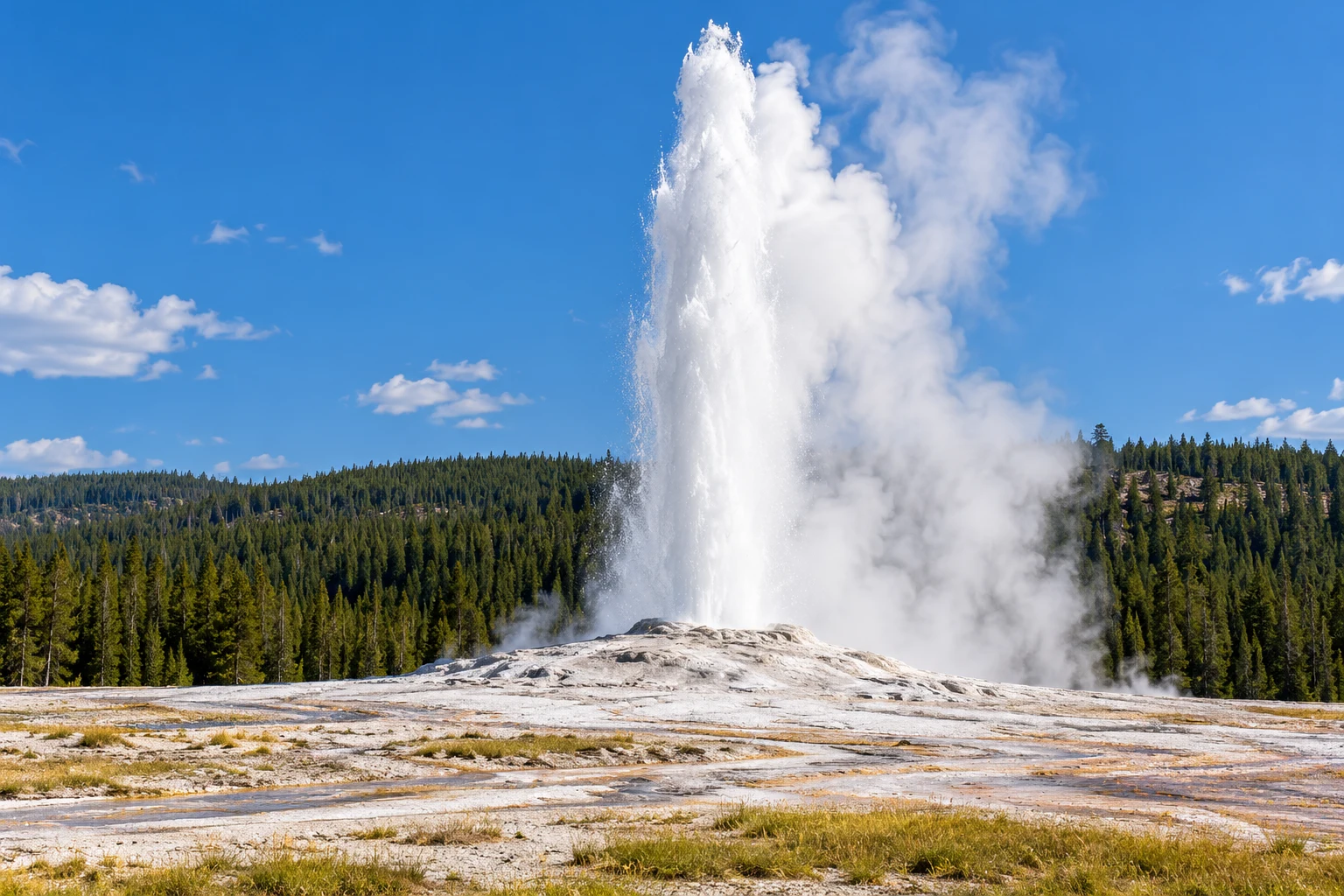
Across the viewing area, a white column of water leaped into the sky. Spray billowed above pale ground, with dark trees behind it.
Andy stared. “That waterfall is installed upside down.”
“It’s a geyser,” Ana said. “Old Faithful.”
“Then somebody gave the upside-down waterfall a name.”
Allie laughed and opened their explorer notebook. At Zion, they had investigated how water helped carve a canyon. Here, water seemed to have forgotten which direction it usually traveled.
They were in Yellowstone National Park, mostly in Wyoming, with parts in Montana and Idaho. Their parents had planned several days, leaving time for long drives, weather changes, short outings, and rests.
Right now they were watching from a designated viewing area. Augie stayed close to Mom, his bottle firmly capped.
The eruption began to shrink. Soon the great jet was gone, although wisps still drifted above the vent.
“Where’s the switch?” Andy asked.
Allie wrote: WHY DOES THE WATER GO UP?
Ana added: WHY DOES IT STOP?
Augie pointed to a third space.
“Is it coming back?”
Dad suggested a visit to the education center. They could investigate while Old Faithful’s underground system prepared for another eruption.
Andy checked his own equipment.
“My underground system is asking for a snack.”
“Your system is mostly above ground,” Ana told him.
“That explains why everyone can hear it.”
2. The plumbing without a plumber
Inside the Old Faithful Visitor Education Center, a display showed what they could not see beneath their feet.
“Water, heat, and natural plumbing,” Allie read.
“Who fixes the plumbing?” Andy asked. “A very small person with a very long ladder?”
A ranger smiled. “Here, plumbing means underground spaces and passages in rock. There aren’t household pipes down there.”
Rain and melted snow could seep underground through cracks. Heat from Yellowstone’s volcanic system warmed the water. The heat ultimately came from magma below the surface, but the geyser erupted water—not lava.
Augie looked relieved.
“No lava in my bottle.”
In a geyser, narrow places in the underground passages helped keep water from circulating freely. Pressure allowed deep water to become hotter than water boiling at the surface. When some water escaped and pressure dropped, more hot water could rapidly turn to steam.
Expanding steam helped force water out of the opening.
Ana spread her fingers upward.
“Water and steam rush out. Then the system has to refill and heat up again.”
“Exactly,” the ranger said. “Different geysers have different underground arrangements.”
Allie drew a simple rock passage, a drop, and arrows. It was a picture to help her remember, not a map of Old Faithful’s actual hidden plumbing.
Andy added a tiny toolbox and crossed it out.
“Zion’s river didn’t need a shovel. This one doesn’t need a plumber.”
Augie considered the page.
“Who gets the jobs?”
“Nature,” Ana said.
Andy sighed. “Very competitive employer.”
3. A clock with no hands
The children asked when Old Faithful would erupt again.
A ranger showed them the prediction information. It gave an estimated time with a window around it, not an appointment guaranteed to the second.
“So it doesn’t happen exactly every hour?” Allie asked.
The ranger shook her head. Observations helped people predict Old Faithful, but it was a natural system, not a clock. Other geysers could be much harder to predict.
Andy looked impressed.
“It can be late and still be called faithful. I should try that at breakfast.”
“You’re never late for breakfast,” Ana said.
“True. Important scientific difference.”
Back at the viewing area, they waited with their parents. Nobody stepped past a barrier or moved toward the vent for a closer look.
Augie tried counting clouds. Andy sketched the cone. Ana noticed how the breeze moved the white plume.
“Is all that white stuff water vapor?” Allie asked.
Dad explained that water vapor itself was invisible. Much of the white cloud they could see was made of tiny liquid droplets formed as the vapor cooled.
“Like a cloud close to the ground,” Ana said.
Augie whispered to his bottle, “No clouds.”
After some small splashes, water surged upward again. Andy forgot his next joke halfway through opening his mouth.
The children watched the jet climb, change shape, and fall back.
Allie’s notes could wait until it was over.
For a few minutes, looking was a full-time job.
4. The very small artists
On another outing, the family followed a marked boardwalk through a hot-spring basin. Their parents had checked which routes were open and suitable for them.
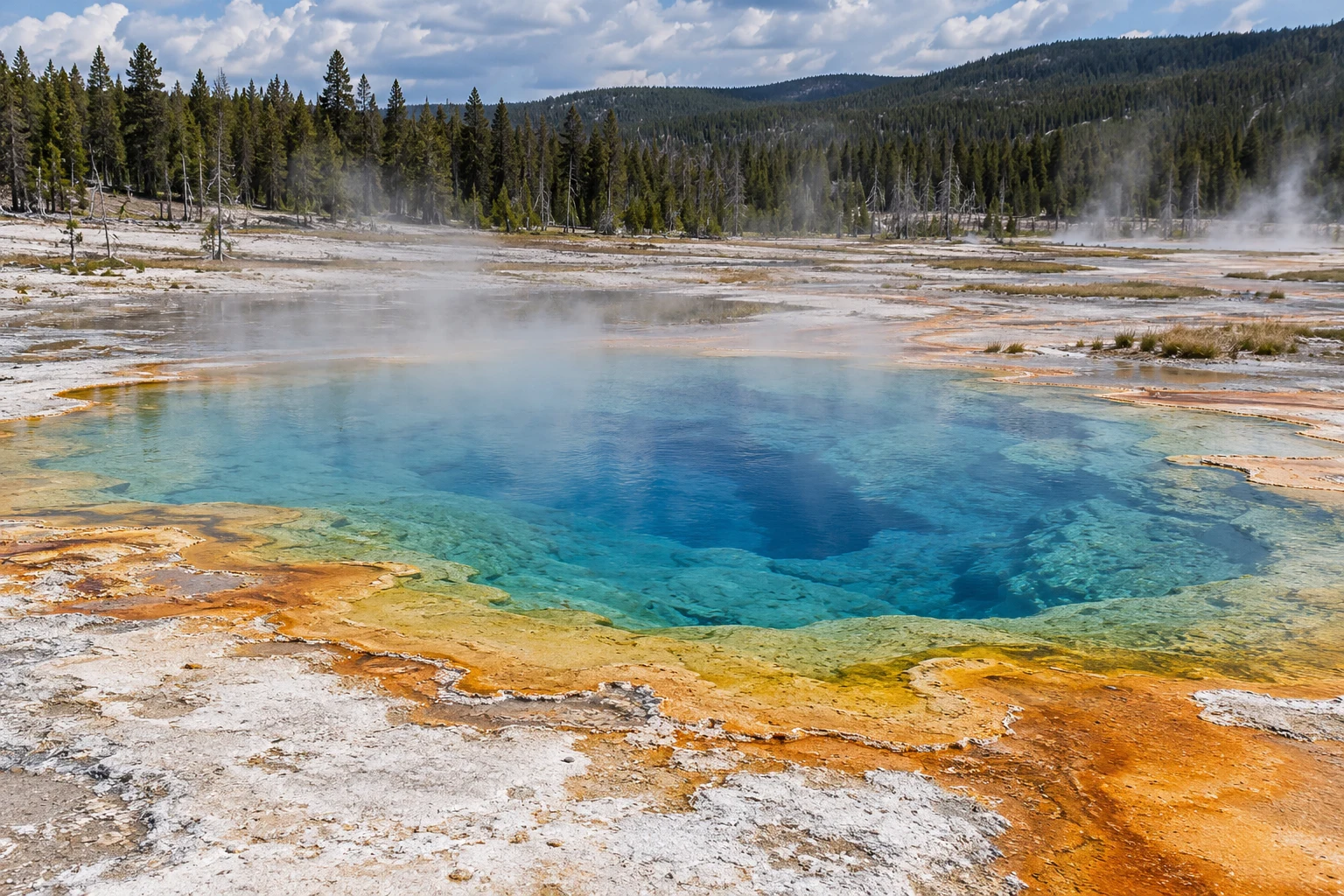
A pool shone blue. Near its edges, colors shifted through yellow and orange.
“Someone spilled a rainbow,” Augie said.
“An extremely organized rainbow,” Andy added. “It stayed in bands.”
They paused where they could read an exhibit without blocking the walkway. Some of the colors came from communities of tiny heat-loving organisms called thermophiles.
Ana sounded out the word.
“Thermo means heat. Phile means lover.”
“Snack-o-phile,” Andy said, pointing to himself.
Allie tried to imagine the organisms. One was too small to see without special help, but huge numbers together could form visible colored mats.
“Little living things can make something we can see from here,” she said.
Different communities could live where temperature and chemistry suited them. Water cooling toward a spring’s edges could support different life from the hotter areas.
“Does that mean the blue middle is blue animals?” Andy asked.
“Not necessarily,” Ana said, reading carefully. “Light interacting with deep, clear water can explain the blue. The whole pool isn’t colored by the same thing.”
Augie inspected his blue sleeve.
“Mine is shirt.”
They smiled, then kept looking from the boardwalk. The color was beautiful, but beauty was not a temperature test. None of them touched the water, its runoff, or the ground beside it.
Allie wrote: A bright color can be a clue. It is not an invitation to touch.
5. The park makes its own sound effects
At Fountain Paint Pot, on an open section of the designated route, the family listened.
Plop.
Blup.
PLOOP.
Andy slowly turned toward Augie.
“That wasn’t me,” Augie said immediately.
Bubbles rose through a patch of thick mud.
Ana grinned. “The ground has the hiccups.”
At a display, the children learned that acidic conditions could help break rock down into clay. With limited water, the result could be a mudpot: a muddy mixture through which gases bubbled.
“So it isn’t melted chocolate,” Andy said.
“Definitely not,” Allie replied.
“Good to label these things.”
They also learned about fumaroles, openings that released steam and gases. A geyser, a hot spring, a mudpot, and a steam vent could all belong to Yellowstone’s hydrothermal world, yet behave differently.
Ana made a four-part list in the notebook:
Spouts. Pools. Bubbles. Hisses.
“Those are memory words,” Allie said. “We need the proper names beside them.”
Andy offered to demonstrate a mudpot noise.
Mom raised one eyebrow.
He settled for a quiet “blup.”
Before walking on, Dad reminded them why the boardwalk mattered. Ground that looked firm could be a thin crust over dangerously hot water. They stayed on marked routes, walked without running, and kept close together.
Augie looked down at the boards beneath his shoes.
“Good bridge.”
“A very important bridge,” Allie agreed.
6. The meadow with a beard
The next day, a line of vehicles slowed ahead of them.
“Traffic?” Andy asked.
Dad nodded toward the road.
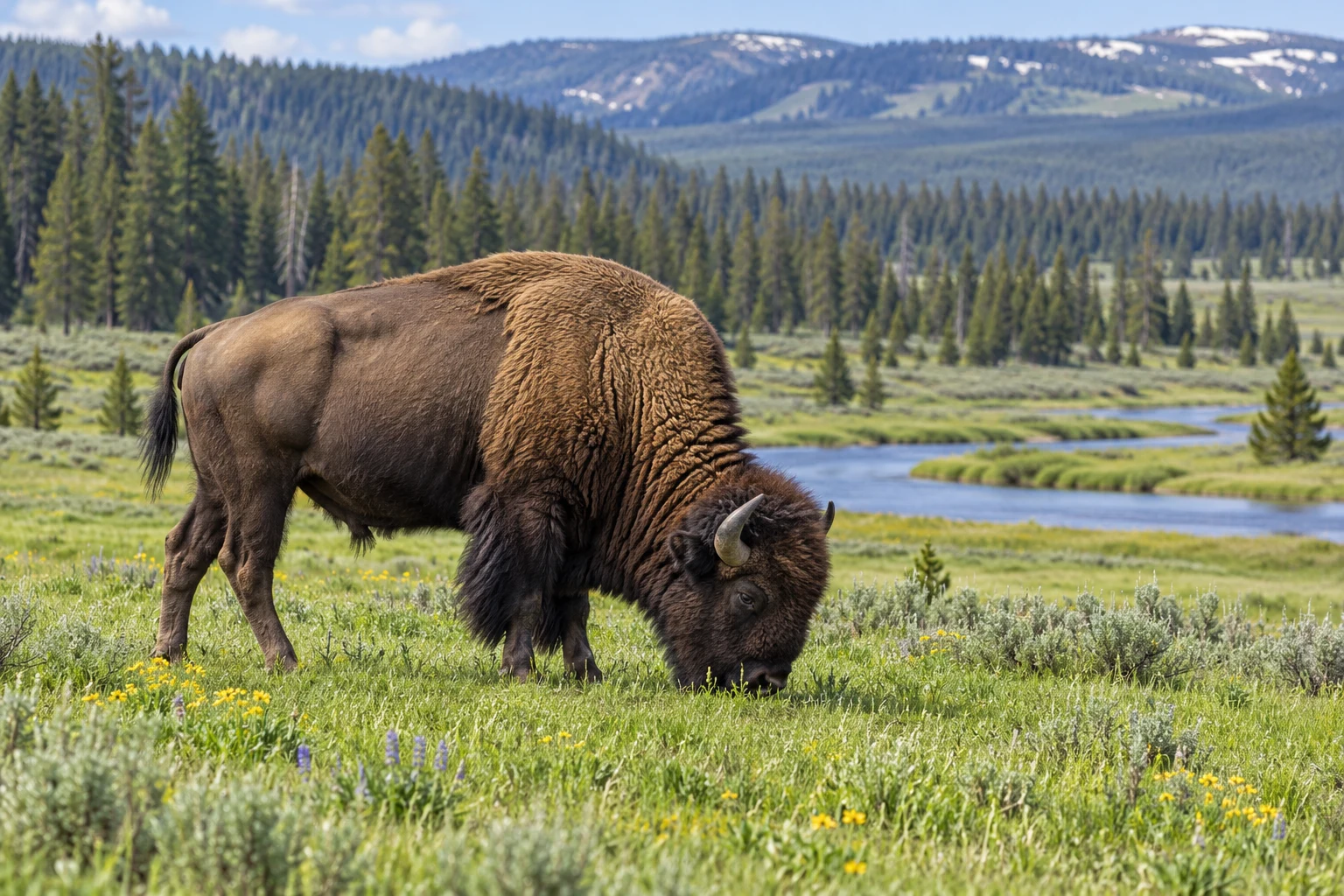
A bison was crossing.
Its head looked enormous. Shaggy hair covered its forequarters, and a hump rose above its shoulders.
Augie peered through the closed window.
“The meadow has a beard.”
“The meadow is walking,” Ana whispered.
They stayed inside while Dad waited. No honking, no opening doors for pictures, and no trying to persuade the animal to hurry.
Andy watched it reach the grass.
“It doesn’t seem worried about being late.”
“It isn’t driving to the visitor center,” Allie said.
Later, from a suitable viewing place chosen by their parents, they watched bison far away through binoculars. They had learned to stay at least twenty-five yards from bison and elk, and at least one hundred yards from bears and wolves. Those were minimum distances; an animal’s behavior and the situation could require much more space.
“Big animal,” Augie said. “Big space.”
A display explained that bison mainly grazed on plants. Their shoulder and neck muscles helped them swing their heavy heads, even clearing snow to reach food in winter.
Ana drew a bison beside a snowy patch.
“A head that helps move snow.”
Andy thought about shoveling.
“My winter equipment is less hairy.”
The bison in the meadow lowered its head and kept eating.
Allie wrote: Looking peaceful does not make a wild animal a pet.
Augie nodded. He preferred pets that did not resemble furniture with horns.
7. Finally, a waterfall following the rules
On a different part of their visit, the family reached a designated overlook at the Grand Canyon of the Yellowstone.
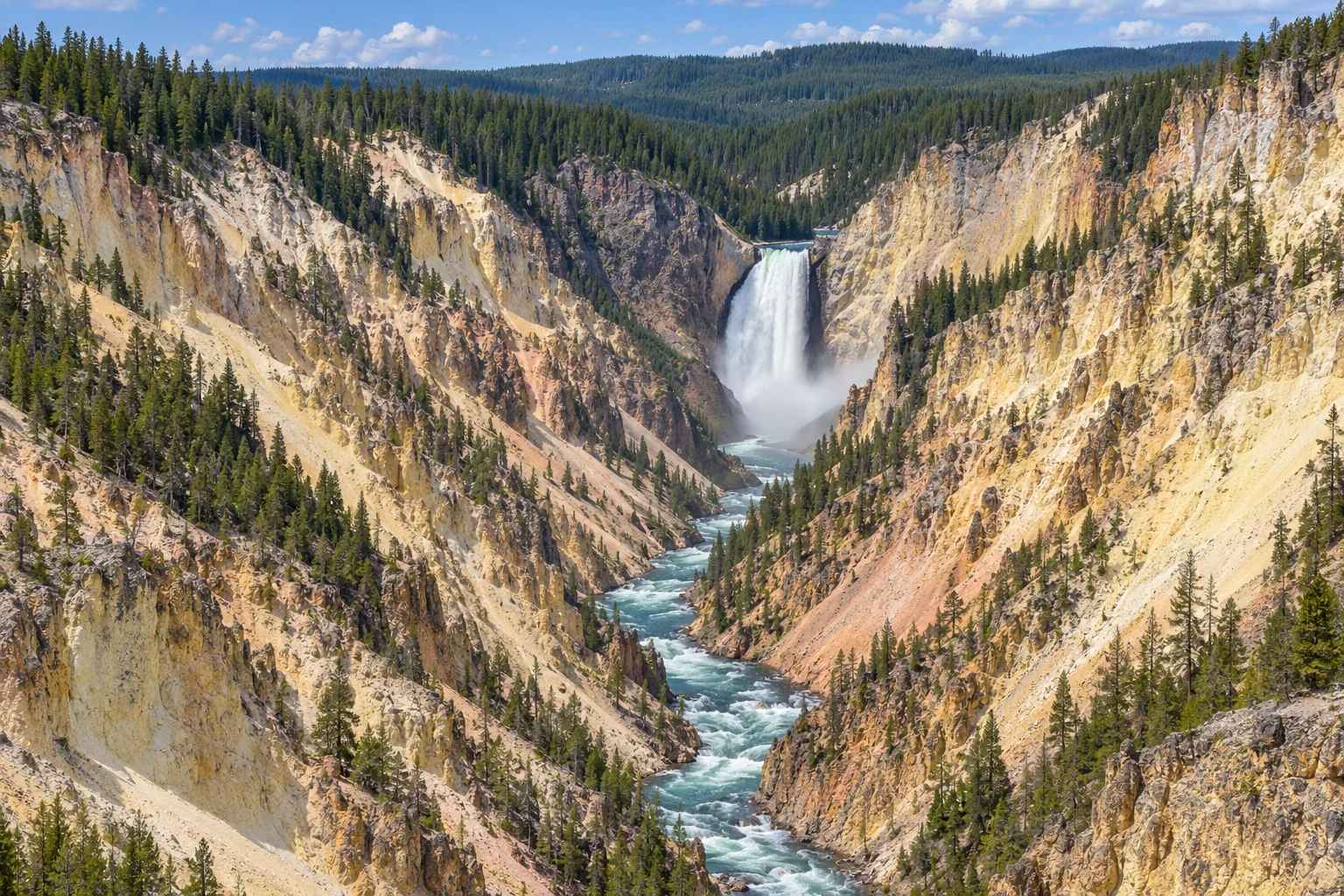
A waterfall plunged into a canyon streaked with pale yellow, orange, and pink. Far below, the Yellowstone River continued between the walls.
Andy let out a satisfied breath.
“At last. Water going down.”
Augie nodded. “This one read the instructions.”
They stayed behind the railing. Allie rested her notebook on her knees while she sketched, well back from the edge.
This was Lower Falls. It was in Yellowstone—not the Grand Canyon in Arizona, which lay ahead in their book of adventures.
Ana looked from the waterfall to the rock walls.
“Is this the same sandstone as Zion?”
The exhibit said no. Much of this canyon’s rock was rhyolite, a volcanic rock. Hot water and chemical changes had weakened parts of it. The river could erode the altered rock more easily, helping deepen and widen the canyon.
“So heat helped change the rock,” Allie said, “and the river carried material away.”
Andy tapped the notebook. “The tools work together again.”
Ana listened to the roar.
“The geyser pushes water upward with expanding steam. Here, water drops under gravity.”
“Then the geyser water falls down afterward,” Allie added.
Andy smiled. “So gravity didn’t take the day off.”
Augie looked relieved.
“Good. My sandwich stays on the table.”
8. A story older than the park sign
Back at a visitor center, Allie noticed the date 1872. Yellowstone had become a national park that year.
“Did its story begin then?” she asked.
Ana shook her head before Dad could answer.
“Park birthday. Not place birthday.”
The family learned that Indigenous peoples had lived in and traveled through the Yellowstone region for thousands of years. Many Tribal Nations had ancestral and continuing connections to the land. Crow, Eastern Shoshone, and Shoshone-Bannock were among the communities connected to its story.
People’s relationships with Yellowstone included gathering, travel, hunting, knowledge, and cultural traditions. Those relationships were not all identical, and they had not ended when park boundaries were drawn.
Allie added a careful note: A park map cannot show every kind of connection to a place.
Mom suggested asking about opportunities to hear from Indigenous presenters, including programs at the Tribal Heritage Center when available.
“From the people whose stories they are,” Ana said.
Andy closed his notebook for a moment.
He had pages of rock arrows and geyser splashes. There was room for much more than that.
Augie pointed to a blank page.
“We didn’t finish.”
“No,” Allie said. “And that’s all right.”
9. The four-person science team
At a table, the children compared their Junior Ranger activities and the questions they wanted to ask a ranger.
Allie liked explanations, but her first drawing had made Old Faithful look like a pipe from a sink. She added cracks and a note saying the actual underground system was more complicated.
Ana checked their colors page.
“Not all colors mean the same thing,” she reminded them.
Andy reviewed his bison drawing.
“I made its beard excellent.”
“Did you include its space?” Ana asked.
He drew a large dotted gap between the animal and four tiny explorers.
“Now I have.”
Augie’s page showed a tall splash and a short splash.
“The first one is up,” he explained. “The other one is down.”
Allie pointed to an empty corner.
“What should we do if we don’t know an answer?”
“Ask,” Ana said.
“Look carefully,” Andy added.
“Not touch the hot,” Augie said.
All excellent contributions.
They shared their work with a ranger, who helped them check a question about the white plume above a spring. The children discovered that changing an explanation after learning more did not mean their investigation had failed.
It meant they were doing an investigation.
Andy crossed out a line that said geyser operated by underground dragon.
“Do we have to remove the dragon completely?”
“You can keep it in the jokes,” Allie told him.
He drew it a small hat.
10. The postcard that needed more room
At the end of their visit, Allie tried to write a postcard.
Dear everyone, Yellowstone has—
She stopped.
“Too many things,” Ana said.
“A waterfall with bad manners,” Andy suggested.
“A geyser,” Ana corrected, smiling.
Allie started again.
We watched water shoot upward, found colors made partly by tiny living things, listened to bubbling mud, and saw a bison carrying its winter muscles around.
“That sounds strange,” she said.
“It was strange,” Andy replied. “In a factual way.”
Augie leaned over the table.
“Put the real waterfall.”
Allie added the canyon and Lower Falls. Then she mentioned the people connected to Yellowstone long before it became a park, and the people keeping those connections alive.
The postcard ran out of room.
So she wrote a second one.
Ana opened the explorer notebook to their first questions. Why did the water go up? Why did it stop? Would it come back?
“We have explanations now,” she said. “And some things we still want to learn.”
Andy put a tiny arrow beside Old Faithful.
“Case closed. Waterfall correctly identified.”
Augie lifted his bottle for one last inspection.
“Mine still stays down.”
Allie turned to the next page and wrote GRAND CANYON.
Andy stared at the empty sheet.
“Another canyon? I hope the river brought its toolbox.”
Ana grinned.
“This one has a very long story.”
Augie put his snack container beside the notebook.
“Ready.”
Explorer’s notebook
What we discovered
- Where: Most of Yellowstone is in Wyoming, with smaller parts in Montana and Idaho.
- Heat below: Yellowstone’s volcanic system supplies heat. Rain and snow supply water, and cracks provide underground pathways.
- Water going up: A geyser’s restricted plumbing and changing pressure allow expanding steam to help force water out. A geyser erupts water, not lava.
- A natural timetable: Old Faithful can be predicted, but it does not run exactly on the hour. Ask for the current prediction.
- Color clues: Heat-loving microorganisms help create colored mats. Light in deep, clear water can explain a spring’s blue color.
- Different features: Hot springs, geysers, mudpots, and steam vents behave differently. None is a place to test the water with your hand.
- Wild neighbors: Bison are grazers with powerful shoulder and neck muscles. Observe wildlife without approaching or feeding it.
- A different canyon: The Grand Canyon of the Yellowstone includes altered volcanic rock and the Yellowstone River’s waterfalls. It is separate from the Grand Canyon in Arizona.
- People and place: Yellowstone has deep Indigenous history and continuing connections with many Tribal Nations.
Try your own Yellowstone adventure
Plan with a grown-up and check current routes, closures, weather, distances, and accessibility. These are separate ideas, not a one-day checklist.
- Watch Old Faithful from its designated viewing area. Check the current prediction, allow time to wait, and sketch how the eruption changes shape.
- Investigate a manageable section of a thermal-basin boardwalk. Stay on designated routes with a grown-up. Look for different feature types without touching water, runoff, or formations.
- Try a wildlife observation break. Use binoculars from a suitable place. Keep at least twenty-five yards from bison and elk and one hundred yards from bears and wolves; give more space whenever needed.
- Visit a Yellowstone canyon overlook. Choose one that suits your family. Watch the falls from behind barriers, compare rock colors, and listen to the river.
- Ask about Junior Ranger activities and ranger programs. Bring a question from your notebook. You can also explore the park’s educational resources from home.
Three questions for the road
- Why is Old Faithful’s eruption a different process from a waterfall dropping into a canyon?
- Why might two colors in a hot spring have different explanations?
- How can changing your first explanation be part of good science?
Useful words
Hydrothermal: Relating to hot water, especially water heated within Earth.
Magma: Molten or partly molten rock beneath Earth’s surface.
Pressure: Force acting over an area; changing pressure affects when water boils.
Thermophile: An organism that thrives at high temperatures.
Rhyolite: A type of volcanic rock rich in silica.
Prediction: An evidence-based estimate of what may happen, rather than a guarantee.