1. One river. Suspiciously large walls.
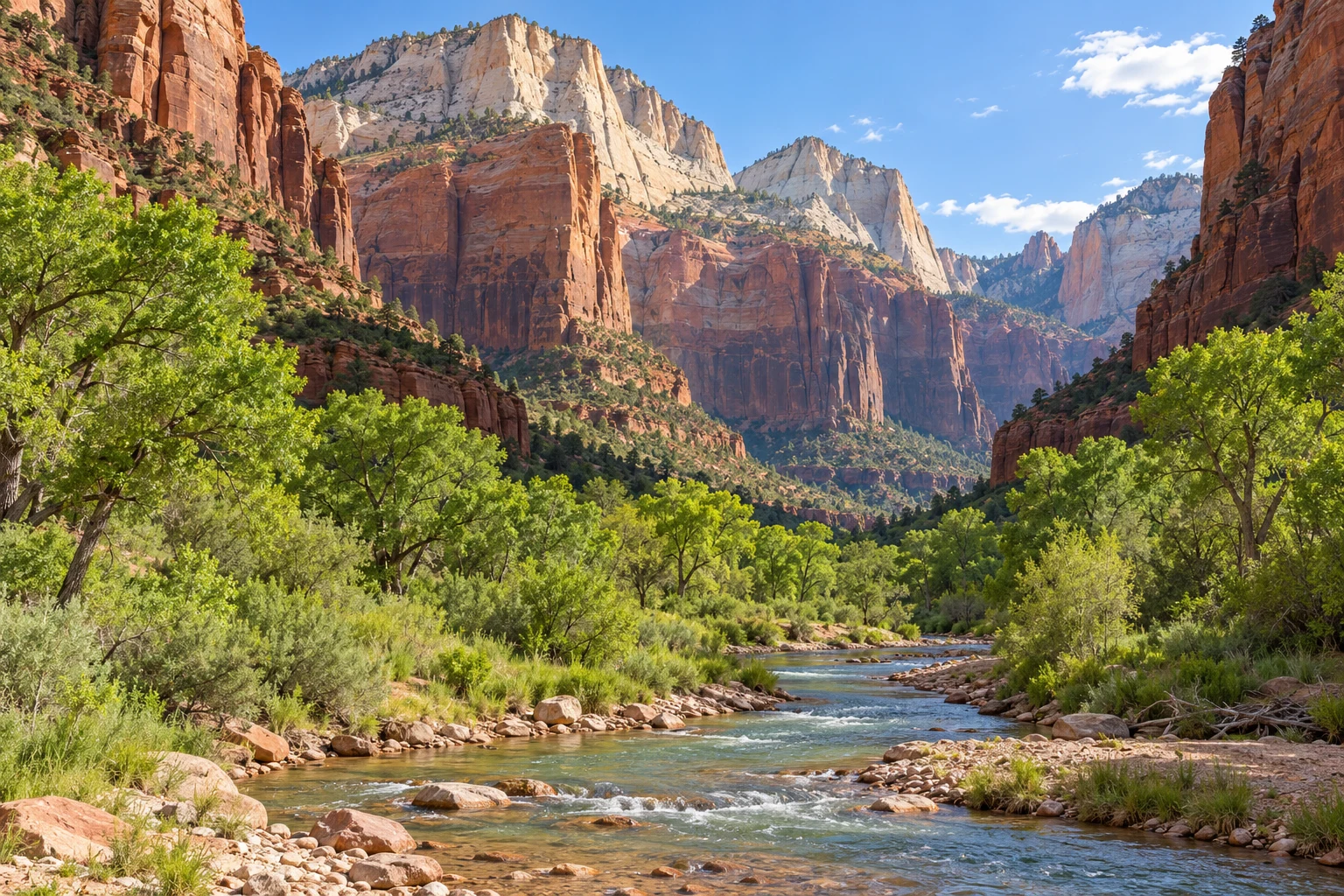
Andy looked at the river. Then he looked at the cliffs. Then he looked at the river again.
“I think somebody has made a mistake.”
Allie opened their explorer notebook. The first page held their discoveries from the Great Smoky Mountains. The next page contained a question: What can a little river do?
Augie had already answered it with a drawing of wet socks.
Now the family stood beside the Pa’rus Trail in Zion National Park, in southwestern Utah. Red and cream cliffs towered over a green ribbon of trees. The Virgin River moved below them, looking much too small for the job it had apparently done.
“You’re saying that made this?” Andy asked.
Ana tilted her head. “It didn’t do it before breakfast.”
“Good. Because I didn’t finish breakfast either.”
Augie looked behind a cottonwood tree.
“What are you finding?” Allie asked.
“The river’s shovel.”
There was no shovel. There was no enormous digging machine. There was only water, rock, and a canyon big enough to make the children feel like four crumbs at the bottom of a bowl.
Allie wrote a new heading.
THE RIVER’S TOOLBOX
Under it, she drew four empty spaces.
“Let’s work out how it did all this,” she said.
“Maybe it hired a bigger river,” Andy suggested.
Mom checked the day’s trail information and weather with Dad. They had planned two unhurried days, with short walks, plenty of breaks, and time to change their plans.
Augie inspected the water from the path.
“If we find the shovel,” he said, “I’m not carrying it.”
2. A beach without an ocean?
At the visitor center, Ana studied a picture of sand dunes beside a picture of Zion’s cliffs.
“Those don’t look like the same place.”
“They aren’t the same scene,” Dad said. “The pictures show how different the landscape was long ago.”
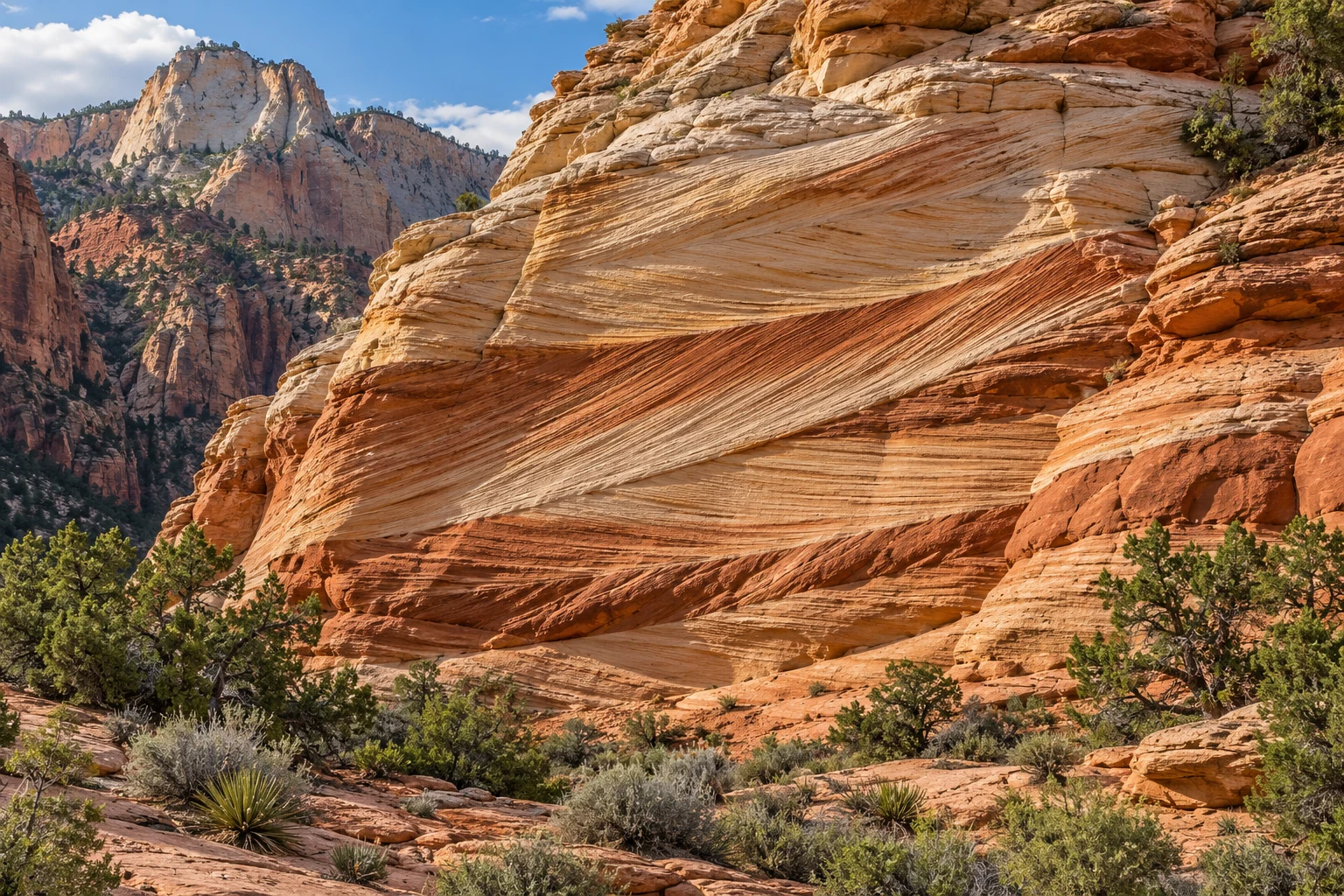
The children learned that the Navajo Sandstone forming many of Zion’s great cliffs began as windblown sand in an enormous ancient desert, roughly 180 million years ago.
Andy folded his arms.
“So first the desert had sand. Then it became a rock. Then a river came along and started taking it apart?”
“That’s the short version,” Allie said.
“Very untidy project.”
A ranger helped them understand the steps. Sand piled up as dunes shifted. More material buried it. Over time, minerals cemented the grains together into sandstone.
Augie rubbed his fingertips together, imagining tiny grains.
“Rock glue?”
“Mineral cement,” Ana said. “Not the glue we keep in the kitchen drawer.”
“So I can’t make a canyon with a glue stick.”
“You can barely keep the lid on it,” Andy said.
The ranger pointed out sloping lines in a photograph of sandstone. These were cross-beds: layers preserving the movement of ancient dunes. The patterns were clues to winds that had blown long before the children existed.
Allie drew diagonal lines in the notebook.
“The rock remembers the wind.”
“Without having a brain,” Ana said.
Andy tapped his own forehead. “I have a brain and still forgot where I put my hat.”
“It’s on your head,” Allie told him.
He checked.
“Excellent. My brain remembered for me.”
3. How to carve a canyon very, very slowly
Outside again, the canyon walls seemed even taller.
The family paused at an exhibit about canyon carving. Allie read while Ana traced the shapes in the picture with a finger held above it.
The land had risen as part of the Colorado Plateau. Streams flowing down from the uplifted land had energy to cut into rock. Over long stretches of time, the North Fork of the Virgin River cut downward and carried material away.
“Uplift,” Allie said. “The land rises.”
“Erosion,” Ana added. “Material gets worn away and moved.”
“Lunch,” Andy said. “Material gets eaten and moved.”
“Not everything is lunch,” Allie replied.
Andy looked at the canyon. “That would need a very large lunchbox.”
Moving water could carry sand, pebbles, and larger pieces when the flow was strong enough. Those pieces could knock and scrape against other rock. The river’s work also connected with cracks, weathering, gravity, and falling rock.
“So it had helpers,” Ana said.
Allie nodded. “We shouldn’t write that the river did every single thing by itself.”
Augie found the first empty space in the notebook.
“Draw a helper.”
Allie sketched a little pebble beside a moving stream.
“And time,” Dad said. “A great deal of time.”
Andy watched the water for a moment.
“I don’t think we can stay until it finishes.”
“It isn’t finishing,” Ana said. “The landscape is still changing.”
Augie sighed.
“Then it needs snack breaks.”
They filled the first space: Moving water, carried rock, gravity, and lots of time.
There was still no shovel.
4. The walking laboratory
The Pa’rus Trail gave them something Andy considered extremely useful: a laboratory with no desks.
It was a paved route beside the river, with bridges, exhibits, and views of the Watchman, a great sandstone landmark. People could walk or ride bicycles here. The family kept to one side and listened for cyclists.
“Coming through,” Ana said softly as a bike approached.
Augie moved closer to Mom.
“I am also coming through,” he announced, “but slowly.”
They did not need to walk the whole trail to make discoveries. Mom suggested a challenge: find three different ways to notice the same place.
Allie chose shapes. She drew the Watchman’s outline without trying to include every crack.
Ana chose colors. The cliffs were not simply red: she spotted cream, rusty orange, warm pink, and patches of brown. At the visitor center they had learned that different amounts and forms of iron oxide helped give Navajo Sandstone its colors.
“Like rust is part of the story?” Andy asked.
“Related iron chemistry,” Ana said. “But the cliff is not a giant rusty bicycle.”
Andy chose sounds. Water, leaves, a bird, footsteps, a bicycle bell.
Augie chose shadows.
“My shadow has long legs.”
“You’ll catch up,” Allie said.
He stepped into a tree’s shade.
“Now it’s hiding.”
The cottonwoods showed another clue: water helped support a greener strip of habitat beside the river. The word for a river-edge habitat was riparian.
Andy tried it twice.
“Riparian. It sounds like the name of a dinosaur who likes libraries.”
“Please return your books,” Ana said in her deepest dinosaur voice.
Augie giggled so hard that his hat slipped over one eye.
5. A garden with no flowerpots
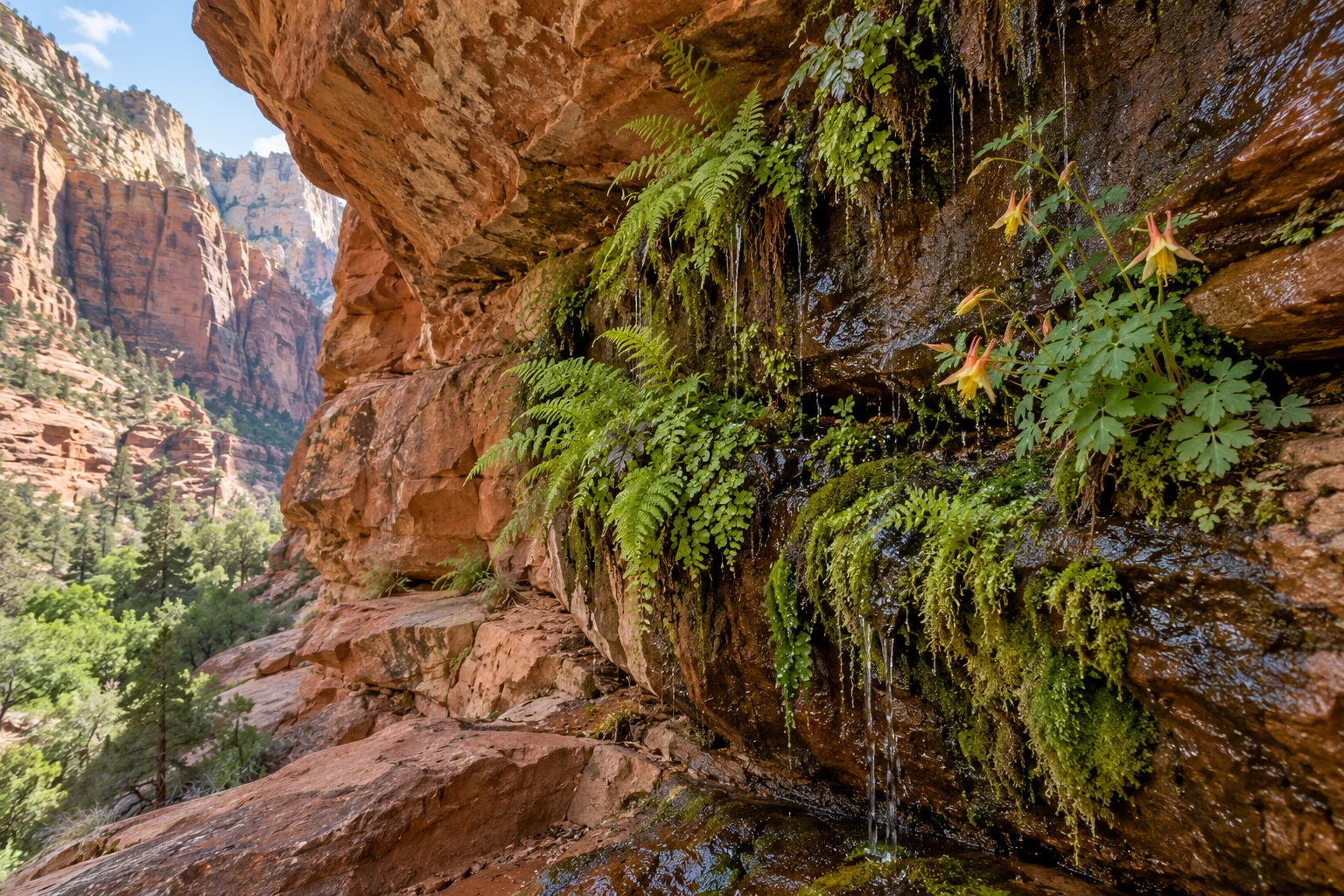
Later, on Riverside Walk, the canyon walls drew closer. Their parents had checked conditions before choosing how far to go. The children stayed on the paved trail, which had uneven places and edges to watch.
Ana noticed green plants growing against a damp rock face.
“Someone forgot the garden.”
“Where’s the gardener?” Andy asked.
Augie pointed at the river.
Everyone looked at him.
“The water,” he explained.
It was an excellent thought, although this water’s journey was different.
At a trailside explanation, they learned that rain and melted snow could soak into porous sandstone. Porous meant it contained tiny spaces. Water could move through connected spaces in the rock and eventually emerge at a spring or seep.
A damp pocket on a cliff could support ferns, mosses, and flowers. These were Zion’s hanging gardens.
“So the garden is hanging on,” Allie said, “not hanging in a basket.”
Andy inspected the vegetation from the trail.
“Good. I was wondering who had to water all those baskets.”
Ana drew a drop traveling through a rock.
“The water doesn’t have to stay on the surface.”
“And it doesn’t travel through every rock the same way,” Dad added.
Augie pressed a finger against the notebook drawing.
“Secret tunnels.”
“Tiny spaces and cracks,” Allie said. “Not tunnels we can crawl through.”
Augie considered the size of a raindrop.
“Very small gardener.”
They left the plants untouched. Pulling at the greenery or walking into a damp pocket for a closer picture could damage the very place they had come to admire.
Allie filled the second space: Water can travel through rock and help create small, green habitats.
Andy looked pleased.
“The river has a gardening department.”
6. The part where dry socks win
Farther along Riverside Walk, the family could see where the canyon tightened toward The Narrows. Beyond the end of the paved route, a hike could involve walking in the river itself.
Andy stared into the gorge.
“It looks like the mountains are trying to shake hands.”
“Very slowly,” Ana said.
Augie looked down at his shoes.
“Are we doing wet socks?”
“No,” Mom said. “We’re turning around on the paved walk.”
The children had heard about The Narrows, but a famous place was not automatically the right outing for every family. The riverbed could be slippery and uneven. Water could be cold and strong. Conditions and warnings mattered.
At the visitor center, they had also learned about flash floods. Heavy rain could send a sudden rush of water down a canyon, even when the storm was farther upstream and the sky overhead looked clear.
Allie frowned. “So checking just our little patch of sky isn’t enough.”
“Exactly,” Dad said. “We check park guidance and weather before deciding where to go. We don’t wait for a flood to start.”
Ana added a serious note: Never enter floodwater.
Their drinking water came from the safe refill supply their parents had checked, not the river. Water that looked clear could still contain things that made people ill. They would not drink stream water or play with algae.
Andy lifted his bottle.
“This water has a less complicated plan.”
They turned back together, with dry socks and plenty left to investigate.
Augie added two sock shapes to Allie’s notebook.
“Successful expedition,” he said.
Nobody argued.
7. The cliff climber who didn’t need a backpack
The next morning, the family explored Zion’s east-side scenery by car, stopping only at designated places their parents chose. The sandstone shapes and patterns gave them more to draw.
At one stop, Dad quietly pointed toward a broad rocky slope.
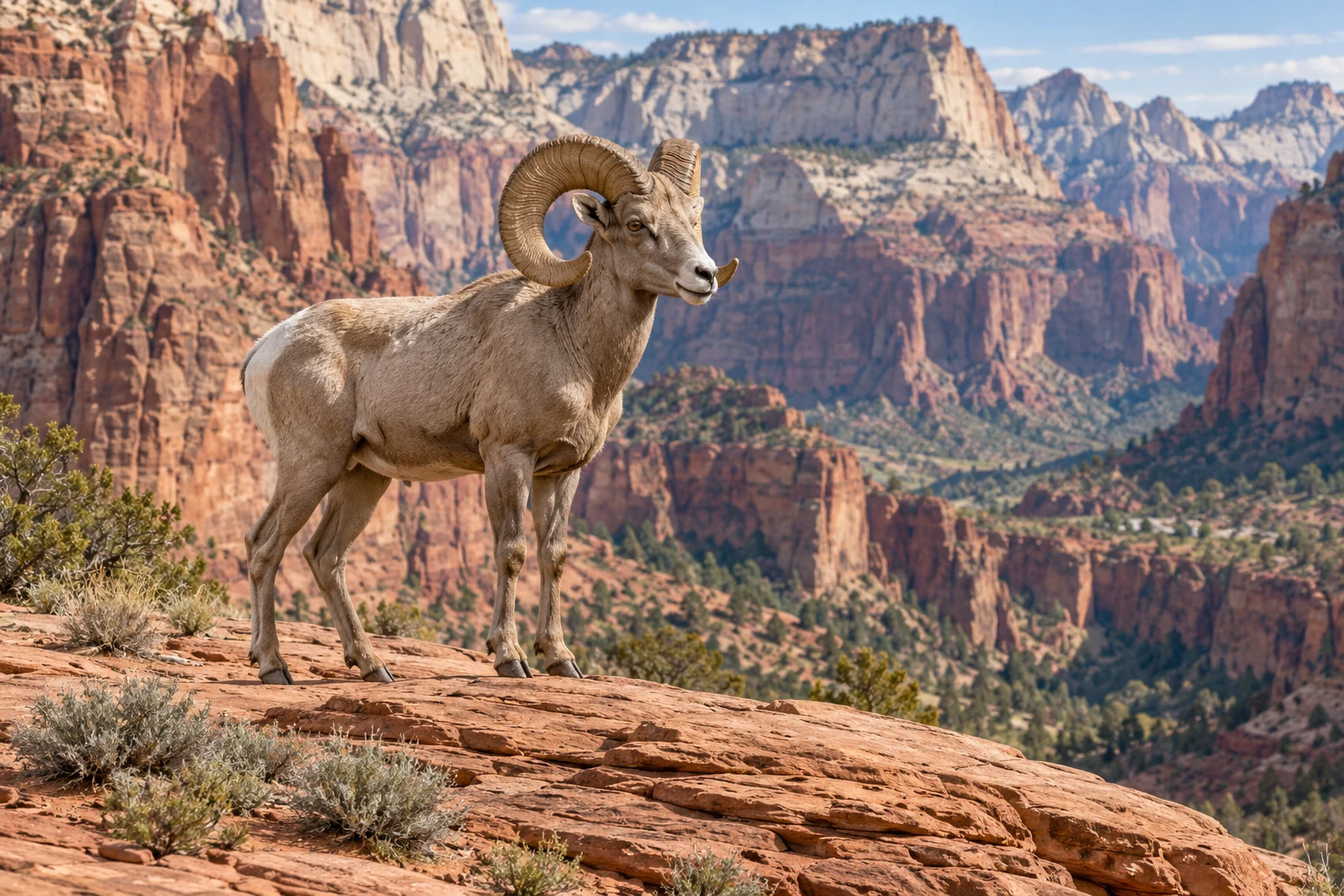
A desert bighorn sheep stood above them.
Its curved horns framed its head. Its tan body nearly blended with the stone.
Andy lifted his binoculars without moving closer.
“That sheep has much better hiking shoes than I do.”
Ana studied the animal. “It has the shoes it was born with.”
“Very convenient shopping arrangement.”
They stayed with their parents and gave it space. The sheep moved out of sight, and that was the end of the sighting. No following. No shouting to bring it back.
Augie waved once, very small.
“Bye, mountain sheep.”
Later, a wildlife display helped them learn more. Desert bighorn sheep were adapted to dry country. Compared with Rocky Mountain bighorn sheep, they had shorter coats and longer legs. Moisture in the plants they ate could help meet their water needs, although springs and other water sources were important too.
“So it can get a drink inside a salad,” Andy said.
“Some moisture,” Ana corrected. “Not a bottle of water in every leaf.”
Allie drew a sheep beside a plant.
The river had not made a home only for creatures living in the water. Water, terrain, plants, and shelter helped shape the lives of many animals across Zion.
They filled the third space: A landscape is a neighborhood, with different homes and different needs.
Augie pointed at the sheep drawing.
“His house has no stairs.”
Andy looked back toward the slope.
“I think his whole house is stairs.”
8. Not the first explorers
At the Zion Human History Museum, the children found stories that reached far beyond their own two-day visit.
Allie remembered something from the Smokies.
“Our notebook is new,” she said. “The place isn’t.”
People had lived in and traveled through this region for thousands of years. The family learned about Ancestral Puebloan people and about Southern Paiute connections to this homeland. Descendant communities continued to live in the region and share knowledge and traditions.
Ana looked again at a picture of the river.
“We called it a canyon-making machine. But it’s part of people’s home.”
Mom nodded. A place could mean different things to different people. Learning from the people connected to it mattered as much as learning its rock names.
They discussed what to do if they ever noticed an old object or markings on rock: leave them where they were, avoid touching or tracing them, and tell a ranger. An object’s location could hold part of its story.
Andy imagined taking a page out of Allie’s notebook and dropping it somewhere else.
“Then the next person wouldn’t know what it belonged to.”
“Exactly,” Allie said.
Augie held the notebook firmly.
“No taking pages.”
They left that part of the page free of jokes. Some discoveries needed a little quiet.
9. Four explorers report for duty
The children had picked up Junior Ranger activities at the visitor center. Now they compared their work and checked what they still needed to do with a ranger.
Allie had a canyon sketch. Ana had questions about hanging gardens. Andy had notes about wildlife and a drawing of an extremely athletic sheep.
Augie had a rock, a drop, and two socks.
Not a real rock. A drawing of one.
“I left the real one outside,” he explained.
“That is an important detail,” Ana said.
A ranger asked what they could do to help care for Zion.
“Stay on trails,” Allie said.
“Watch animals without feeding or bothering them,” Ana added.
“Keep all our rubbish,” Andy said. “Even the sneaky little bits.”
Augie pointed at his drawing.
“Leave the rock’s house alone.”
The ranger listened to their questions. The children discovered that being a Junior Ranger was about noticing, learning, and caring—not knowing every answer immediately.
Andy looked relieved.
“Because I have several questions left.”
“Several?” Allie asked.
He opened his notebook to a nearly full page.
“Several pages.”
10. The toolbox without a shovel
That evening, they watched the light change on the cliffs from a suitable spot along the Pa’rus Trail. Their parents had brought what they needed for the walk back.
The Watchman glowed warmly. The river kept moving.
Allie drew a box around the day’s discoveries.
“We found the toolbox.”
Augie looked around. “Where?”
“In the story,” Ana said. “Moving water. Sand and stones. Cracks. Gravity. Time.”
“And water helping plants and animals live here,” Allie added. “Although not every drop takes the same route.”
Andy looked at the cliffs.
“The river is a sculptor, a delivery service, and part of a neighborhood.”
“A busy river,” Ana said.
Allie filled the last space: Big changes can come from many small actions, working together for a very long time.
Augie took the pencil. Beneath the river’s toolbox, he drew a tiny shovel and crossed it out.
“No shovel,” he said. “Case finished.”
Andy leaned back on his hands.
“One mystery remains.”
Allie sighed happily. “What?”
“If the river has so many jobs, when does it eat?”
“It carries sediment,” Ana said. “That isn’t the same as having dinner.”
Augie hugged his snack container.
“Good.”
On the next page, Allie wrote YELLOWSTONE.
Andy had heard about water there that shot into the air.
He stared at the word, then at his water bottle.
“I would like this one to stay in its container.”
Ana grinned.
“The next water investigation might need a different toolbox.”
Explorer’s notebook
What we discovered
- Where: Zion National Park is in southwestern Utah, on the edge of the Colorado Plateau.
- Sand into stone: Navajo Sandstone preserves ancient desert dunes. Diagonal cross-beds record the movement of sand.
- A changing canyon: Uplift, flowing water, sediment, weathering, and gravity all contribute to shaping the landscape.
- Rock colors: Iron minerals help explain the reds, pinks, and other colors in Navajo Sandstone.
- Green pockets: Springs and seeps support hanging gardens. The river also supports a riparian corridor.
- Desert neighbors: Bighorn sheep have adaptations suited to dry country. Watch wildlife without approaching or feeding it.
- People and place: Zion has deep human history and continuing connections with Southern Paiute and other associated Indigenous communities.
- Careful exploring: Check current conditions with a grown-up, choose a suitable route, carry safe drinking water, and leave natural and cultural objects in place.
Try your own Zion adventure
These are possibilities to plan with a grown-up, not a route you must complete in one day. Check current park information, weather, accessibility, transport, and closures before choosing.
- Sketch the Watchman from the Pa’rus Trail. Walk a manageable section and compare the cliff’s outline with your drawing. Share the path with cyclists.
- Explore part of Riverside Walk. Look for canyon-carving clues and damp habitats from the paved trail. You can turn back without entering the river; watch uneven paving and trail edges.
- Investigate at the visitor center or museum. Ask about the Junior Ranger program and current ranger activities. Learn about people’s connections to Zion as well as its scenery.
- Keep a wildlife notebook. Draw what you actually see, even if it is a small bird. A quiet observation counts; a bighorn sighting is never guaranteed.
- Find three colors and three sounds. Stay on a suitable trail and leave everything where you find it. Compare your discoveries with someone else’s.
Three questions for the road
- Why can a small river have a large effect when it has a very long time to work?
- How might a damp hanging garden differ from a sunny, dry slope nearby?
- What can you discover at a park without taking anything home?
Useful words
Sediment: Loose pieces such as sand, silt, and pebbles.
Uplift: The raising of part of Earth’s surface by geological processes.
Cross-bedding: Sloping layers within rock, including layers made as sand dunes moved.
Porous: Containing small spaces that may hold water or air.
Riparian: Relating to the land and habitats beside a river or stream.
Adaptation: A feature that helps a living thing survive and reproduce in its environment.