1. An orchestra with no music
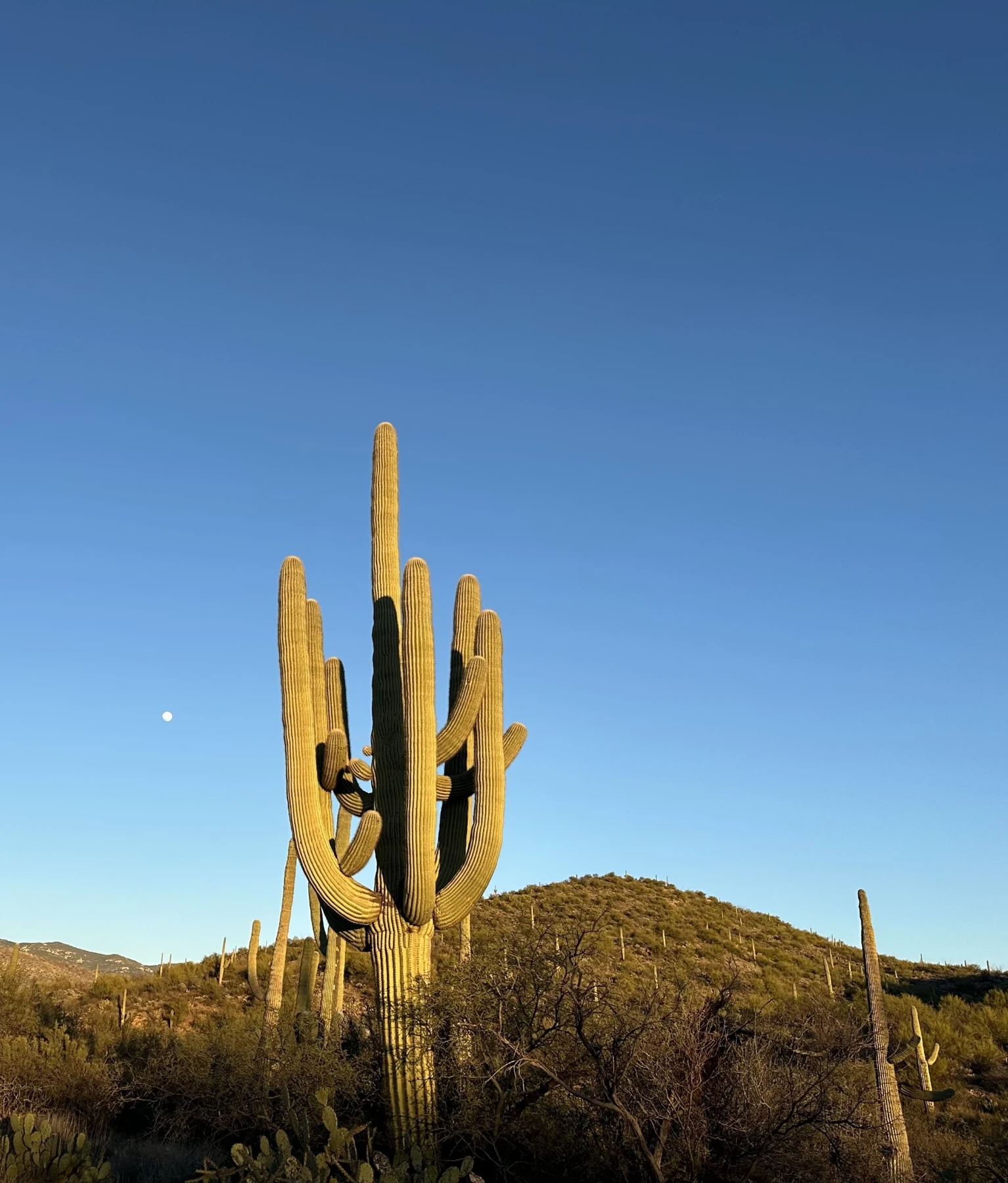
Augie raised both arms and stood very still.
“What are you doing?” asked Allie.
“Being a cactus.”
“Convincing,” Ana said. “Except for the talking.”
Beyond the visitor-center window, tall saguaros lifted branching arms above the desert. Some had many branches; others were straight columns. After examining the Badlands' fossil record, the four explorers had arrived in Arizona to investigate something very much alive.
Andy read the park name slowly. “Sa-goo-arrow?”
“Suh-WAH-ro,” Allie said, checking the pronunciation in their booklet.
“That's what I said,” Andy replied. “With extra exploring.”
Saguaro National Park protected desert landscapes on both sides of Tucson. The Tucson Mountain District was west of the city; the Rincon Mountain District was east. The family was visiting one district today, not trying to hurry through every corner of the park.
Their parents had checked conditions and planned a short outing at a suitable time. Water bottles were full, hats were on, and nobody's hand was going anywhere near a spine.
Ana noticed the long folds running down the cactus stems.
“Like an accordion,” she said.
Andy listened carefully. “A remarkably quiet one.”
Augie made a musical squeak.
“That's you,” said Ana.
Allie opened the notebook. Why does a saguaro need accordion folds? she wrote.
Below it, Andy added: Does it have a secret water bottle?
The plants looked sturdy enough to manage the desert without assistance. But looking sturdy was not an explanation. The children would need to investigate water, food, growth, and some surprisingly busy neighbors.
Augie lowered his arms.
“Cactus break,” he announced.
2. The folds are doing a job
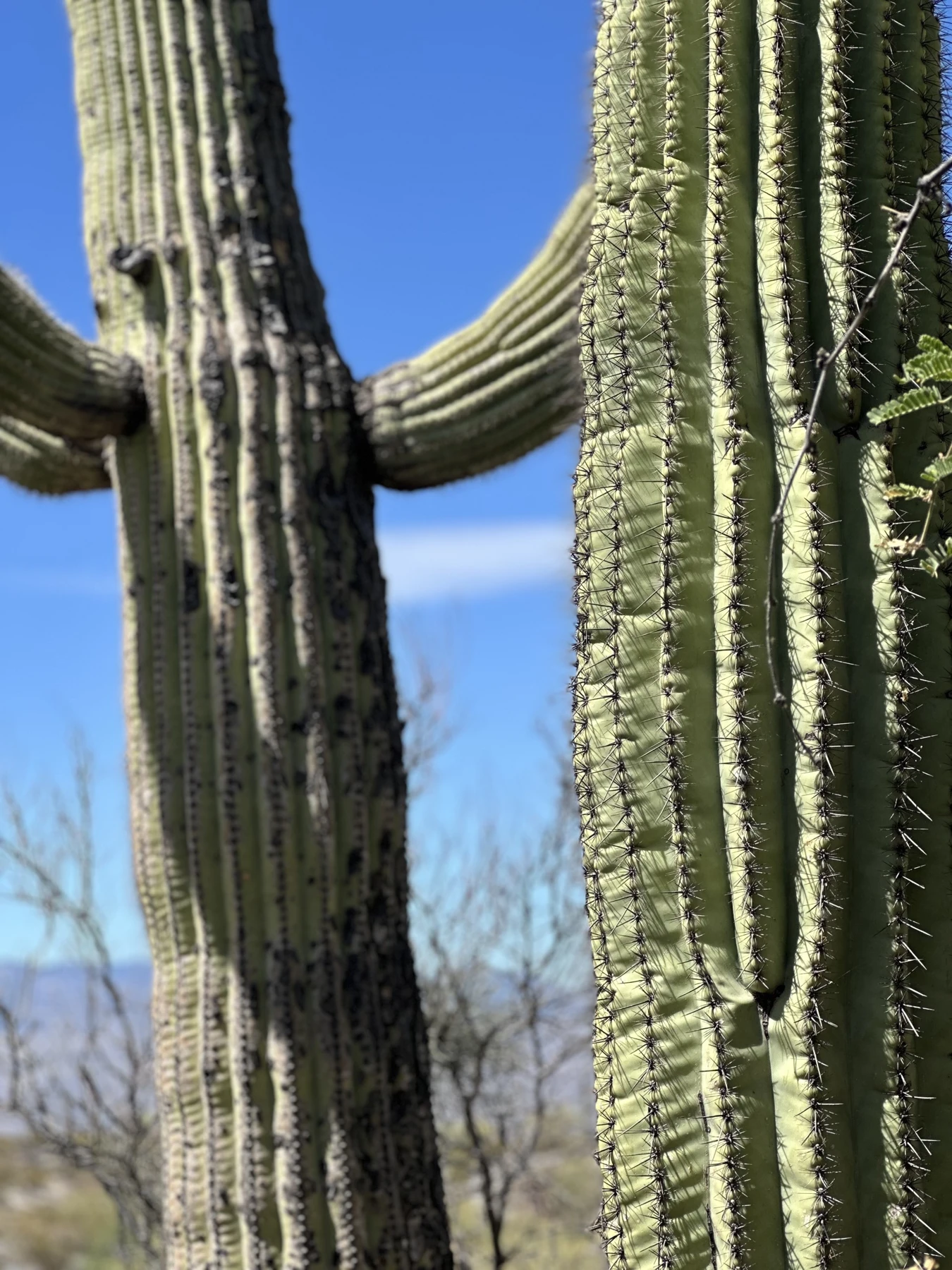
From a clear place on the path, the family looked at a saguaro's ridged green surface. A close-up photograph in their booklet showed the folds even more clearly.
Ana pinched a fold in her own shirt. “Extra room.”
“Room for a biscuit?” Andy asked.
“For the cactus to change size,” Allie said.
A saguaro stored water in its fleshy stem. After rain, water absorbed through its roots could increase that stored supply. The pleats allowed the stem to expand. As the plant used water during dry conditions, it could become narrower again.
It did not have a hard bottle hidden inside. Its own living tissues held water, and its shape accommodated changes in that supply.
“So the folds aren't just decoration,” Ana said. “They're part of how the plant works.”
“Expandable trousers,” Andy suggested.
“An accordion,” Allie corrected.
“Expandable cactus trousers is also scientific.”
“It is extremely memorable,” Ana conceded.
Their mother took out a folded paper fan from the activity bag. Opening and closing its folds changed its shape without requiring a new piece of paper. The model did not explain every detail of cactus tissue, but it helped them picture the extra room.
Augie tried opening his own fingers as wide as possible.
“I have pleats.”
“You have fingers,” said Allie. “Different design.”
The children could not watch a whole cactus swell during their short visit, so they did not pretend the nearby plant was visibly inflating. They used the observed folds, the paper model, and information from the park to understand a process that happened over time.
Ana added a useful warning to Andy's question: Water storage does not mean drinking fountain.
Their own bottles remained the refreshment department.
3. A green kitchen with a night window
“How does the water get in?” asked Andy. “A very long straw?”
The roots offered a different design. Much of a saguaro's absorbing root system spread outward close beneath the soil surface, allowing it to take advantage of rain wetting the ground.
“Collecting across an area,” Ana said, sketching lines radiating from a stem.
“Like me reaching for all the snacks on a picnic blanket,” Andy said.
“Less grabbing, more absorbing.”
They kept their drawing on paper. No digging around a cactus was needed to see whether the diagram was right.
Water alone was not food. Like other green plants, the saguaro used sunlight to help make sugars through photosynthesis. Much of that work took place in its green stems rather than a broad canopy of ordinary leaves.
“Green kitchen,” Augie said.
Allie read about tiny pores called stomata. The cactus could open these mainly at night to take in carbon dioxide, when conditions generally caused less water loss than the hottest part of the day. It stored that carbon in other compounds and used it in the daytime process of making sugars.
“So it doesn't need to keep its gas-exchange windows wide open in the midday heat,” Ana said.
“A kitchen with a night window,” Andy decided.
That did not mean photosynthesis ran on moonbeams. Sunlight still supplied the energy for making food. The timing of gas exchange was one part of a water-conserving system.
Spines, which were modified leaves, and the plant's protective outer surface helped too. No single feature explained survival by itself.
Augie inspected their notebook's cactus.
“Mine needs a fridge.”
“What for?” asked Allie.
“The biscuits.”
4. The giant's very small beginning
The next photograph surprised them more than the giant outside. Young saguaros stood beneath the branches of a tree.
“Why aren't they out in the sunshine?” Andy asked.
“They need some protection while they're small,” Allie said.
A palo verde, mesquite, or another nurse plant could provide shelter from harsh conditions. Shade helped young saguaros survive intense summer sun, and the surrounding vegetation could also protect against winter cold.
“A nurse tree doesn't have a medicine bag,” Ana explained to Augie. “The name describes the help it gives.”
“Does it check the cactus's temperature?”
“No thermometer required.”
Young saguaros grew slowly. Some could be only a few inches tall after many years. Starting with tiny seedlings made the towering adults seem even more extraordinary.
Andy looked down at his shoes. “I would have outgrown my school clothes several times before that cactus got very tall.”
“Please do not make me buy cactus trousers,” their mother said.
A branch was not a birthday candle either. Saguaros grew at different rates depending on conditions, and the number of arms did not give an exact age. Some tall plants had no arms at all.
“Just like the fossils,” Ana said. “A clue isn't automatically a complete calendar.”
Their parents helped them look from the path without searching under shrubs or stepping off to inspect tiny plants. A seedling was too easy to overlook and damage.
“Small and hidden doesn't mean absent,” Allie said.
Augie drew a tiny cactus under a very large tree.
“Can we give it a name?”
“A pretend name for your drawing,” said Ana.
He wrote a large, wobbly B.
“Bob.”
Bob appeared to be having an excellent, unhurried morning.
5. The flower's evening visitors
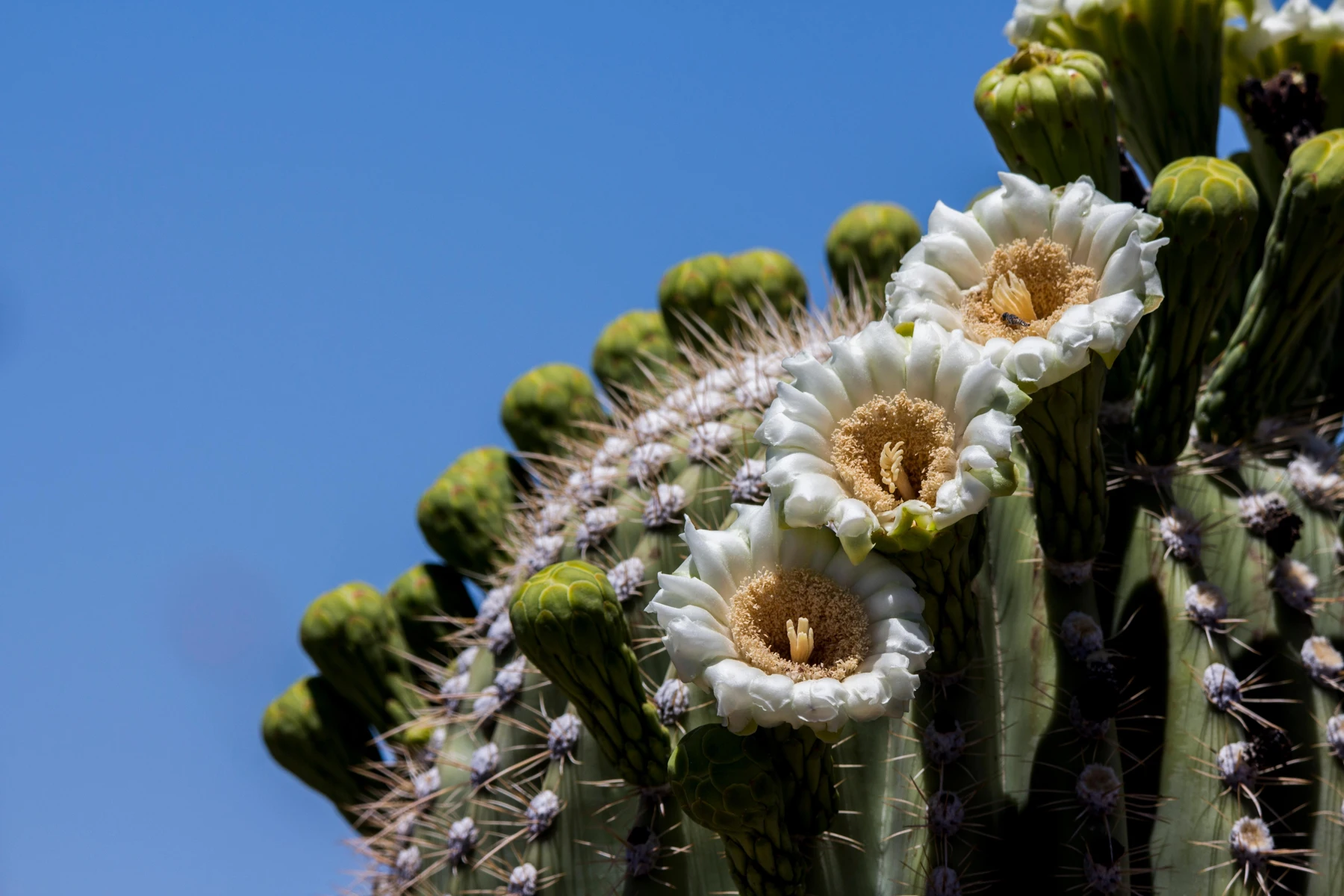
A photograph of white flowers showed another side of the spiny giant.
“Fancy hat,” Augie said.
“Flowers,” Allie replied. “And a way to make the next generation.”
Individual saguaro flowers opened at night and closed the following day. Nectar-feeding bats could visit in darkness; birds and insects could visit while flowers remained open in daylight.
As an animal moved between blossoms, pollen could be carried from one flower to another. That transfer helped make fertilization possible and, when successful, allowed seeds and fruit to develop.
“Delivery service,” said Ana.
“With nectar as the refreshment stop,” Andy added.
Allie remembered the insect-eating bats of Carlsbad Caverns. Here, nectar-feeding species played a different role. Not every bat had the same menu.
“A bat restaurant needs more than one page,” Ana said.
Augie supplied the specials. “Bugs. Flower juice. No soup.”
The family was learning from pictures and park information. Their visit did not guarantee flowers, ripe fruit, or a bat appearance. Seasonal events had their own timing, and the animals were not waiting for an audience.
Later in the plant's reproductive cycle, ripe fruit could contain many small seeds. Animals eating fruit could help disperse some of those seeds, though eating a seed did not always leave it unharmed. Only a small fraction would survive the difficulties of becoming a new cactus.
“Lots of seeds isn't the same as lots of grown-ups,” Allie said.
Ana drew a flower, a fruit, a seed, and Bob beneath his nurse tree.
“Any music yet?” Andy asked.
Augie made another squeak.
“Wrong pollinator,” said Ana.
6. The apartment building with spines
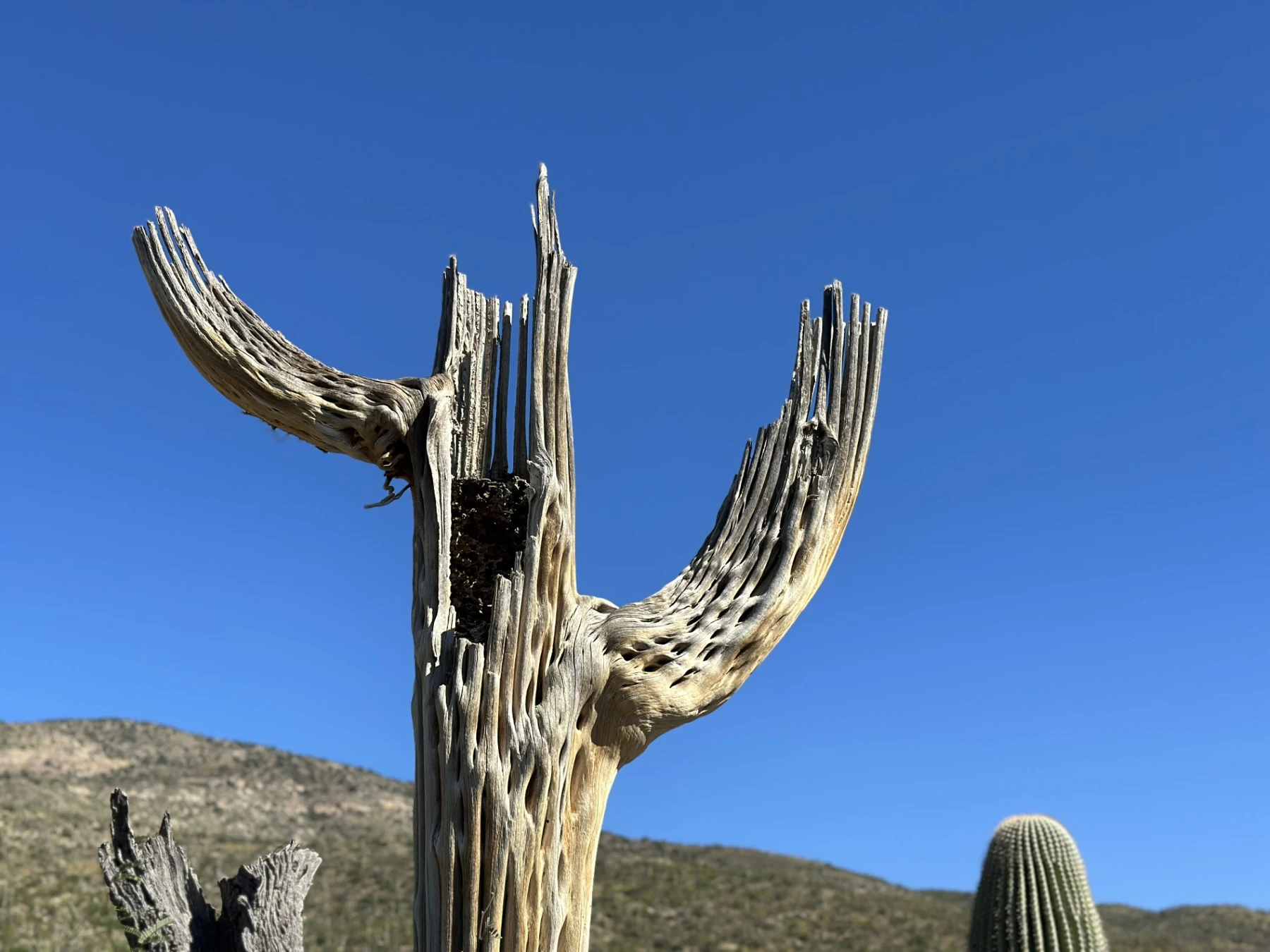
A dark cavity in a photographed saguaro introduced the next neighborhood mystery.
“Door,” Augie whispered.
Some birds, including Gila woodpeckers and gilded flickers, excavated nesting cavities in saguaros. After the original excavators left, other birds could use the spaces. Larger birds sometimes built stick nests among a cactus's arms instead.
“So the cactus can be a home and a food source,” said Ana.
“And a lookout,” Andy added. “A very tall apartment building with no elevator.”
Allie drew connections between the saguaro and its visitors: flowers for pollinators, fruit for feeding animals, cavities for shelter. They were seeing parts of a food web and a habitat, not a set of unrelated park attractions.
Augie wanted to know why such a heavy plant could stand up.
Inside, woody ribs formed a supporting framework. When a saguaro died and softer tissues decayed, that framework could remain, sometimes upright and sometimes lying on the ground.
“Skeleton?” he asked.
“A nickname for the framework,” Allie said. “Woody plant material, not animal bones.”
“Good. I didn't bring a cactus dentist.”
Ana looked back at their Badlands notes. One park had ancient animal remains; another had living plants and their woody remains. Similar-sounding words could describe very different things.
The children did not investigate a cavity by putting hands inside it, and they left fallen ribs where they lay. The cactus was part of other creatures' surroundings, even after it died.
Andy checked the picture for curtains.
“Not everything with a doorway needs decorating,” Ana told him.
“I was only considering a welcome mat.”
7. More than a clever plant
At the visitor center, the family learned that the saguaro's relationships included people too.
The park lay within the traditional lands of the Tohono O'odham people. Their long relationship with the saguaro continued through an annual fruit harvest and living cultural traditions.
“The plant isn't just a shape on a postcard,” Allie said.
Nor was a long-standing tradition simply an outdoor activity any visitor could copy. The family could learn from park information and from the Tohono O'odham Nation's own resources while respecting the people whose knowledge and practices they were learning about.
“Knowing that someone gathers fruit doesn't mean the whole park is our snack cupboard,” Ana said.
Augie closed the imaginary cupboard door.
Their parents explained that the family would leave plants, fruit, and other natural objects in place and follow park instructions. They would not borrow a harvest practice as a game or invent a traditional story to fit their notebook.
Andy looked at the drawing of the saguaro's flower visitors.
“We've been asking what the cactus does,” he said. “We also need to ask what it means to people.”
Allie added a new notebook heading: Learn from the people connected with a place.
Outside, an enormous cactus stood against the hills. The children already knew about its folds, roots, and green food-making stem. Now they understood that a biological description, however useful, was not the only way to learn about it.
Augie drew another open book beside Bob.
“Bob has more homework,” he said.
“We do,” Ana corrected gently.
Bob continued being a drawing, which required very little homework at all.
8. The missing babies in the photograph
Before leaving, the children looked at information about scientists returning to the same places to study saguaros over time.
“Like our fossil investigation,” Andy said. “Keep the clues connected.”
Allie read about repeat photographs of the Cactus Forest. An image showing fewer big saguaros did not, by itself, reveal how many small plants were hidden beneath trees.
“You could miss the next generation if you only counted the tallest shapes,” Ana said.
She drew a view of nurse trees with little cacti hidden beneath their branches. Then she drew the same scene from farther away. Bob disappeared behind a green scribble.
“Bob hasn't left,” Augie pointed out. “Bad camera.”
“Limited view,” Allie said. “A camera can be working perfectly and still leave important things out.”
Scientists combined photographs with measurements and observations on the ground. Long-lived plants required long-term study. One year's flower count, one dry spell, or one striking picture was a clue to investigate, not a complete explanation.
Their parents also showed them information about threats. Drought and damaging freezes mattered; so did changes people brought to the landscape. Invasive grasses could compete with native plants and help fires spread through places where saguaros were poorly equipped to survive them.
“Being excellent at storing water doesn't mean being safe from everything,” Andy said.
The family could help by respecting trails and plants, cleaning seeds and soil from footwear before visiting another natural area, and following ranger guidance. They would not pull unfamiliar plants themselves or assume every grass was an unwanted invader.
Ana circled a sentence in their notebook: Look again before deciding what the picture means.
Augie added: Especially if Bob is behind a tree.
9. The quiet accordion's answer
At their last viewing stop, the children returned to the question that had started the morning.
“Why does it need folds?” Allie asked.
“Room to expand when it stores water,” said Andy.
“And to narrow as it uses that water,” Ana added.
“Without changing trousers,” said Augie.
The rest of their discoveries fitted around that answer. Roots collected water. Living tissues stored it. Protective surfaces and the timing of gas exchange helped conserve it. Sunlight powered food-making. Nurse plants could shelter young saguaros, while flowers, fruit, and nesting spaces connected the adults to other lives.
“No single magic trick,” Allie said. “Several parts working together.”
They also corrected the first impression that these giants simply stood in empty desert. Around them were shrubs and trees, animals and unseen roots, changing seasons, ongoing research, and people with deep connections to the land.
Their parents checked that everyone was comfortable and had enough water before the drive back. A short outing had given them plenty to investigate. Longer was not automatically better, especially in desert heat.
Augie raised his arms again for a final cactus impression, safely away from the plants.
“Quiet orchestra,” he whispered.
For once, he did not squeak.
Their next chapter would take them to Crater Lake National Park and a lake with no river flowing out of it. Ana turned to a fresh page, ready for another water mystery.
Andy made a final note under their saguaro diagram: Excellent storage. Poor drinking fountain. Remarkable neighbors.
Then he looked at Augie.
“Are you still a cactus?”
“No,” Augie said. “I'm a hungry person.”
The accordion investigation ended with a perfectly ordinary snack, supplied by their parents rather than a protected plant.
Explorer’s notebook
Nine discoveries to take home
- Saguaro National Park has districts east and west of Tucson, Arizona. Wild saguaros grow within part of the Sonoran Desert in the United States and Mexico.
- A saguaro's pleats make room for its fleshy stem to expand as water storage increases and contract as stored water is used.
- Much of the absorbing root system spreads near the surface, helping the cactus use rain wetting the soil.
- The green stem makes sugars through photosynthesis. Mainly nighttime carbon-dioxide uptake helps conserve water; sunlight still supplies energy for food-making.
- Young saguaros grow slowly and can benefit from protection beneath nurse trees. Height and arm number do not reveal an exact birthday.
- Saguaro flowers open at night and close the following day. Bats, birds, and insects can transfer pollen between flowers.
- Saguaros supply food and nesting opportunities. Their supporting woody ribs are plant material, not animal bones.
- The Tohono O'odham maintain living relationships with the saguaro, including an annual fruit harvest in the park.
- Repeat photographs and field observations help scientists understand change. A photograph can hide young plants beneath nurse trees.
Five small adventures
- Make a paper accordion. Fold your own paper back and forth, then open and close it gently. What changes? Explain how it models extra room, and why it does not model a cactus's living tissues or roots.
- Design a conservation team. Draw a cactus with roots, folds, a green stem, and a protective surface. Give each feature a job label. Add a reminder: do not cut a cactus for water.
- Compare viewpoints. Hide a small cactus drawing behind a paper tree. Photograph the scene from far away and then closer. Explain why the first picture does not prove the little cactus is missing.
- Follow a flower visitor. Draw a bat, bird, or insect visiting two flowers. Use arrows to show possible pollen transfer. Add fruit and seeds later in the sequence, rather than treating pollen as a seed.
- Plan a short desert discovery. With a grown-up, choose an activity from current park information. Check conditions, accessibility, drinking water, shade, and a return plan. An indoor exhibit or photograph investigation can be part of the adventure.
Talk it over
- Why is “the cactus is a water bottle” a useful comparison with an important limit?
- What might a wide photograph leave out, even when it shows the landscape accurately?
- How does learning about a plant's cultural importance add to learning about its biology?
Words for your explorer pack
- Pleat: A fold that can provide room for a surface to expand or contract.
- Succulent: A plant with tissues adapted to store water.
- Photosynthesis: The process by which plants use light energy to make sugars from carbon dioxide and water.
- Stomata: Tiny pores used in gas exchange; water vapor can also escape through them.
- Nurse plant: A plant that helps shelter a young plant growing nearby.
- Pollination: Transfer of pollen to the pollen-receiving part of a flower, helping reproduction.
- Dispersal: Movement of seeds or other organisms away from their original location.
- Phenology: The study of the timing of seasonal events in living things, such as flowering.