1. A forest with a very unusual floor
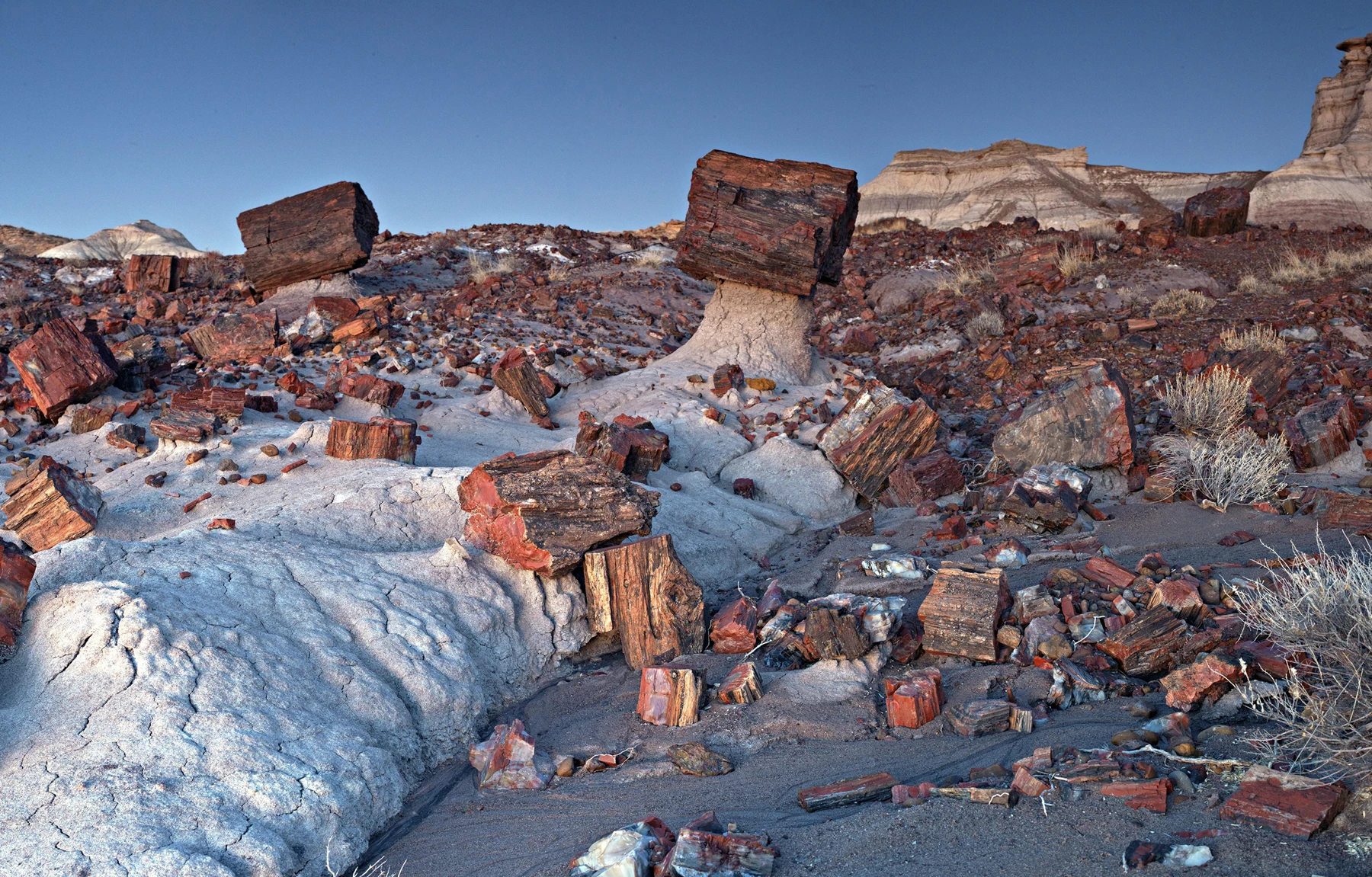
Andy had drawn a tree wearing rock shoes.
He had started the picture at Haleakalā, when the family first discussed their next adventure. Now, after a separate journey to northeastern Arizona, he was ready to test it against the real thing.
“Maybe the shoes spread upward,” he suggested.
Ana looked at a photograph of a petrified log. “That is an impressive theory from somebody who has not put his own shoes on the correct feet.”
Andy checked. Unfortunately, she was right.
The family had arrived at Petrified Forest National Park. Instead of a dense woodland full of living trunks, the view held open ground, colorful hills, and pieces that looked like logs but belonged to a much older forest.
Augie stared at the word petrified on their visitor material.
“Was the forest scared?”
“Petrified can mean frightened,” Allie said. “Here it means turned to stone.”
“By a very scary squirrel?”
“That goes in our first-ideas column,” Ana said.
Allie, ten, opened the notebook. Ana, nine, found the pencil. Seven-year-old Andy corrected his footwear. Four-year-old Augie volunteered to interview the squirrel, if it ever arrived.
Their parents had checked current conditions and chosen a manageable visit, with museum learning, suitable short stops, water, and time to rest. They would use photographs for views they did not visit. Nobody would leave a permitted path to collect evidence.
Their first real question went across the top of the page: How can something made of wood become stone and still look like a tree?
Andy added a second: Who cut the logs?
A photograph of Jasper Forest showed trunks scattered across pale ground. Some rested above the surrounding surface on small pedestals of earth. The scene looked quiet, but Allie suspected it held several kinds of movement.
Augie added one final question.
“Where are the leaves?”
The notebook was officially open for business.
2. The river before the desert
At Rainbow Forest Museum, the family studied an interpretation of the ancient landscape.
Their modern view and the museum's reconstructed world did not match. The Late Triassic landscape had waterways, trees, and other plants, with reptiles, amphibians, fish, and insects sharing its habitats. This region was much nearer the equator than Arizona is today.
Ana pointed to the water in the reconstruction.
“So we shouldn't put today's desert behind every ancient animal.”
“Or today's animals in the ancient forest,” Allie added.
Andy quietly moved a drawing of a modern rabbit into a separate box.
The fossil trees had lived more than 200 million years ago. That was not the age of a living tree that had somehow stayed upright all that time. It was a clue to when the original plants had been alive.
Augie stretched his arms wide.
“More than all my birthdays?”
“Much, much more,” Ana said.
The family learned that fallen trees could be carried by rivers and gather with other logs. Sediment could bury them before they fully decayed. A log found in one place today had not necessarily grown in exactly that spot.
Andy drew a tree beside a river, then a fallen trunk traveling downstream.
“A floating delivery,” he said.
“A possible part of its history,” Allie replied. “We need evidence for each actual fossil, not one drawing that explains every tree.”
Burial helped slow decay by changing the conditions around the wood, including limiting oxygen. But burial alone was not the whole answer. The children had buried toy cars in sand before; the cars had not become gemstones.
“Those mostly became missing,” Ana observed.
Allie added another question: What came into the buried wood?
Augie examined the reconstructed trees. They had not known they would become museum questions.
Andy gave his floating log a speech bubble: Please deliver somewhere with a good explanation.
The museum was making a promising attempt.
3. The tiny spaces inside a tree
The next clue was smaller than any log they could see.
Wood contained tiny spaces and structures. Water moving through buried wood could carry dissolved silica. Volcanic ash mixed into the surrounding sediments was one source of that silica.
Andy imagined a volcano pouring hot lava directly over a tree.
Ana checked their reading. “That isn't the process we're following. Ash, sediment, groundwater, and dissolved material matter here.”
Allie drew three arrows instead: ash in sediment; silica carried by water; minerals forming in the wood.
They learned two useful words. Permineralization meant minerals filling pores. Replacement meant mineral material taking the place of original material that was breaking down or dissolving away. These processes could preserve shape and, in some specimens, very fine detail.
Augie studied the long word.
“That one needs its own lunch.”
“We can start with filling spaces,” Allie said.
At a table, their parent laid out a clean paper grid. The squares stood for tiny spaces in an imaginary piece of wood. Each child colored a few squares to represent minerals being deposited.
The grid stayed on the page. It was not a recipe for petrifying wood, and crayons were not silica. It simply helped them picture something arriving in small spaces rather than wrapping the whole log in a stone coat.
Andy drew a coat anyway, in the rejected-ideas margin.
“The log looks warm.”
“But still not explained,” Ana said.
Much of the park's petrified wood was now made mainly of quartz, a crystalline form of silica. The original tree's form could survive even as its material changed dramatically.
Allie wrote shape and material are different questions.
They also avoided putting a kitchen-timer number on the process. Burial, mineral deposition, later changes, and eventual exposure belonged to a long history, not a trick that could be completed in a bucket over the weekend.
Augie crossed out Saturday in his drawing.
“Not ready by snack time.”
“No,” Ana agreed. “Fortunately, the snack already is.”
4. The rainbow with no paintbrush
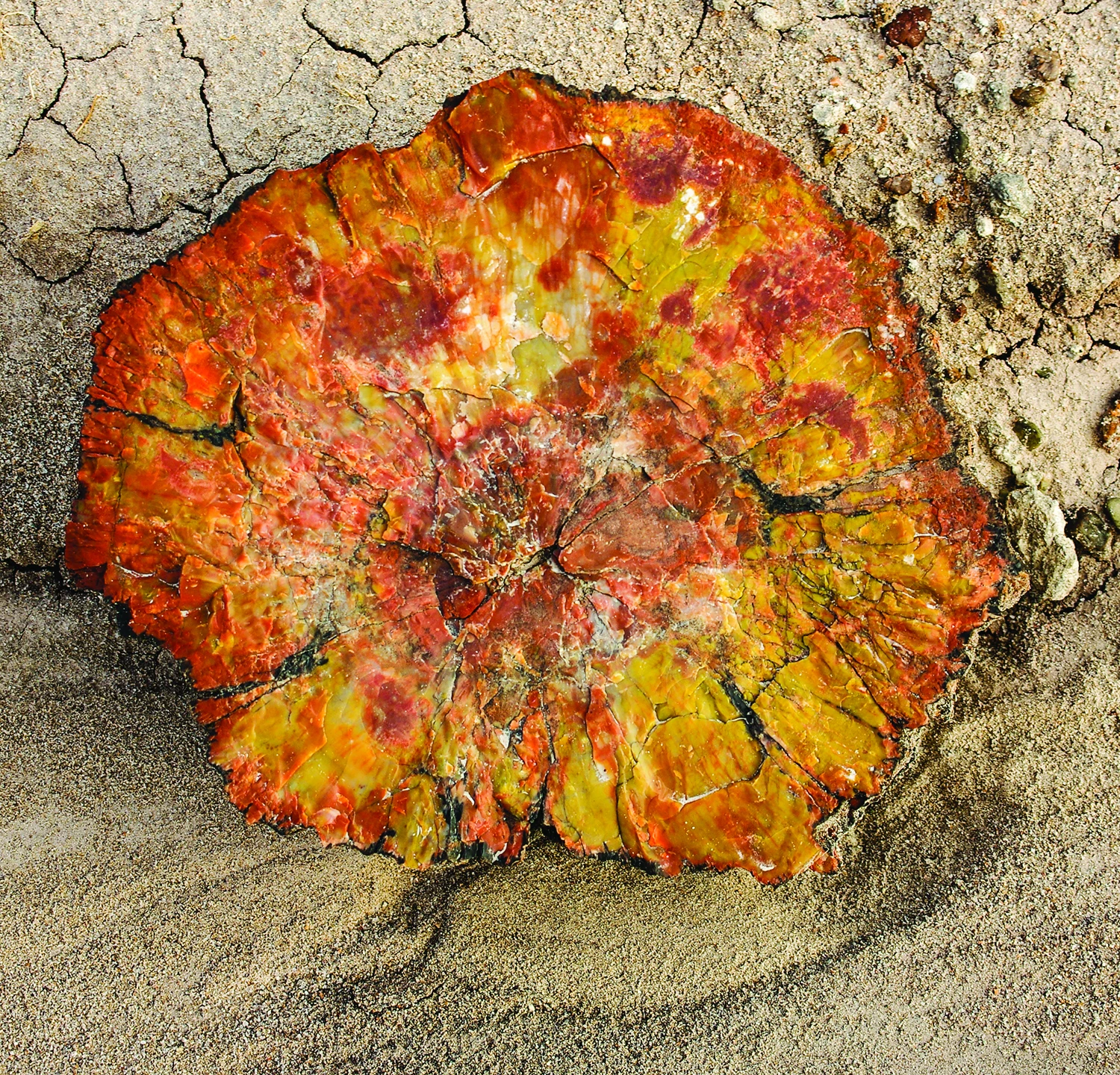
A close-up photograph filled their view with yellow, red, pale white, and dark patches.
Andy opened his colored pencils.
“Finally. A rock that understands my entire pencil box.”
Ana looked at the photograph before choosing a color. The surface was more complicated than tidy rainbow stripes. Some patches blended; others followed cracks or filled spaces. It was worth drawing what they could actually see.
Pure quartz was colorless. Small amounts of other substances could help produce the many colors in petrified wood. Iron compounds, for example, could contribute yellows, reds, and browns. Different chemical conditions and combinations made the full story more complicated than one color belonging to one ingredient.
“So we can't point at every purple patch and announce a laboratory result,” Allie said.
Andy put a question mark beside his boldest color label.
“Even if I say it in my scientist voice?”
“Especially then.”
Augie selected yellow, then red, then changed his mind and used both. His drawing looked like a stone pancake with a magnificent sunset inside it.
Their parent asked whether every colored band should be read as a yearly growth ring.
“No,” Ana said after checking the information. “Mineral colors can make patterns too. We shouldn't count all these colors as birthdays.”
The children compared a photograph showing wood-like surface texture with the colorful close-up. One made the tree shape easy to recognize. The other made the changed material harder to ignore.
Andy wrote two labels under his sketch: looks like a log and made mostly of quartz now.
Allie added a third: evidence of an earlier living thing—a fossil.
Augie wanted to know whether a fossil could be beautiful and useful for science at the same time.
“Definitely,” their parent said.
Andy considered his pancake drawing.
“Mine is beautiful and useful for remembering lunch.”
Ana allowed the claim, provided it did not enter the mineral list.
5. The case of the invisible saw
Outside, at a suitable short trail stop chosen by their parents, the children noticed broken sections of petrified logs.
Some ends looked surprisingly neat. Andy's second question returned at full volume.
“Who cut the wood?”
Ana held up the notebook. “It isn't ordinary wood now. That changes the question.”
Quartz-rich petrified wood was hard, but it was also brittle. Stress could fracture a mineralized trunk across its length rather than making it bend or splinter like fresh wood. Natural fractures could leave sections that resembled saw cuts.
Their parent reminded them that a photograph could not tell the complete fracture history of every individual log. The important discovery was that a clean-looking break did not automatically prove someone had used a saw.
Andy drew a large saw and crossed it out.
Augie suggested a beaver with very strong teeth.
Ana added no evidence beside that proposal too.
They compared the petrified sections with a mental picture of an ordinary fallen branch. The same general shape could behave differently when the material was different. Hardness and resistance to breaking were not the same property.
“A hard thing can still break,” Allie said. “We are not going to demonstrate that on a fossil.”
Their shoes stayed on the path. Nobody tapped a log with a stone, tried fitting pieces together, or moved a fragment for a better picture.
Instead, the children played a paper-only game. Allie drew three rounded rectangles as sections of an imagined trunk. Ana connected them in a possible order. Andy rotated one until the drawn grain no longer matched.
“That seems less likely,” she said.
“An intentionally unhelpful puzzle piece.”
Augie rotated it back.
“Tree repaired.”
The real logs remained just as they had found them. The mystery had lost its invisible saw and gained a much more useful clue: material properties mattered.
6. Not every ancient reptile was a dinosaur
In the museum's fossil displays, Andy was ready to meet dinosaurs.
He was also ready to call nearly everything a dinosaur, which created a small problem.
A crocodile-like animal in the interpretation was a phytosaur. It was an ancient reptile, but not a dinosaur. Armored aetosaurs were another group sharing the Late Triassic landscape. Early dinosaurs were present too, alongside animals that belonged to other branches of life's family tree.
Ana drew several branches instead of one big box labeled dinosaur.
“Looking a bit alike doesn't make everything the same kind of animal.”
Andy checked the animal he had drawn. “Then this one needs a better name than Long Mouth.”
“Long Mouth can be your memory nickname,” Allie said. “It isn't the scientific identification.”
The children learned that the park's early dinosaurs lived long before Tyrannosaurus rex. A fossil scene should not gather every famous prehistoric animal into one afternoon beside one river.
Augie imagined a very crowded picnic.
“Too many teeth.”
“Also too many different times,” Ana said.
Their parent asked why a museum reconstruction might show more than a collection of bones. Scientists used the rocks, plant remains, animal fossils, and their relationships to build an interpretation of an ancient environment. The reconstruction was based on evidence, but it still involved questions and uncertainty.
Allie wrote a fossil forest was an ecosystem, not just a stack of trunks.
Andy added plants, insects, fish, and several carefully separate animal groups to a new page. He left blank space for things they had not learned about yet.
Augie drew a tree without rock shoes.
“This one is still alive in the old story.”
That was an important distinction. The fossil logs belonged to once-living trees, and those trees had been part of a world full of other lives. Becoming stone was a later chapter.
Ana gave Augie's drawing a small star.
7. Who painted the Painted Desert?
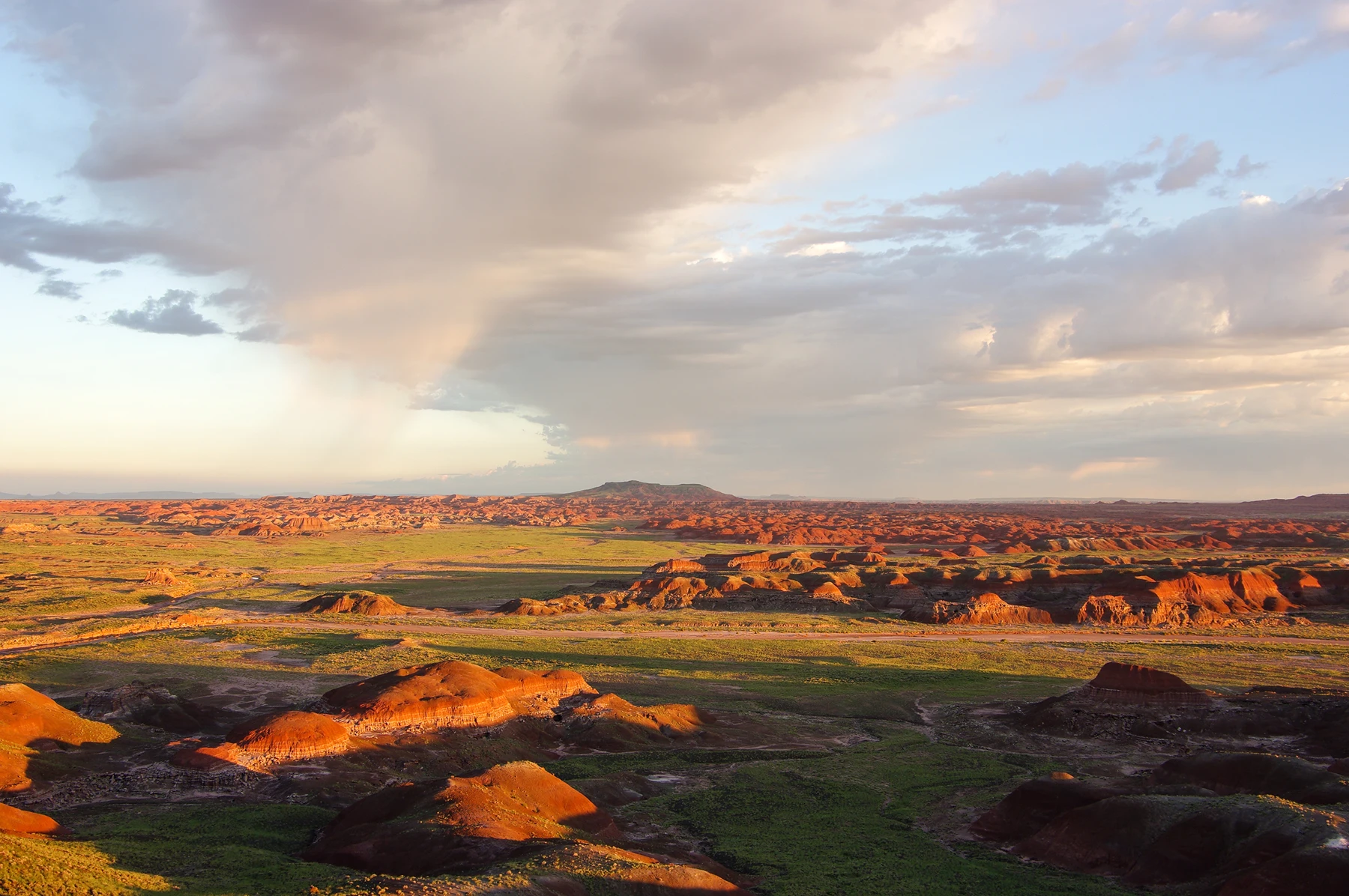
Their parents chose a designated overlook for a broad view of the Painted Desert. Farther-away vistas could be studied in photographs; the family did not need to visit every trail to understand that this was more than one patch of colored ground.
Red and pale bands crossed the hills. Shadows made some slopes look deeper and others brighter.
Andy inspected his pencil box.
“I am being out-colored.”
No enormous painter had arrived with buckets. The hills recorded layers of sediment and ancient soils, with mineral chemistry helping give them their colors. Water, oxygen conditions, and changes through time had affected that chemistry.
Allie remembered their mineral-log investigation. Similar questions could help, but a colored hill and a colored log did not have identical histories.
“Color is a clue,” she said. “Not the whole explanation.”
Much of the park's ancient record lay in the Chinle Formation, rock layers deposited during the Late Triassic. Later weathering and erosion shaped the exposed hills and helped uncover fossils that had once been buried.
Ana returned to the photograph of logs on little pedestals. Softer material could wear away around a more resistant fossil. A log did not have to grow upward through the earth to end up above the surrounding surface.
Augie looked relieved.
“No rock tree climbing out.”
Their parent pointed out that exposure could also leave fossils vulnerable to damage. Erosion was not a museum worker carefully arranging everything forever. The landscape continued changing.
The family kept back from edges and did not walk down fragile slopes to investigate a stripe. Looking from a proper viewpoint gave them room to compare the whole pattern.
Andy drew two pictures of the same hills: one with long shadows and one with shorter shadows.
“Different light. Same rocks.”
“And a reminder that a photograph records a moment,” Ana said.
Augie selected a purple pencil.
The desert was painted again, safely, on paper.
8. A village is more than its walls
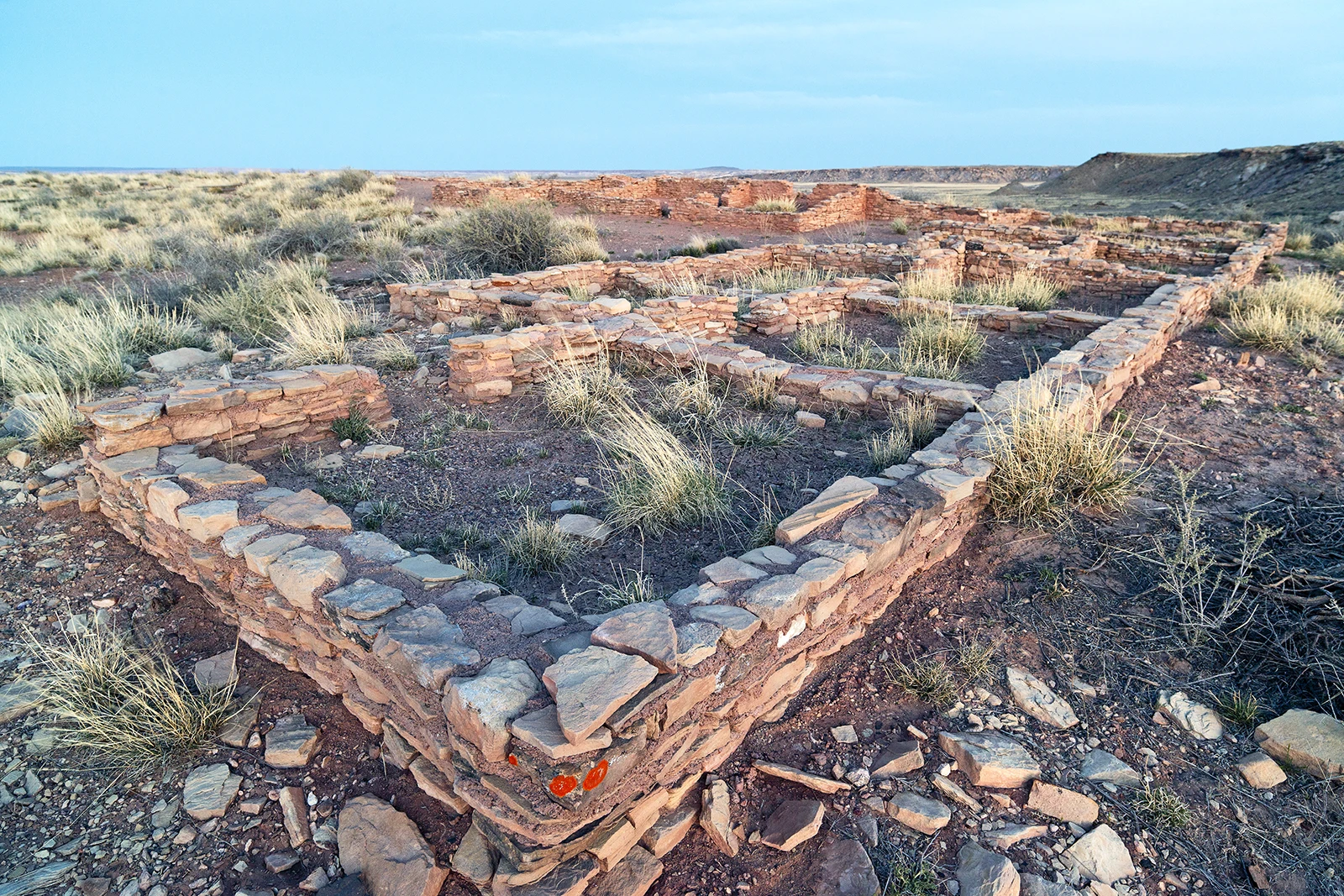
The family's learning also included Puerco Pueblo, an ancestral Puebloan village near the Puerco River. A photograph showed low masonry walls outlining part of a much larger place.
Ana looked beyond the visible stones in the picture.
“There would have been people's lives here. Not just walls waiting for us to look at.”
The village's residents grew crops such as corn, beans, and squash. The river supported farming and formed a corridor for travel and exchange. Rooms, gathering spaces, tools, and other evidence helped researchers investigate how people had lived.
Allie drew a simple plan of an imaginary household on a separate page. It was a way to ask questions about cooking, storage, and neighbors, not a claim that she knew the arrangement of a particular family's home.
Andy drew an enormous pantry.
“An ambitious household,” Ana said.
The park's human story was much more recent than the Triassic trees, but it too reached far beyond their short visit. Puerco Pueblo remained culturally significant to Hopi and Zuni people. Indigenous communities were living peoples with continuing relationships to this region, not characters who vanished when a village changed.
Their parents helped them think about what respectful visiting meant: follow designated routes, do not climb walls, leave objects where they belong, and never touch or mark rock imagery. Public interpretation could introduce them to a place without giving them permission to invent meanings for everything they saw.
Augie kept both hands on his own notebook.
“These are my walls,” he said, showing the edges of his paper house.
“Those you may draw on,” Allie agreed.
Ana added two separate timeline headings: ancient forest and human histories. One did not belong inside the other just because both were in the same park.
Andy added a third heading: our visit.
It took very little room on the page. That felt about right.
9. The smallest piece of the mystery
Near the end of their visit, Augie noticed a little fragment beside the path.
He did not pick it up. He pointed from where he stood and asked whether it was part of the stone forest.
Their parent could not identify it confidently from that glance. But the visitor's decision did not depend on winning an identification contest: it would stay where it was.
“No collecting fossils or petrified wood here,” Ana said. “Even little pieces.”
Andy looked across the scattered material. “A tiny bit seems so small until everybody thinks that.”
Allie considered another reason. A fossil's location, the layer around it, and the things found with it could help tell its story. Removing an object could separate it from evidence. If they noticed a possible fossil worth reporting, their parents could help record the location without disturbing it and tell park staff.
Augie patted his pocket.
“Only my tissue.”
“Excellent collection,” Ana said. “Please keep that one.”
They chose their own souvenirs: a drawing, a photograph from a permitted place, and the explanation they had worked out together.
Andy reviewed the first page. The scary squirrel had no supporting evidence. The rock shoes were imaginative but unhelpful. The saw had been replaced by natural fractures in brittle material.
Their answer now connected several stages: trees had lived; logs had fallen and been buried; mineral-bearing water had helped preserve them as fossils; later changes and erosion had revealed the stone logs.
Allie added that this was a simplified story. Different fossils could preserve different details and histories. They had learned enough to ask better questions, not enough to know every log's biography.
Their next chapter would take them to Theodore Roosevelt National Park, where prairie animals would introduce a different kind of engineering.
Augie drew a prairie dog wearing a hard hat.
“First idea?” he asked.
“Definitely,” Ana said.
The family left with full notebooks and empty fossil pockets. The stone logs stayed in the park, ready to give the next explorers their own surprising questions.
Explorer’s notebook
Nine discoveries to take home
- Petrified Forest National Park is in northeastern Arizona. Its famous stone logs are fossils of once-living trees.
- The Late Triassic environment included waterways, trees, and many kinds of animals; today's open landscape does not represent every past environment.
- River transport and burial helped begin the preservation story of many logs. A fossil's present position is not always where the original tree grew.
- Permineralization fills pores with minerals; replacement changes original material to mineral material. Both can help preserve fossils.
- The park's petrified wood is made mainly of quartz. Other substances help produce its many colors.
- Hard quartz-rich logs can still be brittle. Natural fractures can resemble saw cuts.
- Phytosaurs and aetosaurs were not dinosaurs. The park's early dinosaurs lived long before T. rex.
- The Painted Desert's rock layers, mineral colors, and erosion reveal parts of a changing landscape; Puerco Pueblo adds a distinct human story.
- Petrified wood, other fossils, and cultural objects stay in the park, including the smallest pieces.
Five small adventures
- Make a fossil-story sequence. Draw a living tree, a fallen log, burial, mineral deposition, and later exposure. Label it a simplified sequence, not the exact biography of every fossil.
- Color a pore-space model. Draw a paper grid and color some spaces to represent arriving minerals. Explain what the model shows and why paper and crayons cannot reproduce real petrification.
- Separate observation from explanation. Use a photograph of a broken petrified log. Write “I see” statements first, then possible explanations. Identify what evidence would be needed before saying a saw was involved.
- Build three timelines. On separate strips, label the ancient forest, human histories, and today's visit. Keep their different scales explicit; do not put people or T. rex into a Late Triassic scene.
- Design a no-collection souvenir. Make a drawing or a page of questions inspired by a park photograph. If visiting, take photographs only from permitted places and leave all natural and cultural objects undisturbed.
Talk it over
- How can a fossil keep the shape of a tree while being made of very different material?
- Why doesn't a neat-looking break prove that somebody used a saw?
- What could a scientist learn from where a fossil lies, as well as from the fossil itself?
- Why is a village's history bigger than the walls that remain visible today?
Words for your explorer pack
- Fossil: preserved evidence of past life.
- Sediment: material such as sand, silt, or mud that can be transported and deposited.
- Silica: silicon dioxide, a substance found in quartz and other forms.
- Permineralization: minerals filling natural pores in material such as wood or bone.
- Replacement: mineral material taking the place of original material.
- Brittle: likely to break or fracture rather than bend substantially.
- Erosion: removal and transport of material by processes such as moving water.
- Context: the location and relationships that help explain an object or piece of evidence.