1. A very suspicious place to put a forest
Andy had sand in his shoe before the investigation had officially begun.
“Excellent,” he said. “The park has sent me a sample.”
“The sample stays here,” Ana said. “And please don't mail it to my shoes.”
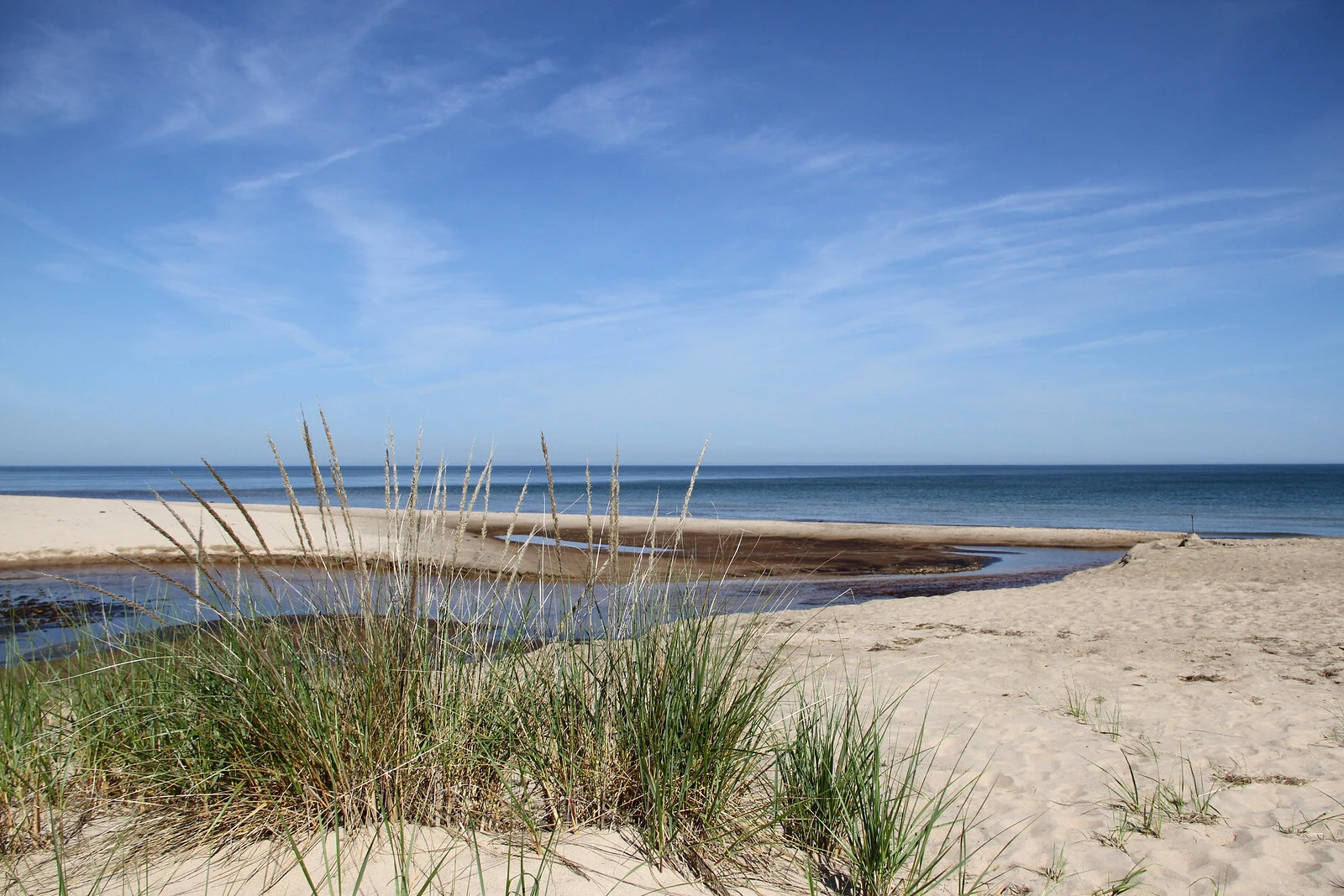
Beyond the designated walkway at West Beach, Lake Michigan stretched toward a blue horizon. The children were visiting Indiana Dunes National Park, along the lake's southern shore. Wind ruffled the grasses. Behind the open sand were shrubs and trees.
Augie pointed at the water. “Ocean.”
“Lake,” Allie said.
He looked again. “Big lake.”
That was a description everyone could accept.
Their grown-ups had checked the weather, park alerts, and the West Beach trail information. Today's plan included the Dune Succession Trail, with its many stairs, frequent rests, and permission to shorten the outing if anyone needed to. They had drinking water, sun protection, and shoes suitable for the walk. There would be no swimming or wandering onto dune slopes.
Andy inspected the first part of the route. “Do stairs count as mountains if there are enough of them?”
“Ask your legs later,” Ana suggested.
Allie opened the notebook they had used at Cuyahoga Valley. Their previous mystery had followed a river's recovery. This time, a photograph of an oak-covered dune had given Augie a different problem.
“Who put a forest in the sand?” he asked.
Andy imagined a delivery truck backing up to the beach.
“One forest. Some assembly required. Please sign for the squirrels.”
Allie wrote their new question: How can a forest grow where the ground is made of sand?
Ana added three smaller questions underneath: What holds the sand? What helps plants grow? Does every dune become forest?
“You're giving our question homework,” Andy said.
“It looked bored.”
They watched the grasses bend. Farther along, leaves shifted in the trees. It was tempting to look at the whole landscape and say, simply, that plants grew there.
But the children had learned that a good mystery often began when an ordinary thing stopped looking ordinary.
For Andy, the ordinary thing was a tree.
For Augie, it was a tree without a flowerpot.
2. The building crew has no shovels
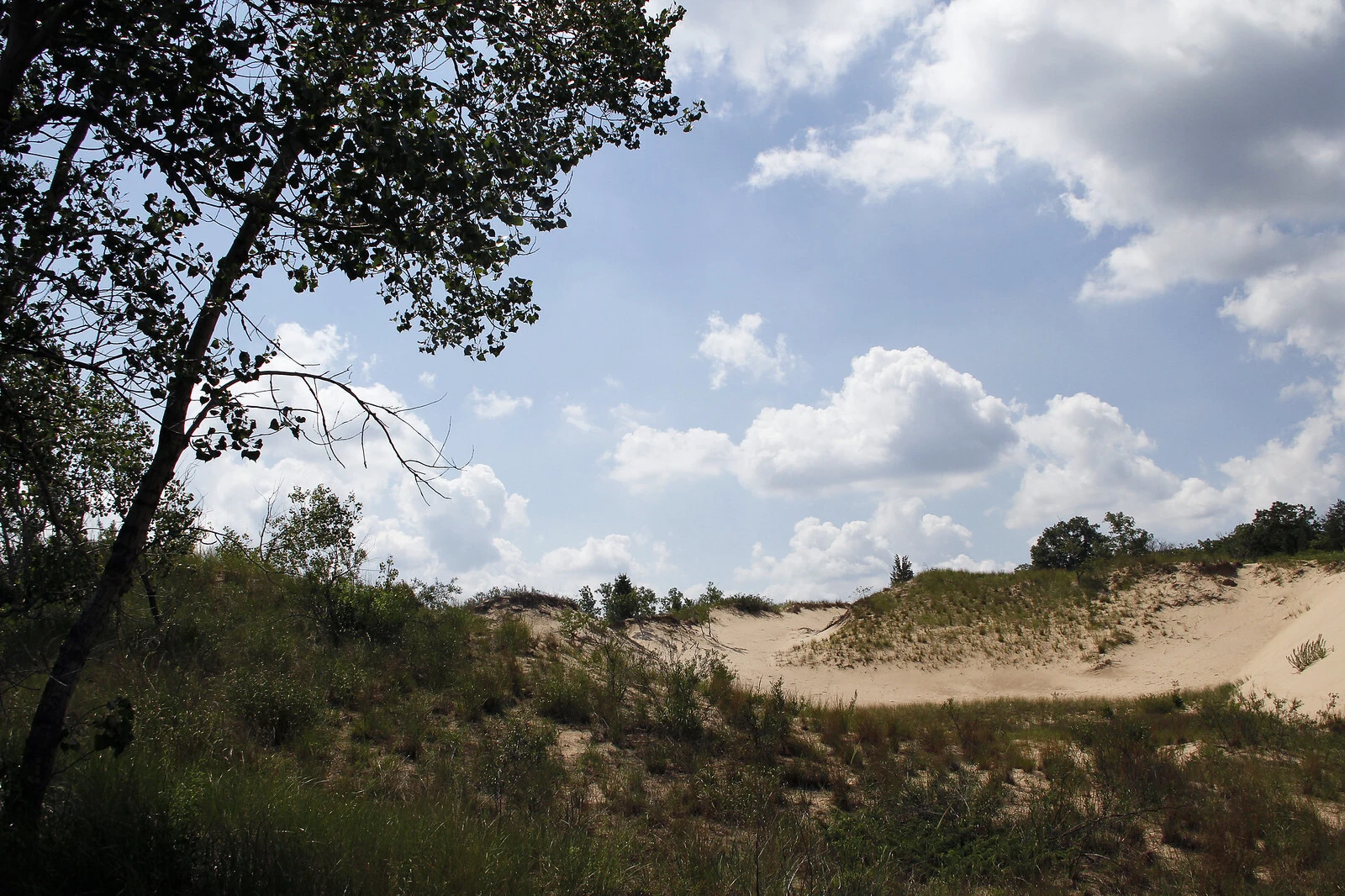
At an allowed stopping place, Ana studied the grass near the trail. She did not step into it or pull up a blade to inspect its base.
“It looks much too thin to hold a dune,” she said.
“Perhaps it has a very stern voice,” Andy suggested. “Sand! Stay!”
Allie read about marram grass, one of the important dune-building plants. Its leaves caught windblown sand. Beneath the surface, roots and spreading stems helped anchor it.
“Underground stems?” Ana asked.
“Called rhizomes,” Allie said. “They're stems, not just another name for roots.”
Andy drew a grass plant with ordinary leaves above and a branching network beneath.
“The part we can see isn't the whole worker.”
“Like you under a blanket,” Ana said. “Except the grass is doing something.”
Augie crouched beside their grown-up on the walkway. “Where's its shovel?”
The grass needed no shovel. The moving air supplied sand, and the plant affected where some of it settled. A living plant and a physical force could help shape the same landform.
Allie gave Andy a challenge. If the leaves caught sand but the plant had no way to remain in place, what might happen?
“The building crew could blow away.”
And if a plant could not cope with sand accumulating around it?
“It might get buried.”
Marram could grow as sand built up around it. That did not mean it could survive every possible condition. A useful adaptation was not an unlimited superpower.
The children noticed a difference between their drawing and the actual view. Their sketch showed everything neatly, including the underground parts. Outside, those parts were hidden.
“We learn from the park's information,” Ana said. “We don't need to dig up the evidence.”
Andy put a small label beside his picture: Construction in progress. Please use the path.
“Does grass mind feet?” Augie asked.
Their grown-up explained that trampling could damage the plants helping hold a dune together. Staying on designated routes was part of looking after the place they had come to see.
Augie checked his feet.
“Mine are staying employed on the stairs.”
3. The lake moves it, the wind delivers it
Now Andy wanted to know who had supplied all the sand.
He pictured a truck again. It had become his favorite explanation for landscapes.
Allie pointed toward Lake Michigan. Waves and currents moved sediment along the shore. Wind could carry exposed sand farther inland, where plants and other obstacles changed its journey.
“So the lake and the air share delivery duties,” Ana said.
There was a much older part to the story too. Ice sheets had helped shape the Great Lakes region. As glaciers retreated and water levels changed, shorelines and dunes developed in different places. Some older dunes now lay inland beneath vegetation.
Augie looked disappointed. “We missed the big ice?”
“By a bit,” Andy said.
“More than a bit,” Allie corrected.
They had studied living glaciers at Glacier Bay through photographs and interpretation. Here, glacial history helped explain a landscape where the ice was long gone.
Ana made a simple drawing: lake, beach, wind, plants, dune.
Then she drew arrows.
“The dune isn't just a pile someone finished.”
It could change as sand arrived or left. Where wind carved into a dune, it could create a hollow called a blowout. Damaging protective vegetation could make erosion worse, although people did not cause every natural opening in a dune.
Andy named his drawing A Hill Having a Busy Day.
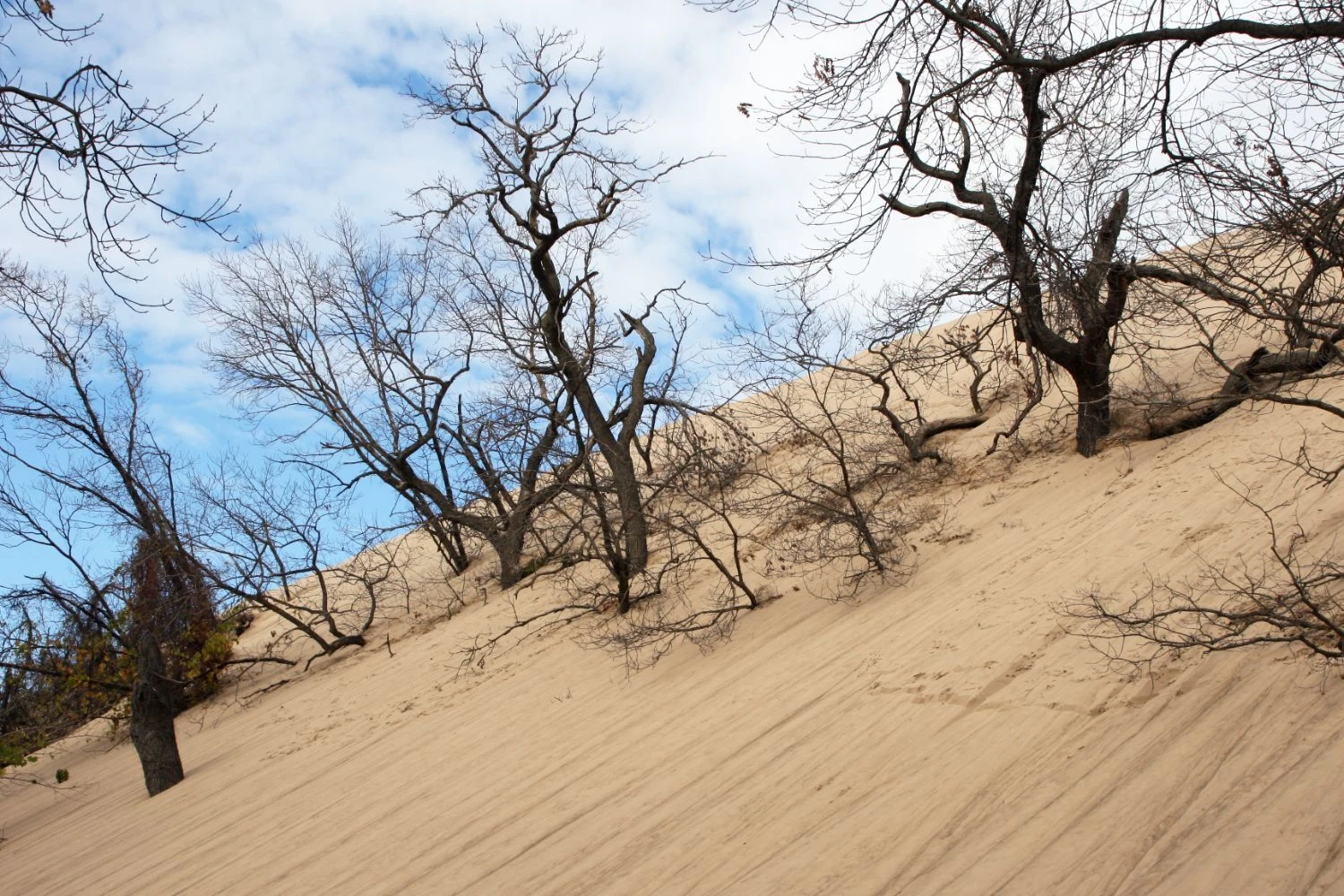
Their grown-up showed them a park photograph of oak trees partly buried by moving sand at Mount Baldy. They were studying an image, not visiting or climbing that dune. Open access and closed areas had to be respected wherever they went.
Augie studied the trunks.
“The ground pulled up its blanket.”
“And a tree can't simply move to another bed,” Ana said.
That photograph complicated their mystery. Sand could help form the place where vegetation established, yet moving sand could also overwhelm existing trees.
Andy crossed out his first proposed answer: Trees are heavier than sand, so they win.
“Weight isn't the whole story,” he admitted.
The lake rolled another small wave toward shore, apparently uninterested in whether the detective team had finished its diagram.
4. Soil is more than sand wearing leaves
In a more sheltered stretch, the children noticed a greater variety of vegetation. Ana compared the open, sunny areas with patches of shade.
“The plants change their surroundings,” she said. “They don't just sit in them.”
Allie thought back to their Glacier Bay chapter. There too, arriving plants and other organisms had been part of changing ground conditions. The two parks were not following identical instructions, but they could ask similar questions.
“What happens to a fallen leaf?” she asked.
“It retires,” Andy said.
“With further duties,” Ana replied.
Fungi, bacteria, and other decomposers helped break down dead material. Over time, organic matter joined mineral particles. Soil also contained water, air, and living organisms. It was not simply a layer of leaves hiding a sandy floor.
Andy imagined a soil recipe with a warning at the bottom: Preparation time may exceed lunch break.
“Please don't actually mix park soil,” their grown-up said as he reached for his pencil. “A drawing is enough.”
Allie drew the recipe instead. They could think about soil without collecting it or moving it from one place to another.
Shade, shelter, moisture, and soil conditions influenced which plants could establish. A place suitable for one species might be difficult for another. Larger plants could then change the light available below them.
Ana held a hand above Andy's notebook to cast a shadow.
“Now imagine you're a seedling that needs lots of sunshine.”
Andy moved the notebook into the light.
“A real seedling can't do that,” she reminded him.
He returned it and drew a worried leaf.
The plants were not planning a forest together. They were growing where their needs could be met, affecting conditions and one another as they did so.
“No committee?” Andy asked.
“No minutes. No chairperson.”
Augie perked up. “There can be chairs?”
They took the hint and paused for a proper rest where their grown-ups judged it suitable. Even a fascinating soil discussion could not replace a four-year-old's need to sit down.
5. The scientist who couldn't wait for a whole forest
When they continued, Allie introduced a name from the park's history: Henry Chandler Cowles.
In the late 1800s, this University of Chicago botanist studied plant communities at the Indiana Dunes. His work helped shape the science of ecology, including ideas about succession—changes in communities over time.
“Did he watch one patch until it grew a forest?” Andy asked.
“He compared different places,” Allie answered. “Including dunes with different plants and different histories.”
Ana could see the attraction. If a change took longer than a person's research project, comparisons might offer clues that a single afternoon could not.
But there was a detective problem hidden in that method.
“Different places aren't the same place at different times,” she said.
Allie smiled. “Exactly. It's a useful comparison, not a time machine.”
She imagined two photographs of Andy: one from when he was smaller, and one of Augie now.
“You can't use Augie's picture as your actual baby photograph.”
“My hair was more dignified,” Andy said.
Augie touched his head. “Mine is good.”
It was. The point was that comparisons needed care. Researchers had to consider differences in conditions and history, not just arrange every landscape into a neat queue.
The habitats along their walk illustrated patterns of change, but they were not watching the same patch transform during one hike. Nor could every tree's age be read from its distance to the water.
Modern ecology continued to investigate succession. The old picture of one inevitable, permanent final community was too simple for a world of storms, fires, changing climate, species arrivals, and many local conditions.
Andy drew a very wobbly arrow, then several branching arrows.
“Our answer has options.”
“Our answer has evidence,” Ana said. “The options follow from that.”
Allie added a note beneath Cowles's name: Ask a good question. Compare carefully. Keep learning.
“Can I add keep snacks?” Augie asked.
They decided that belonged on the field-trip list rather than the definition of ecology.
6. Trees overhead, sand underneath
In the woodland, the children looked up.
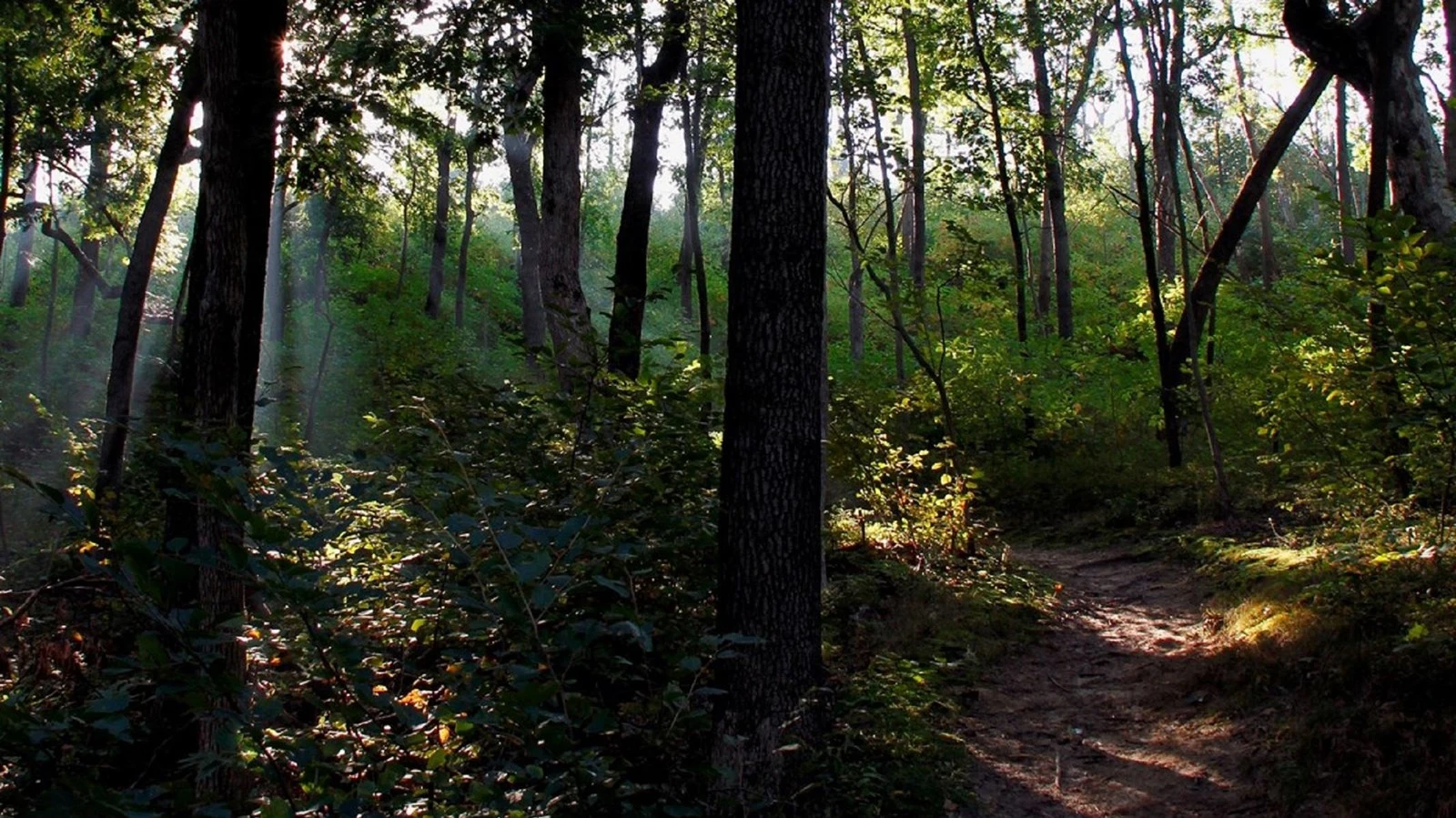
Leaves formed a canopy. Light came through in shifting patches. The scene felt very different from exposed sand near the lake, even though sandy ground was still part of its foundation.
“A forest without a flowerpot,” Augie said, sounding impressed all over again.
The park's interpretation described oaks and other trees growing on older, more sheltered dunes. Over time, plant remains and other processes had changed the soil, while the vegetation itself affected shade and wind near the ground.
A tree did not need a solid block of garden soil to stand in. Its success depended on whether it could establish roots and obtain what it needed in the conditions available.
Andy looked at a sandy section of the designated route.
“So the forest didn't replace every sand grain with brown dirt.”
“Right,” Allie said. “The ground can stay sandy while its soil conditions change.”
They compared the living view with a photograph of the oak woodland on Dune Ridge Trail, elsewhere in the national park. That was another place to explore on another suitable outing, not a secret connecting path from West Beach.
Ana returned to their three questions. What held the sand? Plants and their underground networks could help. What helped plants grow? Suitable water, light, nutrients, shelter, and time were all part of the answer.
“That leaves the third question,” she said. “Does every dune become forest?”
Andy glanced toward the open habitats they had already studied.
“Perhaps they're still waiting for their delivery.”
“Or perhaps they aren't waiting at all.”
They learned that the park contained many habitats side by side. Its jack pines, for example, were associated with northern conditions and persisted here with the help of local sandy soils and the lake's influence on climate. Low areas could support wetlands instead of matching the dry slopes nearby.
“Same park,” Ana said. “Different addresses. Different conditions.”
Augie considered that.
“The wet plants picked the splashy room.”
It was not a scientific explanation, but it helped him remember that a dune landscape could include much more than dry sand and trees.
7. The place that shouldn't get a roof of leaves
During another rest, their grown-up showed them information about Miller Woods. They would not add that separate destination to today's walk. It offered a clue their forest question still needed.
The pictures showed scattered oaks with sunlit grasses and other plants beneath them: an oak savanna.
“Someone forgot to fill in the trees,” Andy said.
“Or the open space is exactly what some plants need,” Ana answered.
Allie read that repeated fires had helped keep such habitats open. Some fires came from lightning; Indigenous people also used fire in caring for landscapes. When fire was excluded for a long time, more woody vegetation could grow and shade sun-loving plants.
The national park used carefully planned prescribed fire and other restoration work to help care for savannas. Trained crews chose conditions, followed plans, protected people, and studied effects. This was professional work, not a campfire experiment.
Augie looked at the bright spaces between the trees.
“The flowers need the sky door open.”
“That's a useful way to picture the light,” Allie said.
A more densely wooded place was not automatically a better version of a savanna. Different living communities had different needs. Conservation could mean maintaining an open habitat, not trying to cover every available space with trees.
Andy looked slightly alarmed at his notebook. His original illustration had shown a dune, an arrow, and a forest wearing a winner's medal.
He removed the medal.
“No habitat competition.”
They still valued the forest. They also valued the open dunes, wetlands, and savannas, each with its own conditions and connections. A park could hold a mosaic rather than a single finished picture.
Ana drew several adjoining shapes and gave each a different pattern.
“This is a better map than one giant forest sticker.”
Augie inspected it.
“Can the wet room be purple?”
It could. The notebook was a learning tool, not an official habitat map, and their youngest explorer was prepared to negotiate firmly on behalf of purple.
8. The people in the landscape's story
Allie had nearly filled a page with grasses, wind, fungi, trees, and fire. Ana pointed to the margin.
“We need people here too.”
They read about the region's long Indigenous history, including connections with Miami and Potawatomi peoples. European arrival and United States expansion brought land loss and forced removals. These histories involved living communities and painful choices imposed on them, not a landscape becoming empty.
Native communities continued today. Learning from their own accounts mattered, and naming a few peoples was only a beginning.
Andy made room on the page rather than squeezing the note under a grass drawing.
“The margins were getting unfairly crowded.”
The children also learned about later changes: settlement, industry, and sand mining. The area around West Beach's parking lots had been altered by mining before protection. A flat surface could hide a history of hills hauled away.
Augie looked surprised. “They took the hill?”
“For its sand,” Allie said.
“That's a very big bucket.”
Protecting the dunes had required years of effort. Dorothy Buell and the Save the Dunes movement, Senator Paul Douglas, and many others helped push for protection. Not every dune was saved. The landscape around the park still included homes, roads, and industry.
The national lakeshore was authorized in 1966; its name became Indiana Dunes National Park in 2019. The nearby state park was a separate park, with its own management and visitor arrangements.
“A place can have more than one kind of boundary,” Ana said. “Plants don't read all our signs.”
“We still should,” Andy replied.
That earned him an approving nod from their grown-up.
He glanced back at their previous river chapter. Caring for a place had involved science and public action there too. The details were different, but one lesson connected both stories: understanding a landscape could help people decide what was worth protecting.
Augie tightened his grip on his water bottle.
“And we don't take the hill home.”
That was a promise everyone could keep.
9. Forest delivery canceled
By the time they returned from their planned walk, Andy's legs had reached a decision about stairs.
“Small mountains,” he announced. “Definitely.”
The family found a suitable place to rest. Ana checked that their belongings and wrappers were accounted for. Allie opened the notebook for their final answer.
How can a forest grow where the ground is made of sand?
Andy began. “The sand isn't always sliding everywhere. Plants can help hold it.”
“Plant remains and decomposers help change the soil,” Ana added. “And conditions such as shelter, water, and light affect which plants establish.”
“Over long periods, some sandy places can support woodland,” Allie said. “But it isn't a promise that every dune must follow the same route.”
Augie delivered the shortest version.
“No forest truck.”
They all agreed that this was a considerable improvement on their first explanation.
Andy drew a small truck at the bottom of the page anyway. Its delivery notice now read: Canceled. Plants already handling it.
Ana added a warning beside the drawing. The plants were not handling everything alone: water, wind, soil organisms, climate, disturbance, and people all affected the landscape.
“Your truck needs a larger notice,” she said.
Their grown-up asked which discovery had surprised them most.
For Allie, it was that a wooded dune still carried its sandy foundation. For Ana, it was the value of open habitats that were not simply waiting to become forest. For Andy, it was that underground stems could be such important builders.
Augie thought carefully.
“Grass has a downstairs.”
Allie wrote that down too.
Their next chapter would take them to Gateway Arch National Park in St. Louis, where another question about standing up awaited them. This time it would concern a human-built arch rather than trees on sand.
Andy looked interested. “Do arches have downstairs?”
“Let's investigate,” Ana said.
As they left, he shook the stray sand from his shoe at an appropriate spot before getting into the car.
The park had sent a sample. The detective had learned something from it.
Now the sample could stay home.
Explorer’s notebook
Nine discoveries to take home
- Indiana Dunes National Park lies along southern Lake Michigan. It includes a varied landscape, not just a beach.
- Glacial history, changing shorelines, water, and wind helped shape its dunes. Some older dunes now lie inland beneath vegetation.
- Marram grass catches moving sand. Roots and rhizomes—underground stems—help anchor dune-building plants.
- Plants affect their surroundings through shelter, shade, and contributions of dead material. Soil includes mineral particles, organic matter, water, air, and organisms.
- Succession means changes in living communities over time. Henry Chandler Cowles's dunes research helped develop this field of ecology.
- Comparing places can reveal clues about change, but different sites are not exact snapshots of one site's past and future.
- Some sandy places support oak woodland. Other conditions support open dunes, wetlands, pine communities, or savannas; forest is not a universal finish line.
- Carefully managed fire can help maintain oak savanna. Prescribed burning belongs to trained professionals following appropriate plans.
- The dunes have long Indigenous histories and continuing Native connections. Their conservation story also includes public action, losses, protection, and ongoing care.
Five family adventures
- Design the underground crew. Draw a grass plant with leaves above the sand, roots below, and a spreading rhizome labeled “stem.” Use the park's information for help. Explain why a small-looking plant can influence a larger patch. Make the drawing at home; do not dig up dune plants.
- Build a habitat mosaic on paper. Divide a page into dry dune, woodland, open savanna, and wetland. Give each different light and water conditions. Explain why putting the same plant everywhere might not work. This is an imaginary learning map, not a planting plan.
- Try the comparison challenge. Compare photographs of two different places. Write one similarity, one difference, and one thing the photographs cannot tell you. Why can't you assume one image shows exactly what the other place will become?
- Follow a leaf's further duties. Draw a fallen leaf, decomposers, soil, and a growing plant. Explain how matter can be broken down and reused. Add sunlight as the plant's energy source. Observe from an approved path or use photographs; leave leaves, logs, and organisms where they belong.
- Choose the right outing. With a grown-up, compare current official trail information. West Beach's Dune Succession Trail has many stairs and is strenuous despite its short distance; Dune Ridge also includes loose sand and slopes. Choose what suits everyone's needs, or use the NPS virtual tour. Check alerts and weather, bring water and sun protection, stay on designated routes, and make a separate plan for any beach activity.
Four questions for the road
- How can a grass plant help shape a dune without deciding to build one?
- Why might two places with sandy ground support different plants?
- Why could maintaining an open savanna be a conservation goal rather than planting more trees there?
- What extra information would you need before using today's woodland to predict the future of a particular open dune?
Words for your explorer pocket
- Dune: a hill or ridge of sand accumulated by wind.
- Rhizome: a stem that grows underground and can produce roots and new shoots.
- Sediment: particles such as sand, silt, and gravel moved or deposited by natural forces.
- Decomposer: an organism, such as a fungus or bacterium, that helps break down dead material.
- Succession: change in an ecological community over time.
- Canopy: the upper layer of leaves and branches in a woodland or forest.
- Savanna: an open habitat with scattered trees and a ground layer that includes grasses and other plants.
- Ecology: the study of relationships among living things and their environment.