1. The mystery of the enormous upside-down smile
Augie had brought all his bones to St. Louis.
He had not packed them separately. They had arrived inside him, as usual. But when Allie announced that today's mystery involved something standing without a skeleton, he checked both knees.
“Mine are still here.”
“Useful,” Ana said. “We have some walking to do.”
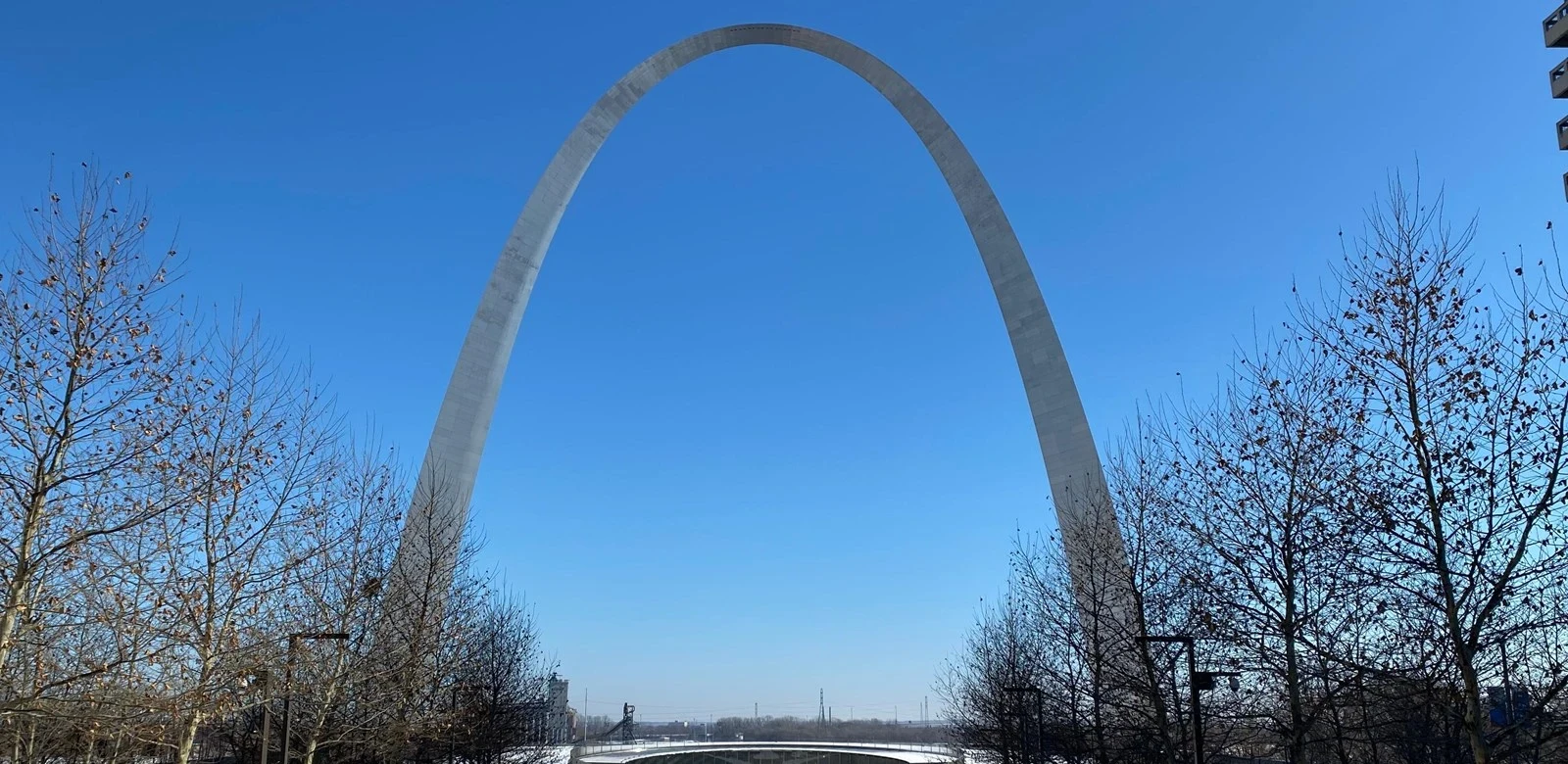
Ahead of the family, the Gateway Arch curved high above the grounds beside the Mississippi River. They were visiting Gateway Arch National Park in St. Louis, Missouri. Instead of a wooded dune, their next puzzle was a monument made by people.
Andy tipped his head back.
“An enormous upside-down smile.”
“Or a doorway,” Ana suggested.
“Where's the door?” Augie asked.
Their grown-ups had planned an outing on the grounds and in the museum beneath the Arch, with breaks and a separate visit to the Old Courthouse if everyone felt ready. They would use designated public routes and street crossings. Today's adventure did not require a tram ride to the top.
Allie opened their Indiana Dunes notebook page. There, they had asked how trees could stand on sandy ground. Now she wrote a new question beside it: What holds up the Gateway Arch?
Andy drew a huge silver curve with a tiny person underneath.
“That's me,” he explained. “Accurately astonished.”
The Arch was 630 feet high. The distance between the outside edges of its legs at ground level was also 630 feet.
Ana raised her eyebrows. “As wide as it is tall?”
“Those measurements,” Allie said. “It doesn't always look that way from where we're standing.”
Moving along the public path changed their view. From some angles the curve opened broadly; from others, its legs seemed much closer together. A shape could look different without changing its actual dimensions.
Augie considered a more urgent issue.
“If it has no bones, is it a jellyfish?”
Andy drew several tentacles under his Arch.
Ana confiscated the idea, though not the pencil.
“Let's learn what 'no skeleton' means before we give the national park tentacles.”
2. The skin is doing some of the work
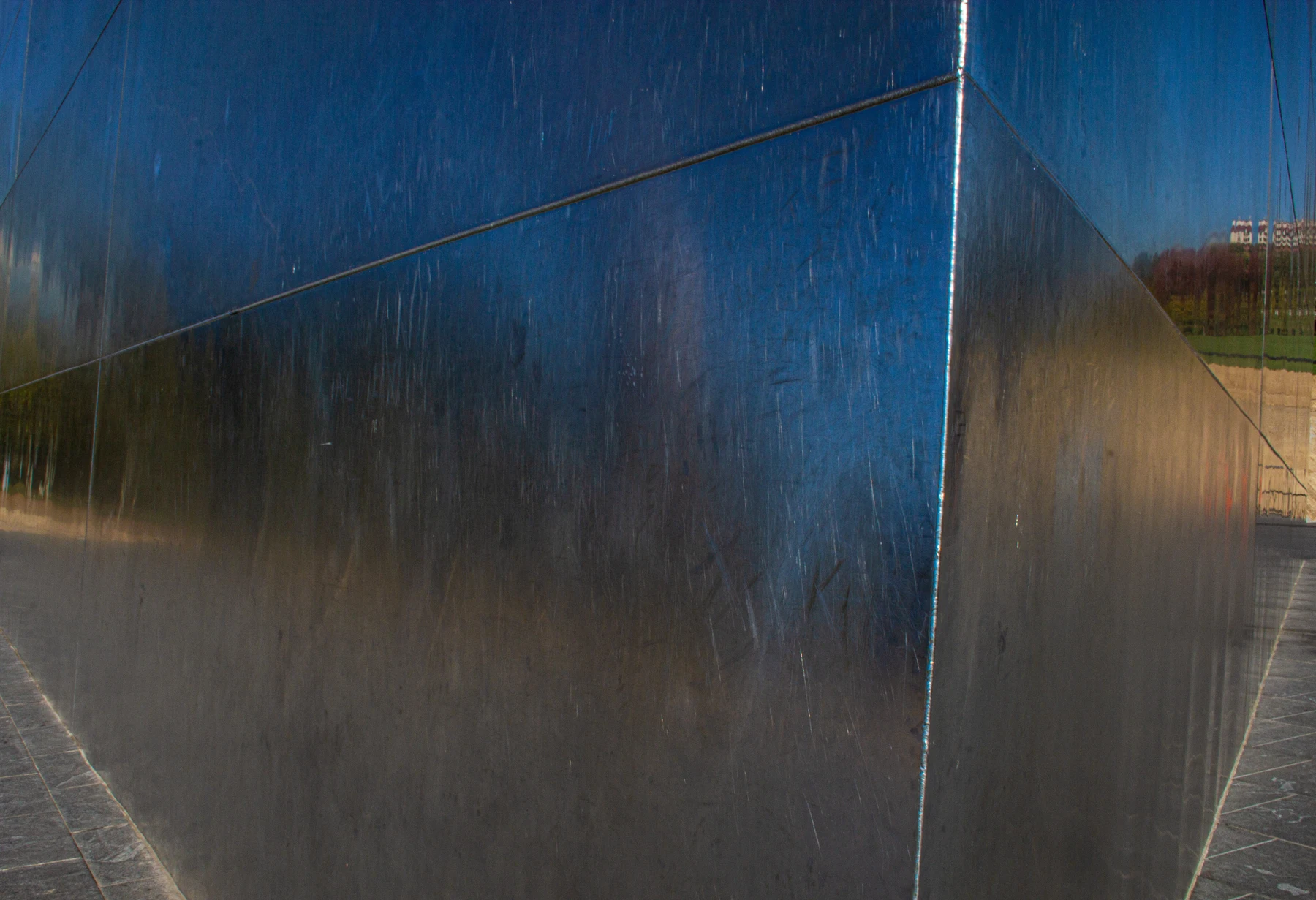
From a public viewing area, the children examined the Arch's gleaming surface. Their close-up photograph showed panels, seams, and reflections that were difficult to study from farther away.
“It looks like a silver coat,” Ana said.
Allie read the explanation. In many buildings, a framework carries loads while the exterior covers it. The Arch worked differently: its steel walls were part of the load-carrying structure itself.
“So the coat has a job beyond looking shiny,” Andy said.
“A very important job.”
The outside was stainless steel; another steel wall lay inside it. In the lower portions, reinforced concrete filled the space between those walls. Higher up, steel connectors and stiffeners joined and supported the walls.
The monument was not a solid metal rainbow, and it was not an empty foil wrapper. Its materials were arranged to work together.
Augie inspected his sleeve.
“My coat cannot do that.”
“Please don't ask it to hold up a monument,” Ana said.
No separate skeleton did not mean no internal parts. There were structural connections, transport equipment, stairs, and other systems inside. The phrase described a way of building, not a mysterious absence of support.
Allie drew a triangle to represent the cross-section of a leg: the shape a slice across it would show. The triangular sections became smaller toward the top.
“A triangle hiding inside a curve,” Andy said. “This park is very sneaky with shapes.”
He wanted to label the concrete a sandwich filling, but Augie had already become interested in that word.
“No eating the engineering,” Ana told them both.
Their grown-up reminded them that the drawing was simplified. The real structure had many connections and details, designed and checked by specialists. A picture in a notebook could explain an idea without containing every bolt, weld, or calculation.
Andy added a note: Not a building plan. Especially not a sandwich recipe.
The youngest explorer looked slightly disappointed.
They took an ordinary snack break later, with ordinary food, which restored his faith in the outing.
3. The feet you cannot see
Ana returned to the main question.
“If the steel carries the weight, where does the weight go?”
“Down,” Andy said confidently.
“Good start. Then where?”
Allie traced the legs in her drawing. Loads traveled through the structure toward substantial foundations beneath the ground. Those foundations were made of reinforced concrete and extended into bedrock.
“The Arch has enormous buried feet,” Andy said.
Augie looked down at the lawn.
“Where are its shoes?”
The foundations were not shoes. Their job was to transfer forces safely into the ground. They reached about 60 feet down, with roughly half that depth in bedrock.
Their grown-up explained the word load. In engineering it could mean a force a structure had to carry or resist, including its own weight. Wind could create loads too.
“So engineers don't only ask whether something looks steady on a nice day,” Ana said.
“Exactly.”
Andy drew a wind arrow aimed at the Arch. Then he drew a smaller arrow aimed at his hair.
“Two very different engineering challenges.”
They learned that tall structures could move a little under changing conditions. Carefully allowed movement was different from a structure failing. Engineers had to consider wind, materials, connections, and the ground together.
Augie tried a tiny wiggle.
“I am checking my wind.”
“Your foundation is currently two shoes,” Ana said. “Keep both on the path.”
The children could not see the foundations directly, but that did not make them unimportant. Indiana Dunes had taught them that hidden roots and stems mattered. Here, a designed system below ground played a crucial role.
Allie drew a line across the page for the ground surface. She made sure the foundation drawing continued below it.
“A photograph of the top doesn't show the whole answer.”
Andy considered his first picture, which had simply stopped at the grass.
“My Arch was missing its downstairs.”
Augie smiled. Grass had a downstairs. The Arch had a downstairs. The world was proving agreeably well supplied with downstairs.
4. A curve that takes its work seriously
Inside the museum, the family spent time learning about the design. Allie introduced the architect: Eero Saarinen, a Finnish-American designer whose proposal won the monument's design competition.
“Did he just draw a rainbow?” Andy asked.
“He developed a design for this place,” Allie answered. “Then engineers helped turn the idea into a structure that could be built.”
Ana followed the outline in their guide. It was not simply half a circle.
To introduce the shape, their grown-up described a short flexible chain hanging between two supported ends. Under its own weight, an ordinary uniform chain made a curve called a catenary. Turn a drawing of that curve upside down, and it offered a useful starting point for thinking about an arch.
“Do not turn the actual chain upside down and expect it to stay there,” Ana said before Andy could suggest it.
He closed his mouth again.
The Gateway Arch's shape was more specialized, commonly described as an inverted weighted catenary. Its width and weight distribution changed along its length. A hanging chain was an illustration of a principle, not an exact model of this enormous monument.
“The necklace version would need extra instructions,” Andy admitted.
The curve helped direct forces through the legs to the foundations. Under its own weight, much of the action involved compression—a pushing or squeezing force. The steel structure also had to resist other effects, including bending and forces associated with wind.
Augie pressed his palms gently together.
“Squish?”
“That's a useful way to remember a push,” Allie said. “But the Arch isn't squishy.”
They decided on a rule for their notebook: a successful structure needed more than an attractive outline. Shape, materials, size, joints, and support all mattered.
Andy tried a professional-looking title above his diagram: Department of Curves That Have Responsibilities.
Ana read it and nodded.
“Finally, a department where your doodles can find employment.”
5. The two sides had to meet
Building something curved from both ends presented a problem Andy understood immediately.
“What if the top pieces missed?”
He drew two arch legs passing each other like people who had agreed to meet outside different shops.
“That's why measurement mattered,” Allie said.
The builders assembled steel sections and raised the two legs. Specialized cranes climbed with the work rather than staying at ground level. Workers joined sections by welding, making strong connections between the metal pieces.
“Not giant sticky tape?” Augie asked.
“Definitely not.”
As the structure grew, its unfinished shape needed careful engineering too. A temporary stabilizing truss connected the legs high above the ground during the later work. The monument had to be safe to construct, not just strong once completed.
Ana liked that distinction.
“The building process has its own problems to solve.”
Allie pointed to the final joining section in the construction story. It was put into place on October 28, 1965. The two sides became a completed arch, but the work had depended on much more than one dramatic moment at the top.
Andy added a list: designers, engineers, fabricators, welders, crane operators, surveyors, and many other workers.
“The shiny curve is hiding a very long team list.”
He imagined the instructions for a toy version: Ask several specialists to help. Allow considerably more than an afternoon.
Their grown-up reminded them that construction photographs recorded real work at height, performed with specialized equipment. The children were studying the story from the museum, not trying to copy the workers on a railing outside.
Augie studied Andy's mismatched-leg drawing.
“Those two need to talk.”
“Another good engineering principle,” Ana said.
Allie added communication to the list beside measurements and materials. An idea passed between people had to be understood, checked, and built accurately. No single person could accomplish the entire project by having an excellent pencil.
Andy looked at his pencil with renewed sympathy.
“I think it was getting worried.”
6. An elevator with an unusual route
There was another mystery inside the Arch.
“How do people get to the top without turning sideways?” Ana asked.
The legs curved and narrowed. An ordinary elevator following a straight shaft would not solve the whole problem.
Allie read about Dick Bowser, who developed the unusual tram system. Small passenger capsules traveled inside the legs, and their pivoting arrangement helped keep riders upright as the angle of the route changed. The design combined ideas associated with elevators and Ferris wheels.
Andy imagined arriving at the observation area upside down.
“That would make the view difficult to review.”
“And the sandwiches difficult to locate,” Ana added.
Augie held his pouch the correct way up, just in case.
The tram began carrying visitors in 1967, after the Arch's final section had been installed. Completing the outside and opening a transport system were different milestones.
Their family was not riding that day. A tram trip required its own planning, and its small spaces and boarding arrangements were not suitable for everyone. The children could still understand the invention and enjoy the park from ground level.
“We don't have to do every possible thing to have an adventure,” Allie said.
Ana compared the tram with a canal lock from their Cuyahoga Valley chapter. Both solved a problem about changing height, but a lock changed the water level around a floating boat. The tram used a completely different mechanical system to carry people along a curved route.
“Please don't fill the Arch with water,” Andy said, adding a large cross through that proposed design.
Their grown-up approved this decision without needing a committee.
Allie gave each child an imaginary design challenge: invent a way to move a lunchbox along a curved route while keeping it upright.
Andy suggested a careful octopus.
Ana requested a less marine solution.
Augie offered to carry it himself, provided it was his lunchbox and the route ended at lunch.
“Strong motivation,” Allie said. “Limited operating hours.”
7. A gateway, but not to an empty place
The museum's history galleries asked a different kind of question: why was the Arch here at all?
It commemorated St. Louis's role in the westward expansion of the United States. The Mississippi riverfront had connected trade, travel, work, and the movement of people and goods.
Andy imagined a map covered in arrows.
Ana was already asking what those arrows left out.
“West for whom?” she said. “People were living there.”
Their grown-up nodded. Native nations already had homelands, governments, cultures, and trading connections across these regions. Expansion brought opportunities for some people and dispossession, violence, and forced removal for many Indigenous communities.
The family learned about multiple perspectives instead of treating the West as an empty space waiting to be discovered. Osage history was one important part of the region's story, and the Osage Nation continued today. No single gallery or short notebook entry could contain every community's experience.
Allie left space for further questions and for learning from Native people's own accounts.
Augie looked at the word gateway.
“A door doesn't tell the whole house.”
“That's true,” Ana said. “A monument doesn't tell the whole history either.”
They considered the Arch's enormous size. Being tall could make a symbol easy to notice. Understanding what it represented required looking beyond the most striking photograph.
Andy drew a speech bubble beside his shiny curve. Then he added more bubbles around it, each representing another person's account or question.
“Our map needs voices as well as arrows.”
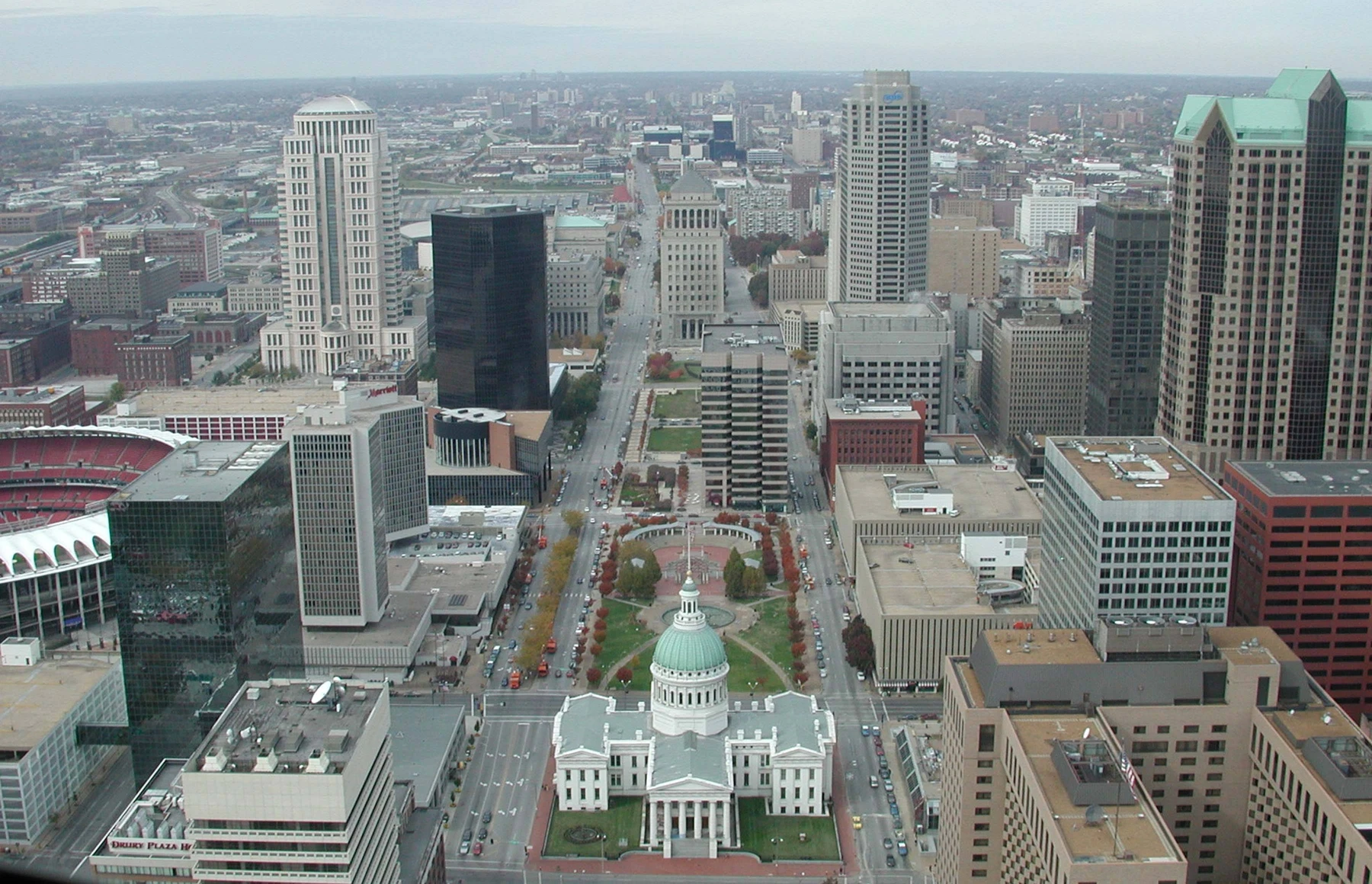
Before heading toward the Old Courthouse, they studied a photograph of it taken from the Arch. Their feet would stay on the ground; the image simply helped them see how the historic building fitted into the city.
Their grown-ups chose the public route and supervised the street crossing. There was time for a rest before the next part of their visit.
The children had learned how forces moved through a structure. Now they were preparing to learn how people had challenged laws and decisions that shaped their lives.
They put the engineering jokes aside for a while.
8. The courthouse stories need careful listening
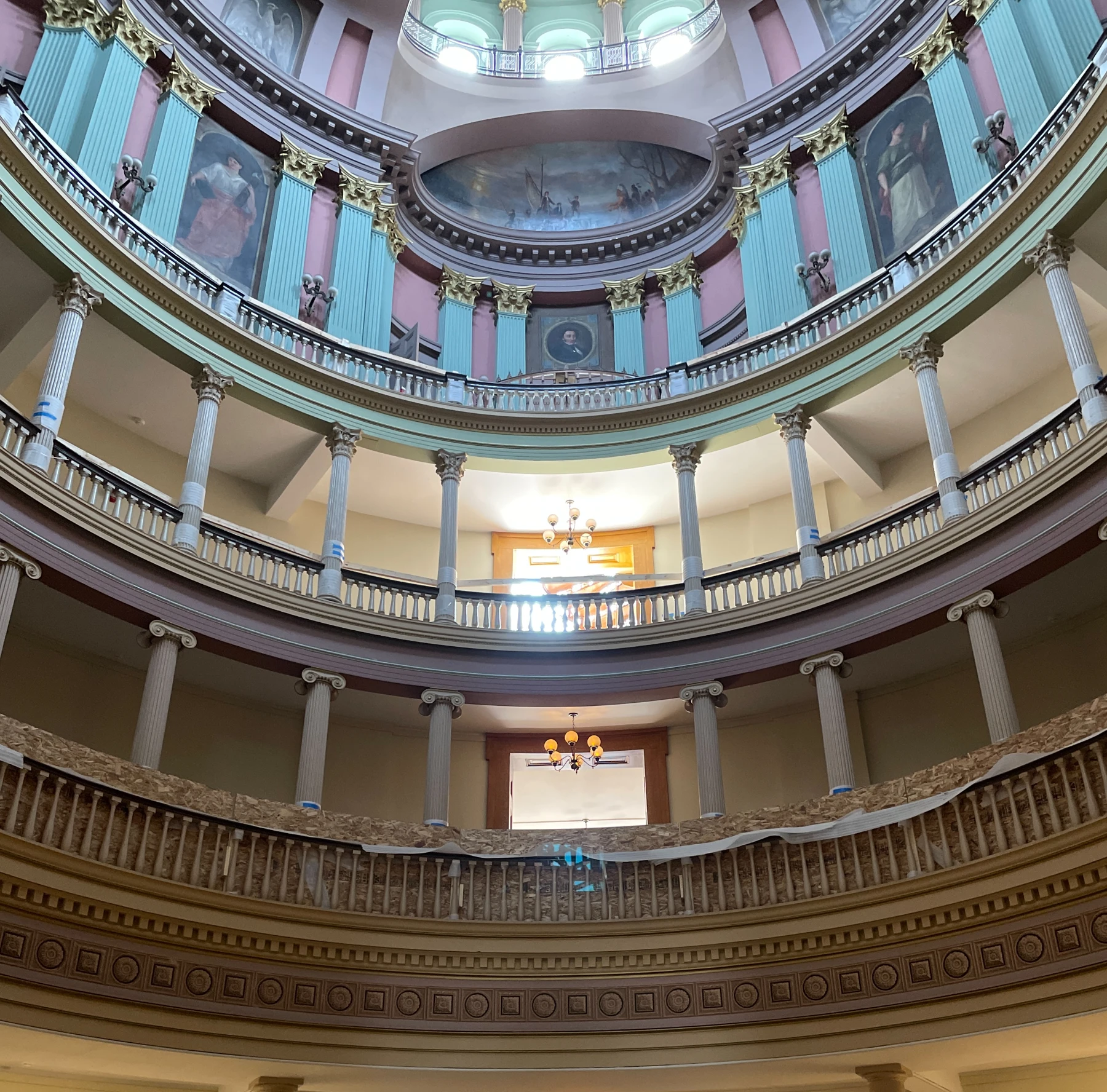
At the Old Courthouse, Allie lowered her voice.
The building's columns, dome, and broad interior spaces were impressive. But its importance was not only architectural. People had come here with questions about freedom and rights.
Their grown-up helped them learn about Dred and Harriet Scott, who filed legal suits seeking freedom from enslavement in 1846. Their family's case passed through years of proceedings, including local trials in this building.
Ana asked what enslavement meant. Their grown-up answered plainly: people were treated as property, forced to work, and denied freedom over their own lives.
“That was wrong,” she said.
“Yes,” their grown-up answered.
The Scotts' legal fight did not secure the freedom they sought. In 1857, the United States Supreme Court issued a profoundly unjust decision denying their claim and denying citizenship to Black people. The family did later become free through a separate action by people who legally held them in slavery; it was not a victory granted by that Supreme Court ruling.
Allie wrote both Dred's and Harriet's names. A case often remembered under one person's name had affected an entire family.
“We should not leave her out,” Ana said.
The children also learned about Virginia Minor. In 1872 she tried to register to vote in St. Louis and was refused because she was a woman. She challenged that exclusion through the courts, but her case did not win voting rights for women.
Their grown-up explained that change involved long struggles by many people. Neither case could be turned into a simple story where asking a court automatically made things fair.
Andy kept his notebook open without adding a joke.
“A building can look important,” he said, “and the decisions inside can still be wrong.”
“That's something worth remembering,” their grown-up replied.
Augie sat close and listened. He did not understand every date or legal step, but he understood that people should not own other people, and that the children were hearing about real families.
The group took time to talk, ask questions, and pause. A respectful visit did not require a young child to absorb everything at once.
Allie added one final note: Learn people's names. Listen carefully. Ask what happened next.
9. No bones does not mean no support
Later, the family returned to an open public viewing area on the grounds. Their grown-ups had left enough time and energy for the walk back.
The Arch rose above them again. This time, Andy's drawing looked rather different.
It still contained a very small, astonished child. But now it also showed a simplified foundation, arrows for forces, and a note about steel walls sharing the work.
Allie read their original question aloud.
What holds up the Gateway Arch?
“A carefully designed structure,” Ana said. “Its shape, steel walls, connections, and foundations work together.”
“With concrete in the lower wall sections,” Andy added. “And actual experts doing the calculations.”
“Not jellyfish,” Augie said.
They agreed that this had been a useful possibility to eliminate.
Their grown-up asked what else they had learned.
Allie thought of Saarinen's design and the many people who helped build it. Ana thought of the museum's different perspectives on expansion. Andy thought of Dred and Harriet Scott and Virginia Minor, whose stories deserved attention beyond the gleaming monument.
“We came with an engineering question,” he said. “We found history questions too.”
“Parks can hold more than one kind of discovery,” Allie replied.
Their next chapter would take them to New River Gorge National Park and Preserve. A river with the word new in its name would present a puzzle about age—and a great bridge would offer another opportunity to look at structure.
Andy made a cautious prediction.
“If it's called New River, we should probably check before buying it a birthday balloon.”
Ana smiled. Their next investigation was already beginning.
Before leaving, Augie took one last look at the Arch. Then he bent both knees.
“I still like my bones.”
“Keep them,” Andy advised. “Your steel replacement would be very hard to put in pajamas.”
The youngest explorer found this completely convincing.
He walked back with the family on his own ordinary, well-supported legs.
Explorer’s notebook
Nine discoveries to take home
- Gateway Arch National Park is in St. Louis, Missouri, beside the Mississippi River. A national park can protect a designed place and important history.
- The Arch is 630 feet tall and 630 feet across between the outside edges of its legs at ground level. Viewing angle changes how its proportions appear.
- Its steel walls are structural, not simply decoration covering a separate skeleton. Internal connectors and stiffeners still matter.
- Lower wall sections contain reinforced concrete between steel walls. The triangular cross-sections become smaller toward the top.
- Deep foundations transfer forces into the ground. Engineers considered the structure's own weight, wind, and other effects.
- The shape is commonly called an inverted weighted catenary. An ordinary hanging chain introduces an idea; it does not reproduce every feature of the Arch.
- Eero Saarinen designed the monument with engineering collaboration. Dick Bowser developed its unusual tram. Many skilled workers contributed to construction.
- Westward expansion was not movement into an empty land. Different communities experienced its opportunities, conflict, dispossession, and consequences differently.
- The Old Courthouse preserves important histories of freedom and voting-rights struggles, including those of Dred and Harriet Scott and Virginia Minor.
Five family adventures
- Follow the load on paper. Draw the Arch, the ground line, and simplified foundations below. Add arrows showing a possible route for weight toward the supports. Explain why the real engineers also needed to consider wind and connections. This is an illustration, not a structural calculation or construction plan.
- Meet a hanging curve. With an adult, hold the ends of a short, thick cord over a tabletop and let the middle hang freely. Sketch its curve, then turn the drawing upside down. The cord stays hanging: it will not support itself as an inverted arch. Explain why the real monument needs rigid materials, designed connections, and foundations. Keep cords away from necks and younger children's unsupervised play.
- Design for a constraint. Draw a pretend passenger capsule traveling along a curved route. How might its seat stay upright? Name two needs, such as room for people and a safe way to enter. No machinery-building or elevated rides are part of this paper activity.
- Ask whose story is missing. Choose a monument or historic place with a grown-up. Ask what it commemorates, whose experiences are included, and whose accounts you should seek next. Use age-appropriate primary accounts and reliable interpretation. Listen respectfully; a role-play of enslavement or discrimination is not needed.
- Plan a visit that fits your family. Compare the grounds, Museum at the Gateway Arch, Old Courthouse, and optional tram. Check official access, weather, security procedures, hours, and accessibility information. The tram's small capsules and stairs need separate consideration. Ground-level exploring is a complete choice. Keep children together, use appropriate crossings, and stay back from the river's edge.
Four questions for the road
- Why does “no separate skeleton” mean something different from “nothing inside helps support it”?
- What can a hanging cord help explain, and what can it not prove about a rigid arch?
- Why did the builders need to think about the unfinished monument as well as the completed one?
- How can a visit to one park involve engineering, the history of expansion, and struggles for freedom and rights?
Words for your explorer pocket
- Structure: connected parts arranged to carry loads and hold a form.
- Load: a force that a structure carries or resists.
- Foundation: the supporting part that transfers loads into the ground.
- Compression: a pushing or squeezing action.
- Tension: a pulling or stretching action.
- Catenary: the curve of a freely hanging uniform flexible chain under its own weight; the Arch uses a specialized related shape.
- Weld: a joint made by joining metal through a welding process.
- Commemorate: to mark or remember a person, event, or part of history.