1. The floor is growing teeth
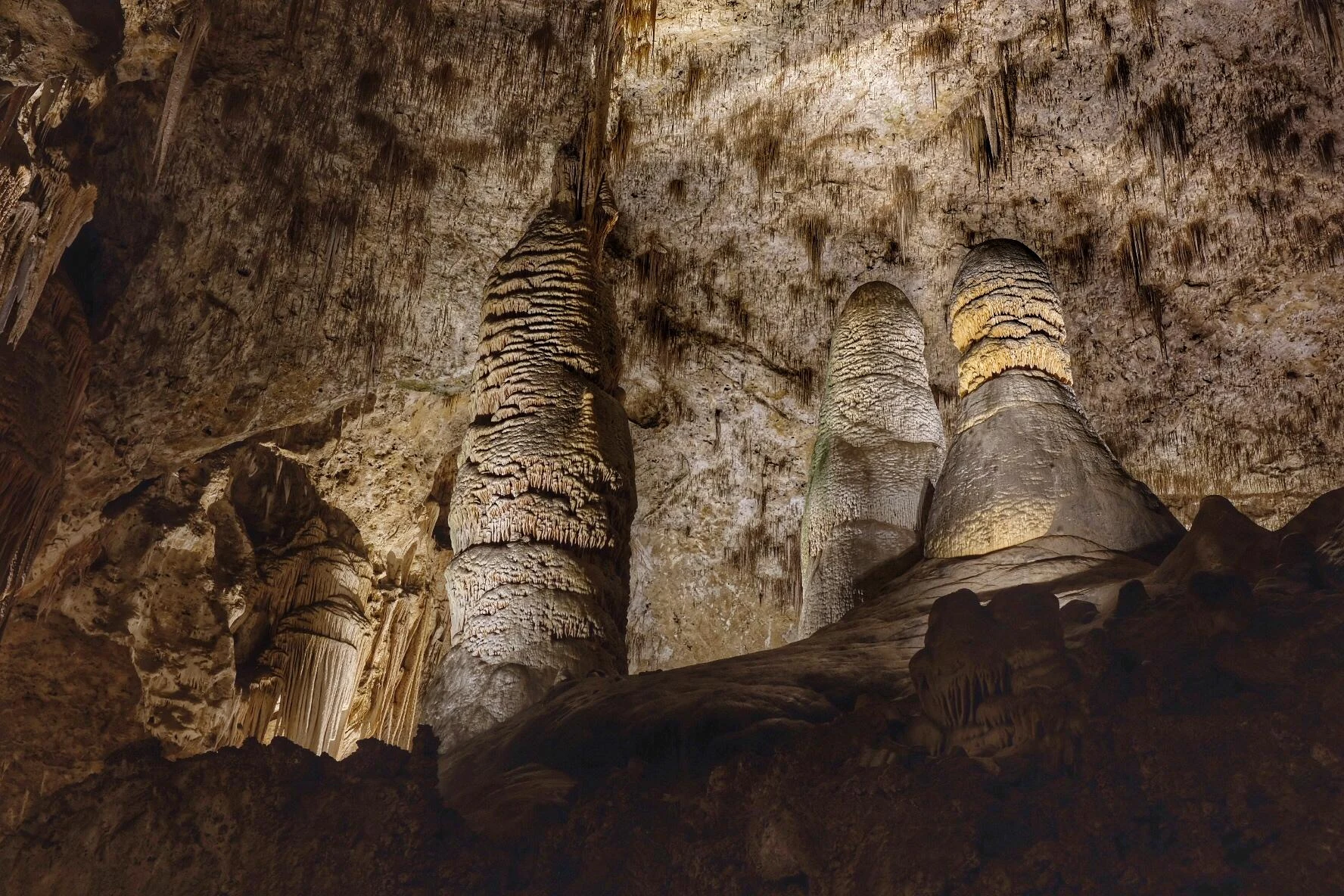
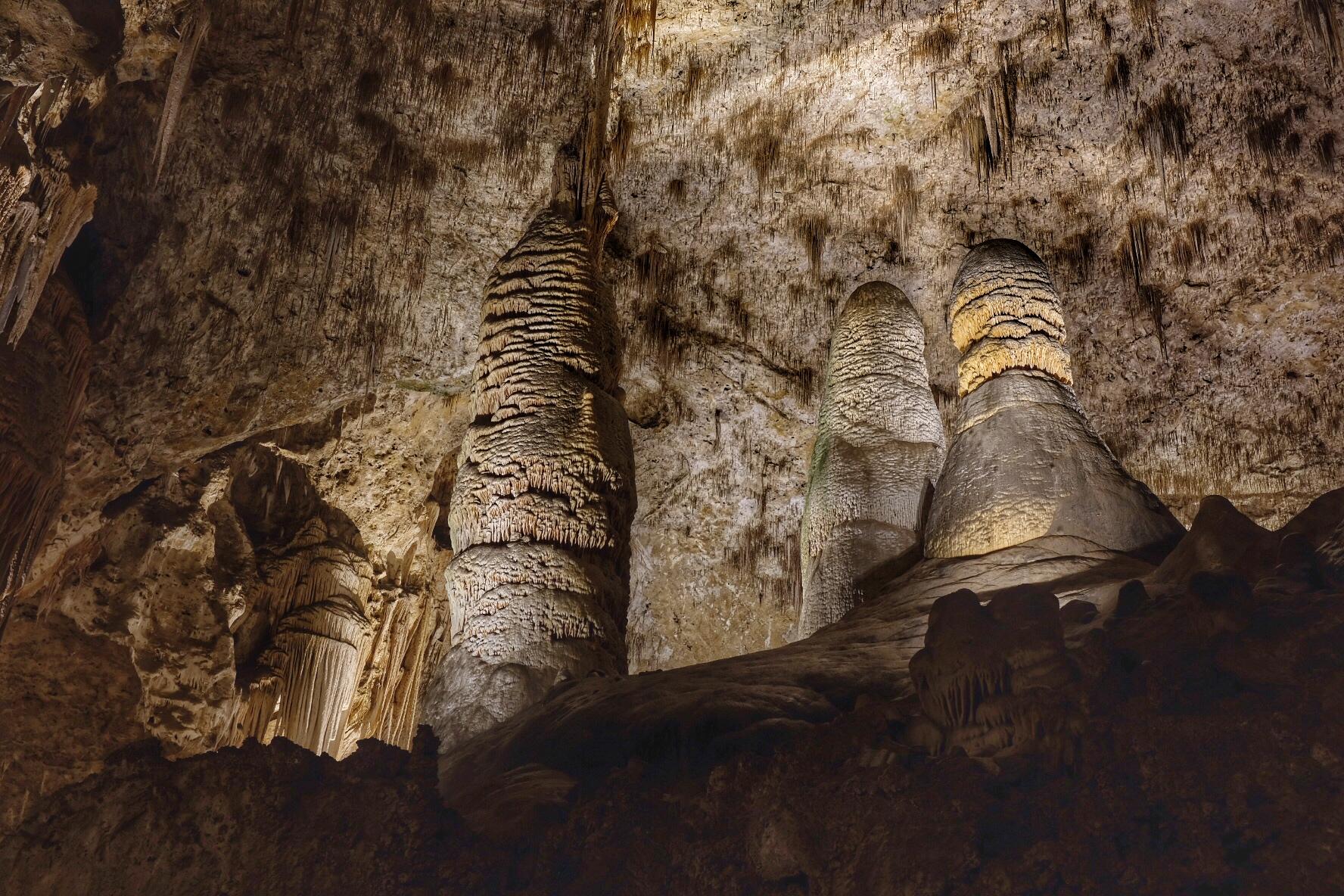
Augie recognized the cave photograph immediately.
“Floor teeth.”
Andy examined the great rounded formations rising from the ground.
“Those are going to need an enormous toothbrush.”
After Sequoia’s tiny seed and giant tree, the children had come to Carlsbad Caverns National Park in southeastern New Mexico. Aboveground lay a desert of rocky slopes and hardy plants. Below it waited a very different landscape.
Ana opened the notebook to the words they had written in the forest: THE CAVE THAT BUILDS UPWARD.
“Does the whole cave grow up?” she asked.
“Good question,” Allie said. “Or are we looking at things growing inside it?”
Augie pointed at one of the domes in the photograph.
“Needs room for its head.”
Their grown-ups had planned around current park guidance, entry requirements, route demands, and the family’s needs. Photographs and exhibits would help them investigate features beyond the particular route they chose.
Andy drew a giant tree next to a tall cave formation.
“Both grow up. Both are too big for my first page.”
“But a stalagmite isn’t alive like a tree,” Allie said.
Ana made two questions instead of one: HOW DID THE ROOM FORM? HOW DID THE FORMATIONS FORM?
“That sounds like the same question twice,” Andy said.
“Let’s see.”
The illuminated cavern photograph showed domes, hanging points, shadows, and stone that seemed to flow like frozen fabric. Yet this was not a hidden forest, an ice palace, or a room built by people.
Augie drew a small construction worker, then crossed it out.
“Water again?”
“Yes,” said Allie. “But with a surprising earlier chapter.”
2. A reef in the desert
Andy did not expect their first clue to involve an ocean.
“We just did the ocean-before-Kentucky case.”
“Different place, different ancient sea,” Ana said.
Long before the modern Guadalupe Mountains and desert, a shallow sea occupied this region. Along its margin, living organisms and sediments helped build the Capitan Reef. This ancient reef was made largely by organisms such as sponges and algae rather than the reef-building corals people often picture today.
Augie added a sponge to his drawing.
“For washing dishes?”
“A living sponge,” Allie explained. “Not one from our kitchen.”
The reef deposits became part of the limestone in which the caverns later formed. Burial, uplift, and erosion transformed the landscape over immense spans of time.
Ana drew three separate pages: ancient sea, rock, and much later cave.
“We should keep the ages separate. Old rock doesn’t mean every opening inside it is the same age.”
Andy remembered Mammoth Cave.
“The rooms arrive after the building material.”
“Exactly.”
The desert outside was not evidence that water had never been important here. Nor did a fossil reef mean the ocean was waiting behind the next cavern wall.
Augie drew a fish looking at a desert plant.
“Wrong time.”
The kids did not collect fossils or scratch rock to identify it. Official photographs and exhibits could reveal the ancient sea without removing a piece of the story.
Allie put LIMESTONE in the first box of their investigation.
Andy added a tiny receipt.
“Building material delivered a very long time ago.”
“Keep the receipt,” Ana said. “We still need to find out who made the empty space.”
3. The acid clue comes from below
At Mammoth Cave, they had learned how rainwater picked up carbon dioxide and dissolved limestone. Andy was ready to reuse the whole explanation.
“Rainwater contractor. Same company. New branch.”
Allie held up a finger.
“Similar material. Different important chemistry.”
Carlsbad Cavern’s great spaces formed through an unusual process involving sulfuric acid. Hydrogen-sulfide-rich water moved through the rock from below. Where sulfur compounds met oxygen in the underground environment, chemical reactions produced acid that dissolved limestone.
Ana drew arrows meeting inside the rock.
“The chemical ingredients came together underground.”
“Over long periods,” Allie said. “Not someone pouring a bottle into the entrance.”
Augie removed a bottle from his drawing.
“Not a science trick.”
Minerals such as gypsum left evidence of that earlier dissolution. Scientists studied the rock and mineral clues to understand a process nobody could simply watch happening millions of years ago.
As groundwater levels changed relative to the rock, different passages developed and were left above the active water zone. Later changes, including rock falling from ceilings, also affected the rooms.
Andy looked at their two questions.
“So the empty room was made by taking material away.”
“Yes. Dissolution,” Ana said.
“That does not sound like building upward.”
“Which means we haven’t answered the second question yet.”
The children did not imagine that today’s visitor route was full of the ancient cave-making acid. They were reconstructing an earlier stage from evidence, with a simplified drawing rather than a complete underground history.
Allie wrote CREATING THE SPACE beneath the arrows.
Augie gave the raindrop a new question mark.
“What comes after?”
4. The drip delivers a tiny parcel
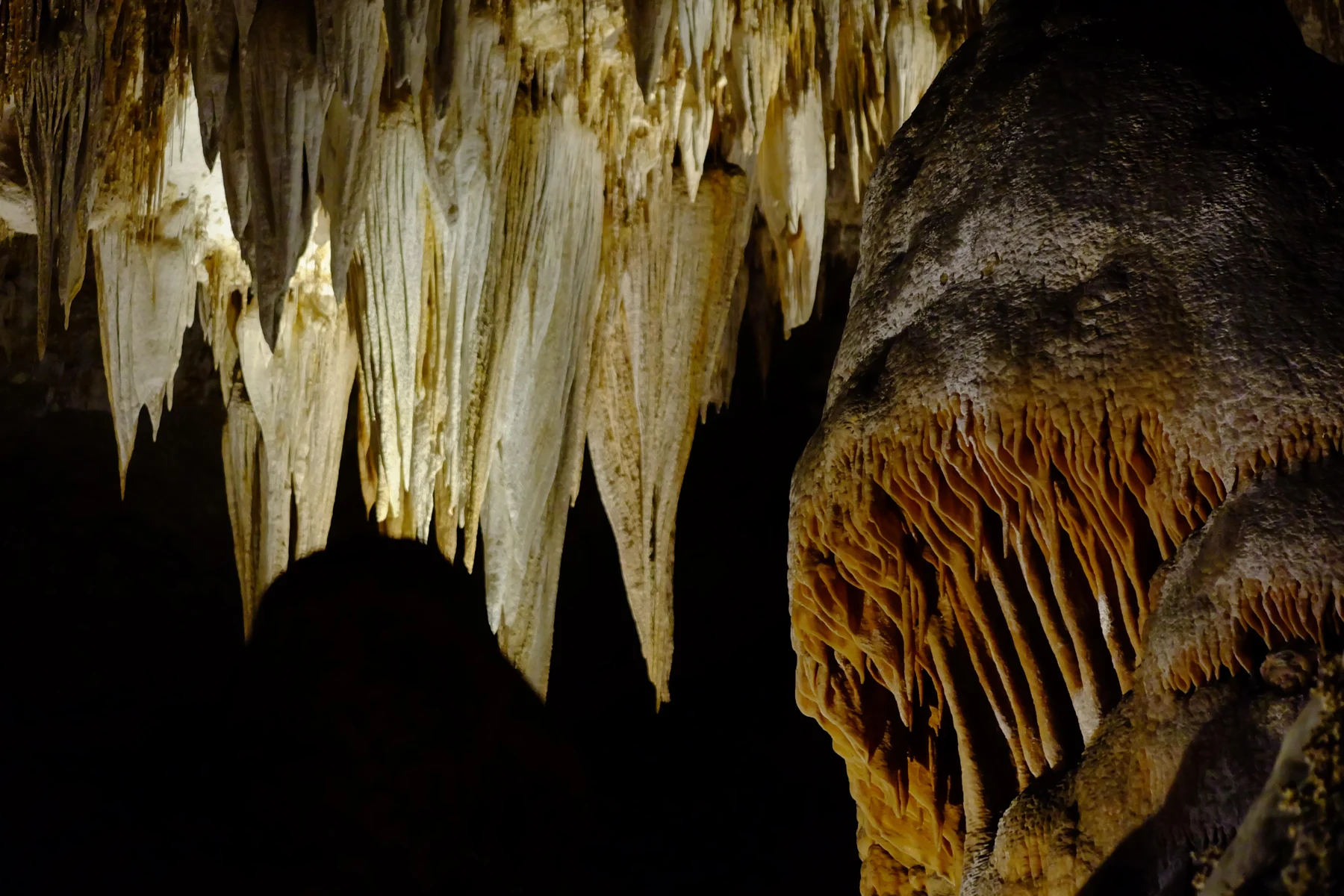

The next photograph showed mineral forms hanging from above and rising from below. Their labels included the Chandelier and Caveman formations in the Big Room.
Andy leaned closer.
“The decorating crew has arrived.”
Rain and snowmelt could seep through soil and limestone above an air-filled cave. Water carrying carbon dioxide could dissolve a little calcium carbonate along the way. Once it entered the cavern, losing carbon dioxide to the cave air could cause calcite to deposit.
Ana drew a drop with a tiny parcel.
“Dissolved material arrives. Some becomes solid here.”
“Many small deliveries over time,” Allie said.
Mineral-rich water dripping onto a cave floor could build a stalagmite upward. Deposits on the ceiling could form a stalactite hanging down. If the two eventually joined, they could form a column.
Augie pointed at the floor shape.
“Not a tree.”
“No roots, no leaves, no photosynthesis,” Ana agreed.
“Extremely poor shade,” Andy added.
The upward-building part of their title was becoming clear. The formations grew by adding mineral layers inside an existing space. That did not mean the cavern itself was growing like a plant or that all its features pointed upward.
Allie drew one down arrow and one up arrow.
“Where the water goes and how it deposits material help shape the result.”
Andy compared the two notebook boxes again. First, rock dissolved to make space. Later, other water deposited minerals inside that space.
“Removal crew. Delivery crew.”
“A useful comparison,” Ana said. “Not two crews with matching lunchboxes.”
Augie added matching lunchboxes anyway, then labeled them IMAGINARY with help.
5. A stone curtain does not need a window
The children’s list of shapes kept growing.
Points. Mounds. Sheets. Curtains. Little knobs.
“Underground furniture store,” Andy whispered.
Allie introduced a long word: speleothem. It meant a cave feature formed by mineral deposition. The name did not describe just one shape.
Water spreading over a surface could leave flowstone. Water following an edge could produce drapery-like shapes. Tiny nodules were sometimes nicknamed cave popcorn.
Augie brightened.
“Popcorn?”
“Rock,” everyone said together.
The formations’ shapes reflected water pathways, chemistry, air, and time. Not every room had the same conditions, and not every formation was actively growing. A dry-looking feature could record a wetter past.
Ana drew a curtain with a question mark beside it.
“We can recognize a resemblance without pretending it’s actual cloth.”
Andy added a price label, then removed it.
“Not for sale.”
The children kept hands away from walls and formations. Mineral features could be damaged by touching or breaking, and a photograph could be their souvenir instead.
“Can a tiny touch matter?” Augie asked.
“All our visits add up,” Mom said. “And the formations’ histories are much longer than our afternoon.”
Ana wrote a new rule under the shape list: ADMIRE THE DETAILS WITHOUT CHANGING THEM.
The cavern’s lighting helped visitors see texture and depth. It also shaped the photograph’s colors and shadows. The children would not treat every bright patch as a different mineral or assume that a dark patch was an empty hole.
Andy looked at the Chandelier picture again.
“I am pleased nobody has asked me to change that lightbulb.”
6. The night shift leaves for dinner
A bat display gave Augie a completely different kind of cave resident.
“Flying teeth?”
“Mammals,” Allie said. “With fur and wings.”
The park’s well-known seasonal colony included Brazilian free-tailed bats. They roosted in the cavern and flew outside to feed on insects. The bats connected the underground shelter with the wider landscape.
Andy drew a restaurant outside the entrance.
“Dinner is flying.”
Many insect-eating bats used echolocation: sending out sounds and listening to returning echoes to locate objects and prey. That did not mean they were blind or that visitors should make noise to test their navigation.
Ana drew sound waves returning from an insect.
“Information from echoes. Not a flashlight in the nose.”
Augie crossed a lamp off his bat drawing.
The family learned about the park’s bat-flight program, while their grown-ups checked whether the season, timing, and conditions suited a visit. Bat activity varied. A photograph or video could explain the behavior even if they did not see an outflight themselves.
Not every bat species in the park used the same roost. Some used trees or rock crevices. The children would not expect every dark room to contain bats, nor every bat to behave identically.
Allie added a line from the cave to the surface in their connection map.
“An underground home can depend on food outside.”
“And protecting bats includes respecting their space,” Ana said.
They followed the park’s current wildlife, bat-flight, and cave-protection instructions. Nobody tried to handle a bat, enter its roost, or get an attention-grabbing photograph.
Andy closed the imaginary restaurant.
“The insects may have mixed feelings about this menu.”
7. Who knew the doorway first?
In the history material, the children found a familiar name: Jim White, associated with exploring and publicizing the cavern.
“Was he the first person who knew about it?” Andy asked.
“Let’s read carefully,” Ana said.
Indigenous people knew the area long before modern tourism. Evidence near the entrance and elsewhere in the region told a longer human story. Mescalero Apache connections were part of the Guadalupe Mountains’ cultural landscape.
Allie left space between several notes.
“A famous explorer’s story doesn’t erase everyone who came before.”
Park history described earlier knowledge of the cavern as well as later exploration. Some accounts and details were uncertain or incomplete. The children could name what was known without filling the gaps with an invented adventure.
Augie drew a doorway with several footprints approaching it.
“More people.”
“Different times,” Ana added.
They also considered the changing ways people had used caves: as meaningful places, sources of materials, scientific subjects, and visitor destinations. Industrial exploitation and tourism left marks too.
“Learning about a place and taking everything from it are different choices,” Allie said.
The family looked for attributed accounts and Native voices rather than treating people’s histories as decoration around the geology. They did not trace rock art, collect objects, or turn cultural sites into a treasure hunt.
Andy wrote WHOSE STORY? beside his first note about Jim White.
“That question needs to stay on the page.”
Mom nodded.
“Good explorers notice both the story they’re hearing and what it might leave out.”
Augie added an ear beside the doorway.
“Listening entrance.”
8. The trail is not the whole cavern
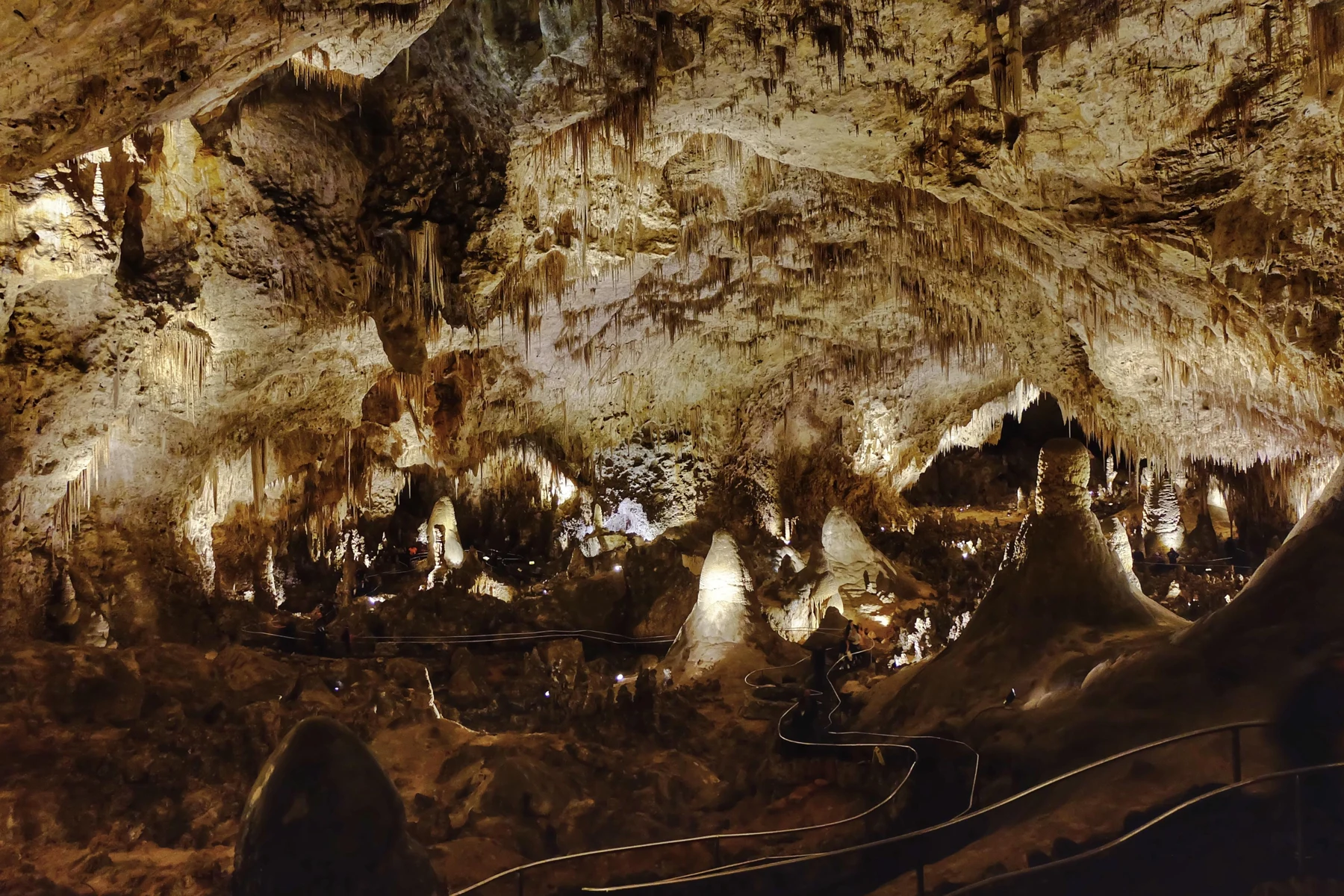

A photograph of the Big Room showed a designated trail winding between formations.
Andy traced it in the air.
“Someone thoughtfully installed a line for my feet.”
“The route helps people visit while protecting the place,” Allie said.
Their grown-ups had compared available options, accessibility, distances, slopes, and other demands before choosing the family’s visit. A large room on a photograph did not make every route easy. An entrance trail, an elevator, and a visitor path were different parts of planning, each subject to current access information.
Ana looked at the map.
“A short line can still include a steep part.”
“And a very large room can still have a very specific path,” Andy replied.
The kids stayed on their permitted route and followed instructions. They did not climb toward a formation, step around a railing, or investigate an unmarked opening.
Augie kept his imaginary worker beside the path.
“Not going in there.”
Photography let them study places beyond their route, but an image’s light and perspective could make size difficult to judge. They would not estimate a safe step or a reachable ledge from a picture.
Allie returned to their two questions. The whole cavern was not a single object that grew upward. A system of spaces had formed through dissolution and other changes; mineral deposits later took many shapes within it.
Andy drew a tiny upward arrow on one stalagmite and a much larger outline around the room.
“Part of the answer. Not the whole answer.”
Ana smiled.
“That might be our best drawing yet.”
Augie looked at the tall dome again.
“Still floor teeth.”
“A very memorable description,” Allie admitted.
9. The desert is upstairs
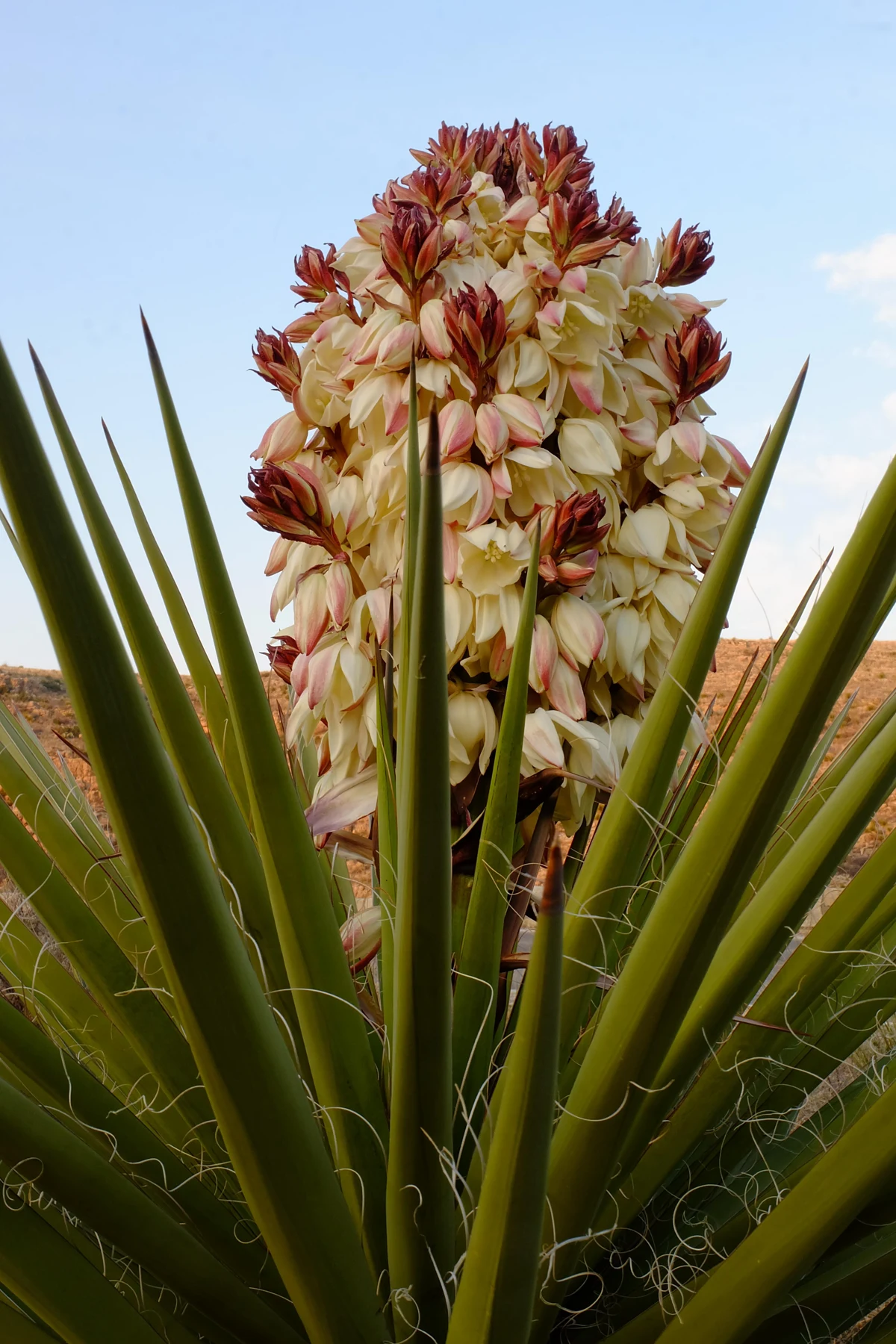

Back in their surface investigation, a photograph of a flowering yucca replaced the cavern pictures.
Augie pointed at the pale blossoms.
“Those are alive.”
“Yes,” Allie said. “And they have a different way of growing.”
The Chihuahuan Desert above the caverns was not an empty lid. Rocky canyons, plants, wildlife, and changing weather belonged to the same park. The family could choose suitable surface learning as well as an underground visit.
Ana drew sunlight above her yucca and darkness around a stalagmite.
“One grows as a living plant. One builds as minerals are deposited.”
“And the cave room was made by removing rock,” Andy said.
The two original questions finally had separate answers. Sulfuric-acid chemistry had played a major role in making the cavern’s spaces. Later seepage and mineral deposition had built many of its decorations, including stalagmites rising from the floor.
Augie crossed out his enormous toothbrush.
“No brushing.”
Their notebook now held an ancient reef, underground chemistry, dripping water, bats, desert plants, and human histories. The place beneath the ground made more sense when the children remembered the world above it.
Andy compared their last three chapters. A cave could form in limestone. A tree could grow from a seed. A mineral formation could build inside an older cave.
“Up is a direction,” he said. “It isn’t a single recipe.”
Next they would travel north in their book journey to Denali National Park, where a mountain could change the weather around it.
Augie drew a cloud with a very large hat.
“Does the mountain order snow?”
Ana wrote THE MOUNTAIN THAT MAKES WEATHER.
Allie shut the notebook carefully.
“Another question with more than one layer.”
Andy put away the yucca photograph.
“I’m packing a larger page.”
Explorer’s notebook
Nine discoveries to keep
- Carlsbad Caverns lies beneath a Chihuahuan Desert landscape in New Mexico.
- The limestone records an ancient reef, long before the modern caverns.
- Sulfuric-acid processes played a major role in dissolving the cavern’s spaces.
- Making a cave room and building formations inside it are different processes.
- Seeping water can lose carbon dioxide and deposit calcite in an air-filled cave.
- Stalagmites build upward; stalactites hang down; other deposits form sheets and varied shapes.
- Mineral formations grow by deposition, not like living trees.
- Seasonal bats connect an underground roost with insect prey outside.
- The region’s human history predates modern cave tourism and includes continuing Indigenous connections.
Five ways to explore
- Draw two diagrams: removing rock to make space, and adding mineral deposits inside the space.
- Find upward, downward, and sheet-like formations in official photographs.
- Compare a yucca, a giant sequoia, and a stalagmite. Which are living, and how does each increase in size?
- Choose suitable surface or cavern activities using current park information and family needs.
- Make a connection map linking desert, rainfall, rock, cave air, bats, and insects.
Talk it through
- Why isn’t “the cave grows upward” a complete explanation?
- How does Carlsbad’s cave-making story differ from Mammoth Cave’s?
- What can a famous explorer’s story leave out?
Words for your backpack
Reef: a structure built by communities of marine organisms and associated material.
Dissolution: a solid becoming dissolved material in a liquid.
Deposition: material being laid down or accumulated.
Calcite: a calcium carbonate mineral common in cave formations.
Speleothem: a cave feature formed by mineral deposition.
Echolocation: locating objects by sending sounds and detecting returning echoes.