1. The mountain has gone missing
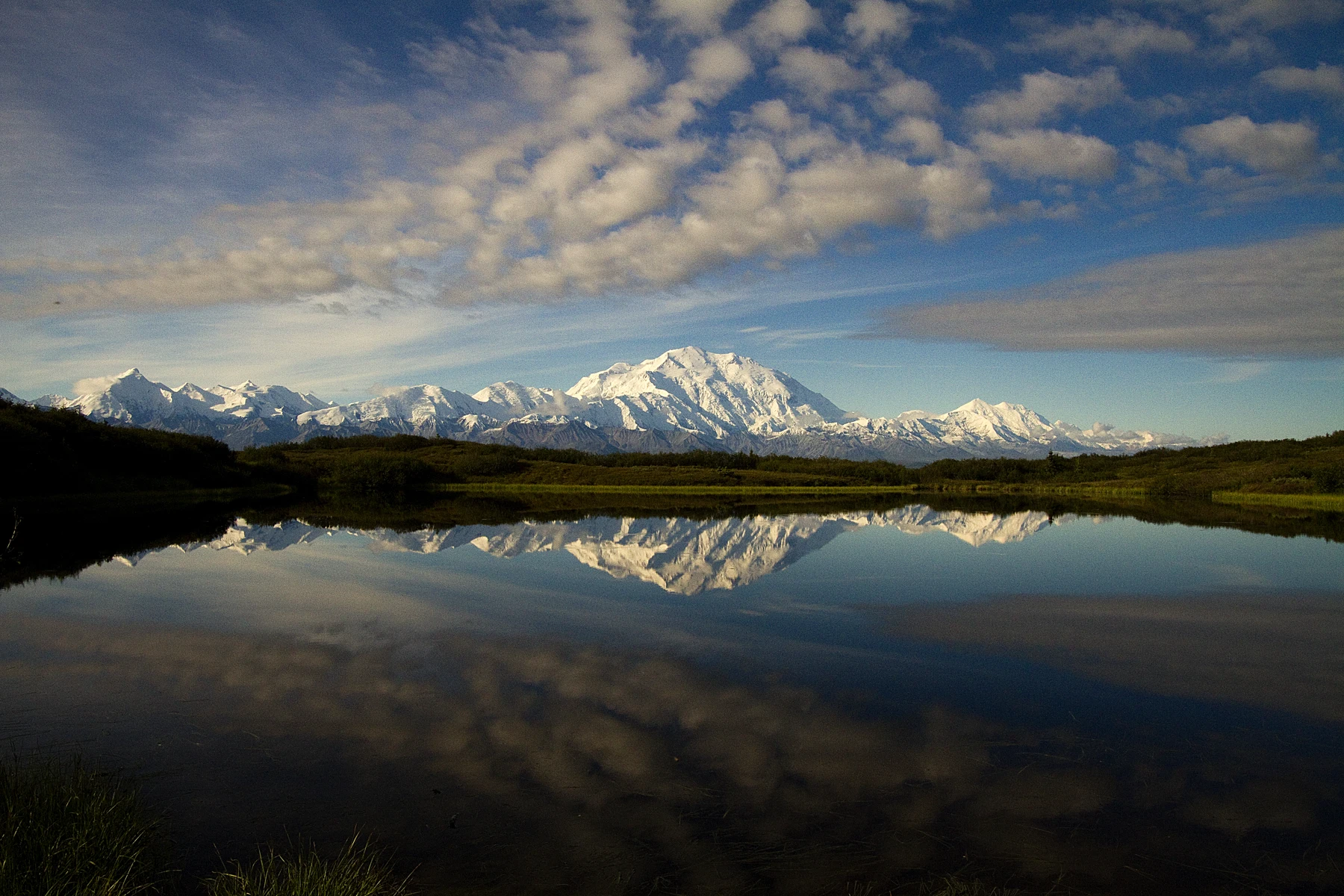
Augie pressed his nose toward the visitor-center window. Beyond the trees lay a pale, cloudy sky.
“Someone forgot the mountain.”
“It’s behind the clouds,” said Allie.
“Then someone forgot the mountain’s curtains.”
Their parents were checking the day’s conditions with a ranger. The four explorers had reached Denali National Park and Preserve in Alaska, a very different world from the desert above Carlsbad Caverns. Here, spruce trees pointed into the cool air, and distant slopes disappeared into gray.
Ana found a photograph showing an enormous snowy peak reflected in water. She looked from the photograph to the window and back again.
“The mountain is quite good at being somewhere we can’t see.”
Andy studied the park map. “Maybe it makes clouds to hide behind.”
That sounded like a first-class mystery. Allie opened their notebook and wrote: Can a mountain make weather?
Below it, Ana added a second question: If we don’t see the summit, can we still discover Denali?
“I can see my summit,” Augie announced, patting his head.
“Good,” said Andy. “We’ll use you as a landmark.”
The photograph offered one important clue: a huge mountain occupies space that moving air would otherwise pass through. But the clouds outside did not explain themselves. The children would need more than a beautiful view—or a missing one—to solve this case.
Allie divided a clean page into three columns: What we notice. What we think. What we can check.
Andy considered this arrangement. “Where does ‘the mountain is shy’ go?”
“The middle column,” said Ana. “In very light pencil.”
2. A name older than the sign
Before investigating clouds, they investigated the map’s names.
“Denali comes from a Koyukon name connected with being high or tall,” Allie read from the park’s history information. “People often explain it as ‘the tall one.’”
Augie stood on tiptoe. “That could be me.”
“The mountain has a considerable head start,” Ana said.
The children learned that different Alaska Native peoples have their own names for this immense landmark. One familiar name could not stand in for every language or community.
The Denali region is homeland to Ahtna, Dena’ina, Koyukon, Upper Kuskokwim, and Tanana peoples. Their connections with these lands began long before the national park and continue today.
Andy looked at the empty spaces between the printed roads. “So a map without lots of lines doesn’t mean a place without people or history.”
“Exactly,” Allie said. “It tells us what that particular map chose to show.”
They also noticed the mountain labeled Mount McKinley in current federal park information. The park was still Denali National Park and Preserve. A mountain’s federal name, its traditional names, and the name of the surrounding park were different pieces of the story.
“One mountain, more homework,” Andy said.
“More people to listen to,” Ana replied.
They kept Denali in their adventure notebook, alongside a reminder to read the park’s naming history rather than assume the newest sign told the whole story.
Then Augie drew a tall triangle beside his own name.
“Is that you?” asked Allie.
“Me, with a mountain hat.”
3. Air takes the stairs
Back at their table, Ana made a ridge with her hand. Andy moved his other hand toward it to represent wind.
“The air hits the mountain. Bonk.”
“Some air can flow around terrain,” said Allie. “But air can also be pushed upward over it. Let’s follow that part.”
Andy guided his hand up Ana’s imaginary slope. Higher in the atmosphere, pressure is lower. Rising air expands, and that expansion cools it.
“Like climbing invisible stairs,” Ana said.
“Stairs with no handrail,” said Augie.
Allie explained the next step carefully. Air can contain water vapor, an invisible gas. If moist air rises and cools enough, some vapor can condense into tiny droplets or form ice crystals, making a cloud. Under suitable conditions, cloud particles grow into precipitation: rain or snow.
“So clouds aren’t made of invisible gas?” Andy asked.
“The part we see is tiny liquid droplets, ice crystals, or both.”
Ana drew arrows rising over a mountain, then a cloud. “The mountain changes the air’s journey. The cooling can help make a cloud.”
“Orographic lifting,” Allie read. “That’s the scientific name for air being lifted by hills or mountains.”
Andy repeated it slowly. “O-ro-graphic. That sounds like a dinosaur who forecasts rain.”
Augie supplied the dinosaur’s announcement: “ROAR. Bring coat.”
They laughed, but Allie added a useful correction to their sketch. A mountain did not create water from nothing, and rising air did not always produce rain. Moisture, temperature, wind, and the wider weather pattern all mattered.
The children had found a mechanism, not a magic weather button.
“And we haven’t proved exactly how those clouds outside formed,” Ana said. “We’d need weather observations for that.”
Andy erased SHY from their theory column. He left the dinosaur in the margin.
4. The shadow that isn't dark
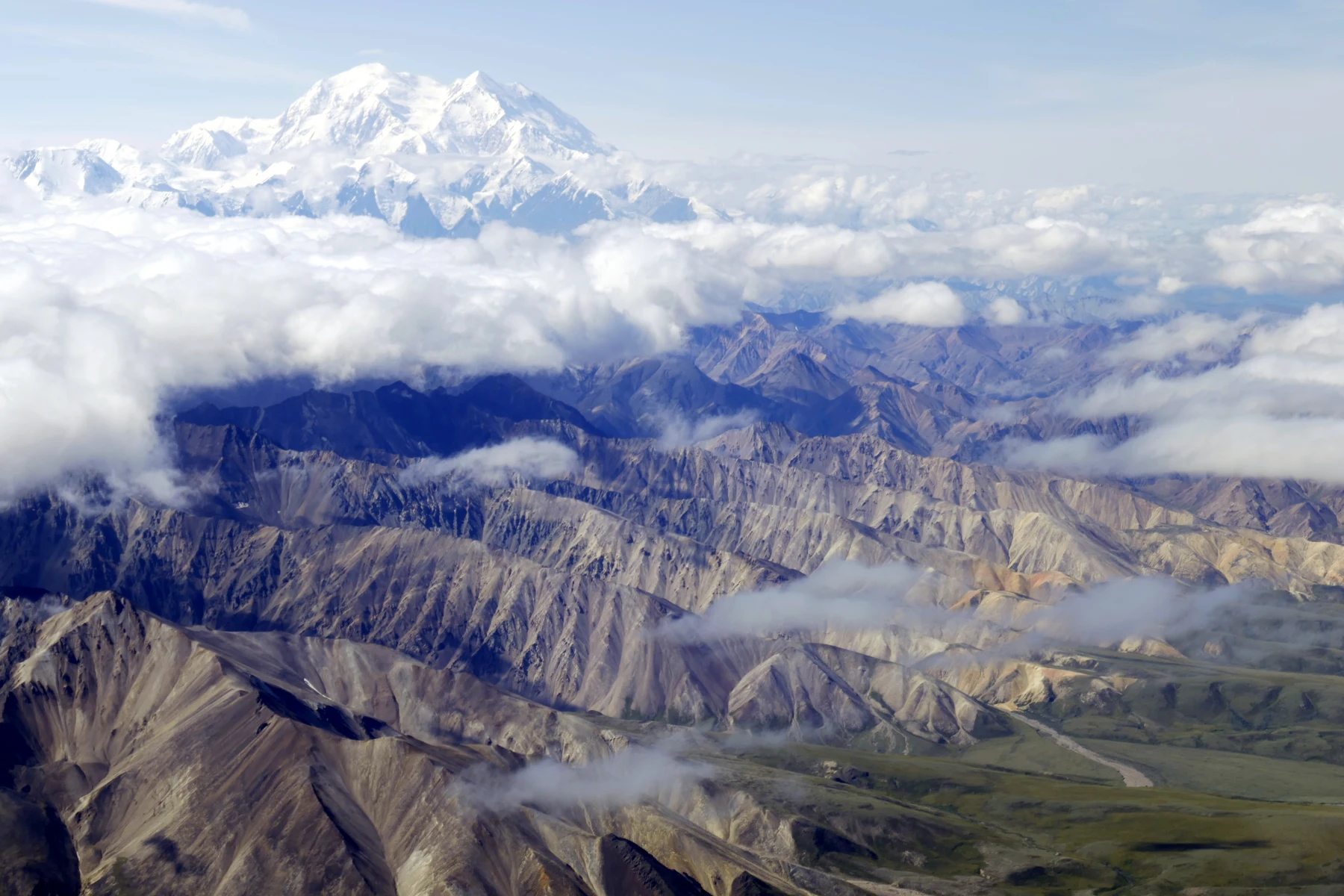
The Alaska Range divided more than the view. Park information described a generally wetter, ocean-influenced climate to its south and a drier interior climate to its north.
“The Gulf of Alaska is on this side,” Ana said, tracing their map. “Moist air can come from that direction.”
When that air crosses the mountain barrier, lifting and cooling can encourage rain or snow. After moisture has fallen, air descending on the other side can warm, making clouds less likely to persist. This helps produce a rain shadow.
Augie checked beneath the table. “No shadow rain.”
“It isn’t a dark patch like a tree’s shadow,” Andy explained. “It means the mountains help make one side drier.”
“And drier doesn’t mean never wet,” Allie added.
Ana drew a raindrop wearing a very small raincoat on the northern side. “This raindrop would like to confirm that.”
One weather event was only a snapshot. Climate described patterns over many years. A rainy afternoon north of the range would not cancel the larger pattern, just as one warm afternoon would not turn Alaska into a tropical island.
“Even if I bring a pineapple?” Andy asked.
“Especially then. You would have one pineapple and the same climate.”
Their mother returned with the day’s plan. The family would explore near the entrance and use exhibits and photographs to investigate distant places. They would not chase a clear summit view along a closed road or into unsafe terrain.
Outside, a bright patch opened between clouds.
“The mountain has opened one curtain,” Augie reported.
The summit remained hidden. Their mystery, however, was becoming much clearer.
5. The river with rock-flour milk
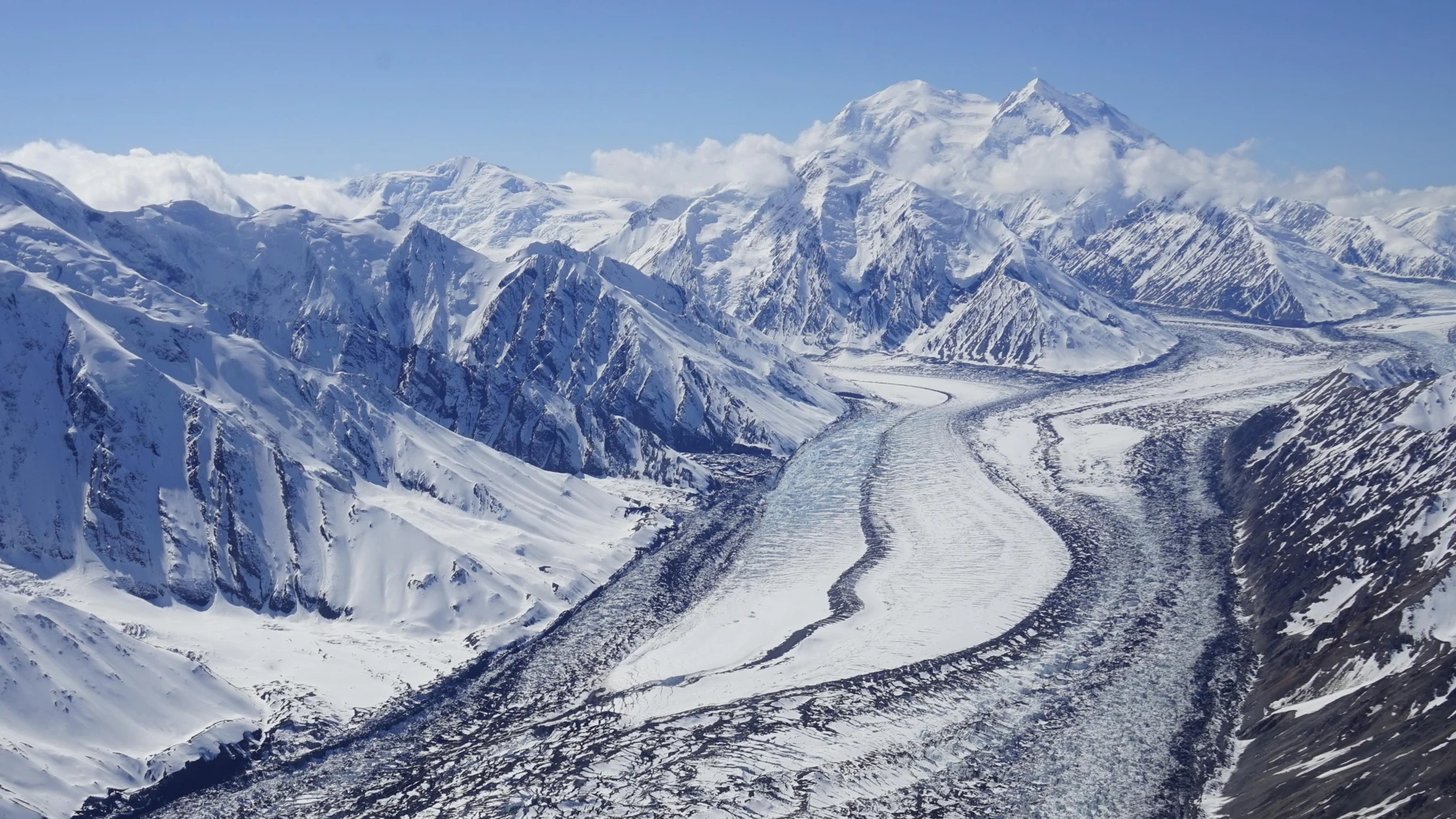
A glacier photograph brought the next puzzle. White ice streamed between mountain walls, marked with darker bands.
“Is that a frozen road?” Andy asked.
“A moving body of ice,” Allie said. “A glacier.”
Where snowfall builds up over time faster than it disappears, buried snow can be compressed into glacier ice. Gravity helps that ice flow. It can bend and deform slowly, and some glaciers also slide over the ground beneath them.
Augie pictured a slippery ice pancake. “Does it say wheeee?”
“Very, very slowly,” said Ana.
The children remembered glaciers shaping Yosemite and Grand Teton. Here was the same sort of tool operating in Alaska. Rocks carried in the ice could scrape bedrock; moving glaciers could also pull away chunks. Deep valleys and scattered debris recorded work done over long periods.
Andy pointed to a picture of cloudy meltwater. “That river needs a bath.”
The cloudiness could come from fine sediment ground by glaciers. People called that powder rock flour, and the milky-looking water glacial milk.
“Neither belongs in a cake,” Allie said before Augie could ask.
“I was going to ask for a biscuit.”
Ana drew a deliberately crossed-out recipe: ice, grinding, rock flour—no cookies.
Mountain weather helped deliver snow to the high country. Glaciers moved some of that stored water through the landscape as ice, and melting released water and sediment downstream. The weather mystery had become a land-shaping mystery too.
They admired it from photographs. Walking onto an unfamiliar glacier or stepping into a fast, cold river was not part of their experiment.
“Good,” Andy said. “My boots are explorers. They are not boats.”
6. A forest that runs out of height
On their short walk with their parents, the children noticed spruce trees, shrubs, and small plants beneath them. Their grown-ups had chosen a suitable open trail after checking current conditions.
“Taiga,” Allie said, remembering the park introduction. “Another name for boreal forest.”
“I thought you said tiger,” said Augie. He moved closer to their mother.
“Forest,” Ana reassured him. “No tiger in the vocabulary lesson.”
At higher elevations, photographs showed open alpine tundra instead of tall forest. Cold, wind, a short growing season, and local ground conditions helped shape where trees could thrive. A line on a diagram made the change seem tidy; the real landscape was more patchwork than ruler-straight.
Andy crouched beside the path without touching the plants. “Small doesn’t mean there’s nothing here.”
Exactly. Low vegetation provided food and shelter. A landscape without tall trees could still be full of life.
Back indoors, a display introduced another hidden feature: permafrost, ground that stays frozen for at least two consecutive years. It was not a blanket of surface snow, and it was not everywhere.
“Underground freezer?” Augie suggested.
“A useful comparison, if we remember it has no plug,” said Ana.
Thawing ground could alter water drainage and the stability of land above it. Scientists monitored these changes as the climate warmed. Roads and buildings could be affected too.
Allie drew a glacier flowing over land and permafrost within the ground. “Two kinds of frozen clues. Different places, different behavior.”
“I shall label my ice cream separately,” Andy said.
They returned the pencils to their bag. Nothing from beside the trail needed to come home to prove they had learned something.
7. The sheep has better shoes
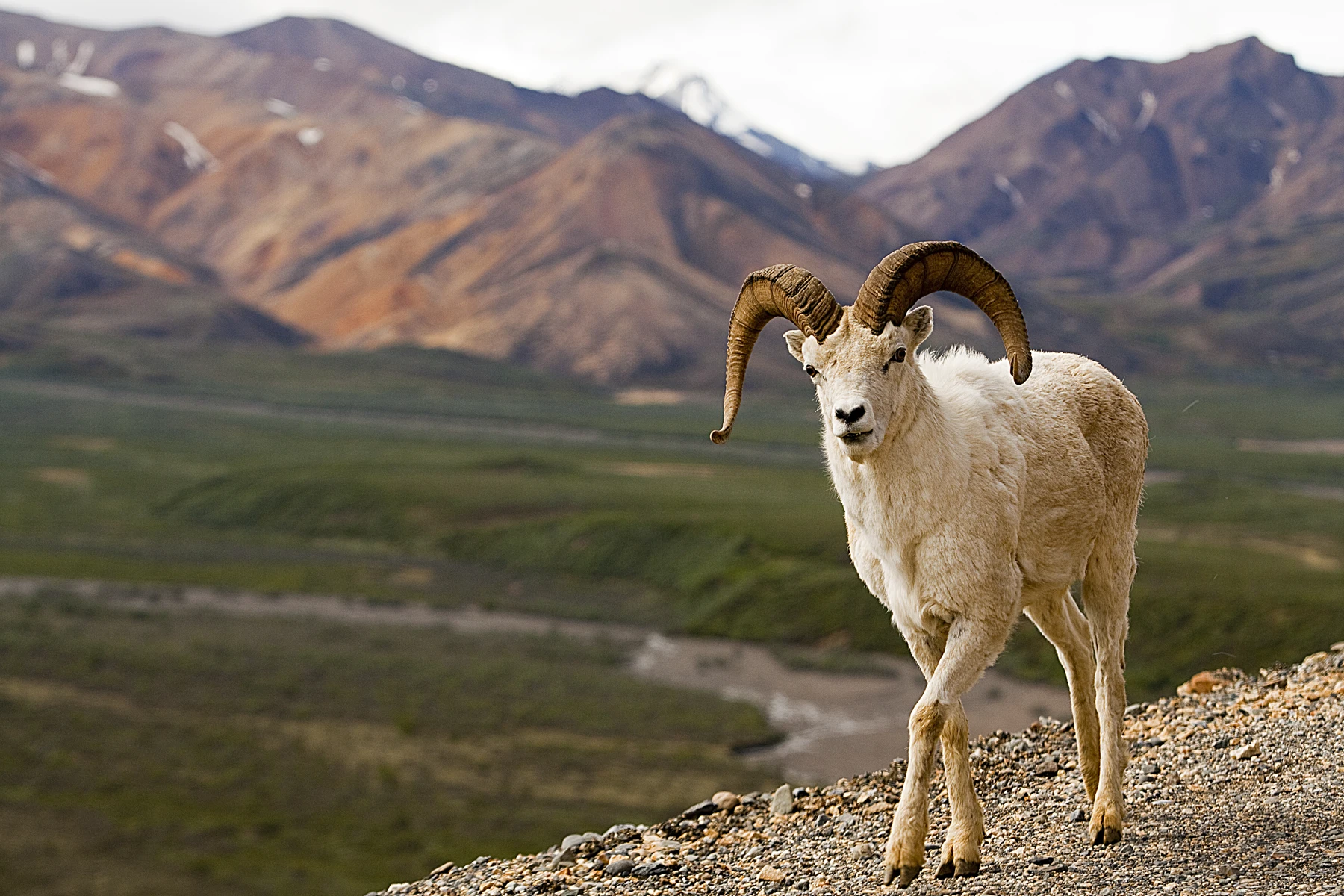
In a photograph, a white Dall sheep stood on a rocky slope above a wide valley. Its curved horns swept back from its head.
Augie inspected his own shoes. “Mine light up. His don’t.”
“His feet suit his job,” said Ana.
Dall sheep used steep, rocky country for feeding and resting, and rugged crags could help them evade predators. Adult rams could develop large curling horns. Ewes had smaller, more slender horns.
“A ram carries fancy head furniture,” Andy said.
“And a sheep is still a wild animal,” Allie replied. “We admire from a distance.”
Protecting wildlife, especially Dall sheep, had been an important reason the original national park was established. Its story was much bigger than a single summit.
The children examined photographs of caribou, moose, bears, and small mammals too. Each was part of a living community with its own needs. They were not performers waiting to complete the family’s checklist.
“What if we don’t see a bear?” asked Andy.
“Then we don’t see a bear,” Ana said. “The bear still has a perfectly valid day.”
The family had binoculars so distant animals could appear closer without the family moving closer. Their parents reviewed the park’s wildlife guidance: never feed animals, keep the required distances, and follow ranger instructions.
Augie proposed a wildlife list with three columns: seen, learned about, and possibly busy elsewhere.
Allie approved it immediately.
“Where do I put the sheep?” he asked.
“Learned about.”
“And my missing biscuit?”
Andy looked unusually interested in the ceiling.
8. The staff member with four paws
One member of the park’s working team would have been delighted by a biscuit, but the children knew better than to offer one.
At the sled-dog kennels, they followed the ranger’s directions, staying with their parents and respecting the dogs’ space. Visiting the dogs’ home did not mean reaching through fences, feeding them, or running through the yard.
“These dogs help people work in the park in winter,” Allie said.
Andy imagined a dog at a desk. “Do they answer email?”
“Only bark-mail,” Ana said.
Dog teams helped carry equipment and supplies, supported research, and assisted winter patrol work. Their role belonged to Denali’s present, not just to an old photograph of Alaska.
Augie considered his career options. “I could be a sled dog.”
“You’d need excellent teamwork,” said Allie.
“I share my crayons.”
“And training.”
“I trained Andy to get my cup.”
“That was persuasion,” Andy said. “There was considerable shouting.”
The dogs offered another answer to their first mystery. People did not control the mountain’s weather. Instead, they learned the conditions and chose ways to work within them. Clothing, transport, timing, training, and knowing when to change a plan all mattered.
The family was visiting in the warmer season. They did not expect a winter sled ride, and demonstrations or dog visits depended on the park’s current arrangements. Learning what happened at another time of year was part of seeing the whole place.
Outside the kennels, Ana gave their notebook a new heading: Adaptation is better than arguing with a snowstorm.
“That should go on my coat,” Andy said.
9. A forecast with no promises
Later, a few raindrops tapped their hoods. Augie looked up indignantly.
“We are in the rain shadow!”
“A drier pattern,” Ana reminded him. “Not an invisible roof.”
The family had packed layers and rain protection. They could adjust their clothing, return to shelter, and change the walk. Snow was possible in the park even in summer, especially up in the mountains; a warm-looking morning was not a promise for the whole day.
Their parents checked the forecast again before deciding what to do next. The children checked their notebook.
“Mountain lifts some moving air,” Andy began.
“Rising air expands and cools,” said Allie.
“Enough cooling can help clouds form,” Ana continued. “Rain or snow may follow. Across the range, the longer-term pattern can be different.”
“Mountain does not have a weather remote,” Augie finished.
That was the version they all liked best.
They had not reached the summit. They had not seen every animal. They had not even persuaded all the clouds to leave. Still, their page held a mountain of discoveries: names and living communities, ice and rock flour, low plants and frozen ground, sheep and working dogs.
Allie returned to their second question. Can we discover Denali without a clear summit view?
Ana wrote YES so firmly that the pencil squeaked.
At the window, a narrow opening revealed a distant snowy slope before clouds drifted across it again. Nobody claimed to have identified the summit from that little glimpse.
“The curtains are still working,” Augie said.
Their next chapter would take them to Badlands National Park and a different kind of evidence: fossils. Andy closed the notebook carefully.
“Do fossils predict rain?”
“Only if you leave your notebook outside,” said Ana.
Explorer’s notebook
Nine discoveries to take home
- Denali National Park and Preserve is in Alaska. Its landscape includes forest, tundra, mountains, and glaciers.
- The name Denali comes from Koyukon; different Alaska Native languages have their own names for the mountain. The region remains homeland to living Native communities.
- Mountains can lift moving air. Rising air expands and cools; enough cooling can help water vapor form cloud droplets or ice crystals.
- A rain shadow is a relatively drier area associated with a mountain barrier. It can still rain there.
- Weather means conditions over a short time; climate describes longer-term patterns. One day's weather does not establish a climate trend.
- Glaciers are moving bodies of ice. Their grinding can produce the fine sediment nicknamed rock flour.
- Taiga means boreal forest. Alpine tundra has low vegetation rather than tall forest; small plants are important parts of the ecosystem.
- Permafrost is ground that remains frozen for two or more consecutive years. It differs from surface snow and glacier ice.
- Dall sheep helped inspire the park’s original protection, and working sled-dog teams still assist park projects in winter.
Five small adventures
- Build the air journey on paper. Draw a mountain cross-section. Add arrows for one possible wind direction, rising air, cooling, clouds, and a drier side. Label it a simplified pattern, not a forecast.
- Keep two weather records. For a week, note the sky and temperature at the same time each day with a grown-up. Compare your short record with published climate information. Explain why they answer different questions.
- Be a photograph detective. Choose one chapter photo. Write three things you actually see and two questions the picture cannot answer. Can it tell you today's weather or how close the photographer stood?
- Design a prepared explorer. Draw clothing and equipment for a family walk in changeable weather. Ask a grown-up what else the real route and forecast would require. Add a plan for turning back.
- Make a fair wildlife list. Use Augie’s three headings: seen, learned about, and possibly busy elsewhere. Put a photograph sighting in the second column. No approaching animals is required.
Talk it over
- Why can “the mountain makes weather” be useful shorthand but misleading if taken literally?
- How can a map be accurate and still leave out important human history?
- If clouds hide a mountain and no large animals appear, what could still make the visit worthwhile?
Words for your explorer pack
- Water vapor: Water in its invisible gaseous form.
- Condensation: A change from gas to liquid; it helps form tiny cloud droplets when moist air cools sufficiently.
- Orographic lifting: Air being forced upward by terrain such as mountains.
- Rain shadow: A relatively dry area on the sheltered side of a mountain barrier in a prevailing weather pattern.
- Taiga: Boreal forest, a forest type associated with cold northern regions.
- Permafrost: Ground that stays at or below freezing for at least two consecutive years.