1. The snowball plan needs revision
Augie had packed a drawing of a snowman for their next adventure. The snowman wore sunglasses, carried a water bottle and looked extremely pleased with its holiday plans.
“Prepared for the white desert,” he explained.
Andy looked out at the dunes. “We may need to revise the snowball part.”
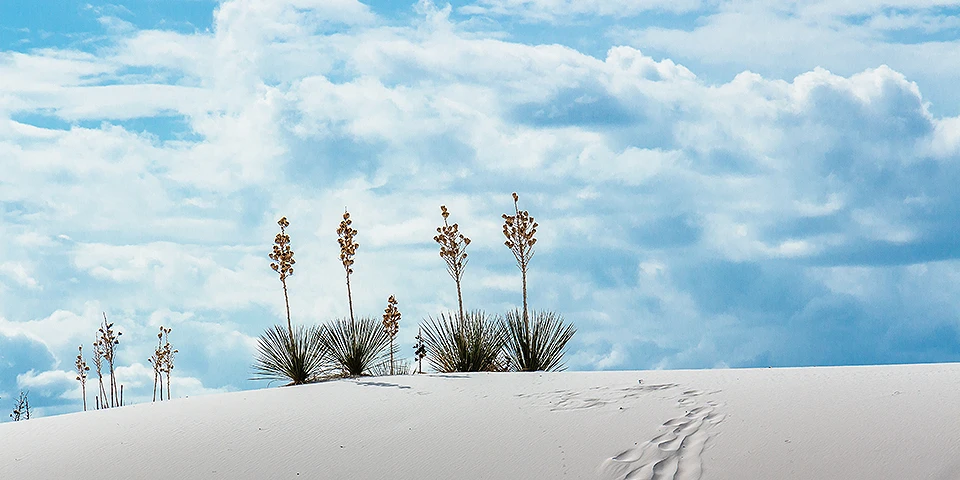
The family had arrived at White Sands National Park in southern New Mexico. Bright dunes rose beneath the sky, their ridges casting soft shadows. Plants stood in scattered patches, and distant mountains marked the edges of a much larger landscape.
Allie opened the notebook from Hot Springs. Their last investigation had followed rainwater deep into warm rock. Here, another water journey had helped make an extraordinary place at the surface.
“Our challenge,” she said, “is to discover why this sand is white and how it became dunes.”
Ana added a second question. “And why the material stayed here instead of being carried away to the sea.”
Augie inspected the snowman drawing. “It can still wear sunglasses.”
Their grown-up had chosen a short, suitable outing and checked the day’s conditions. They would stay together, follow the designated route and use exhibits and photographs to investigate places beyond their own walk. Lake Lucero belonged on their learning map, but they were not setting out across the basin to find it.
The family carried their own drinking water and sun protection. White sand could make a landscape look wintry without giving it winter temperatures or gentle weather.
Andy drew three boxes in the notebook: material, movement, living neighbors.
“A sand mystery with residents,” he said.
Allie wrote their title above the boxes: The Desert Made of Snow-White Sand.
Augie crossed out the snowman’s carrot nose and replaced it with a tiny compass.
“Now it’s an explorer.”
2. Sand is a size, not one ingredient
At an exhibit, the children learned the name of the mineral that made these dunes unusual: gypsum.
“Not snow,” Andy said. “And not powdered sugar, despite appearances.”
Ana drew a label beside the white landscape. “Gypsum sand.”
Sand described grains within a range of sizes. It did not mean that every beach or dune was made from the same material. Many familiar sands contained a lot of quartz. At White Sands, gypsum supplied the dune grains.
Allie liked the distinction. “Like crumbs,” she said. “Crumbs tells us something about size, but we still need to ask what crumbled.”
Augie immediately nominated a cracker for scientific investigation.
“Our picnic can wait,” their grown-up said.
Gypsum could dissolve in water. Later, under suitable conditions, dissolved material could form solid crystals again. That ability would explain why water mattered so much to a landscape that looked dry.
Andy drew a little gypsum grain beside a much larger crystal. “Same mineral, different pieces?”
“Exactly,” Ana said. “We need to follow how the material changes form and size.”
The story reached back to ancient deposits of gypsum. Later geological changes placed gypsum-bearing rocks in the surrounding landscape, where water could interact with them.
Allie remembered Guadalupe Mountains. An ancient sea could leave evidence in rocks that later appeared in a very different setting. But the white dunes were not a reef ground into sand. Their material and sequence needed a separate explanation.
Augie gave the gypsum grain a suitcase.
“Another traveler.”
Andy added a small label: Ask what carried it.
That was becoming one of their best questions. A familiar-looking landscape could begin with an unfamiliar ingredient, then travel through several processes before reaching the view in front of them.
3. A basin with no river exit
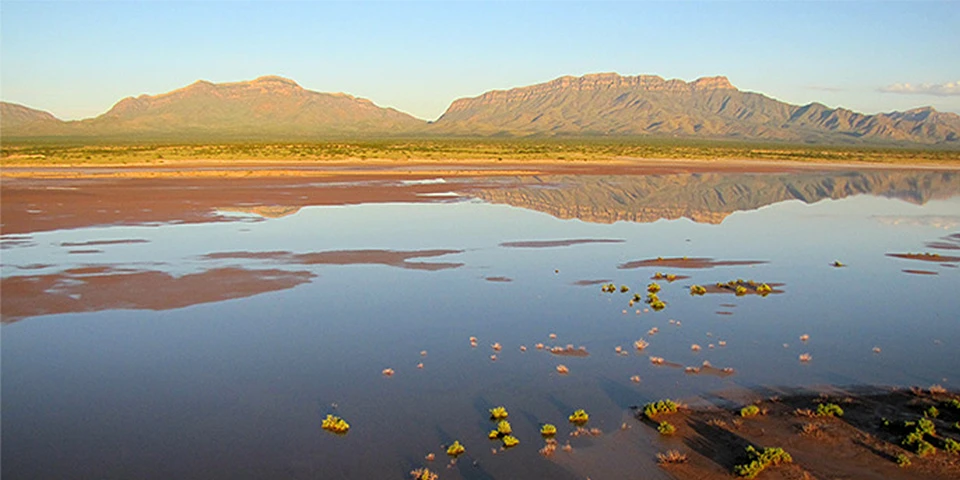
Ana spread out a map of the Tularosa Basin. The San Andres Mountains stood to the west and the Sacramento Mountains to the east. Lower ground lay between them.
“A very large bowl,” Andy said.
Augie checked the picnic bag. “We don’t have a spoon that size.”
The basin was closed with respect to surface drainage: water did not have a river route flowing out to the ocean. Some water soaked into the ground, some collected in low places, and much returned to the atmosphere through evaporation.
Allie drew arrows entering the bowl, then searched for the outgoing river.
“There isn’t one on this diagram,” she said.
Rain and snowmelt could dissolve gypsum from surrounding rocks and carry it into the basin. The mineral material traveled with the water even when it could not be seen as separate grains.
“Invisible passengers again,” Andy said. “Like the minerals at Hot Springs.”
“A useful connection,” Ana agreed. “Now we need to see what happens when the water gathers here.”
During wetter parts of the past, a large lake called Lake Otero occupied much of the basin. As conditions changed and the lake shrank, mineral-rich deposits remained. Today, Lake Lucero and Alkali Flat were important parts of the story of new gypsum sand.
The children studied a photograph rather than claim they could see the entire lakebed from their own route. A basin was much larger than the next dune.
Augie drew a bathtub with no drainpipe. Allie added a note: a comparison for surface drainage.
“The real basin still has groundwater and evaporation,” she said. “Our bathtub drawing leaves those out unless we add them.”
Andy supplied the missing arrows.
“The bowl has a complicated instruction manual.”
Their second answer was ready: the basin keeps water and dissolved minerals from simply following a river to the sea.
4. The lake leaves crystal clues
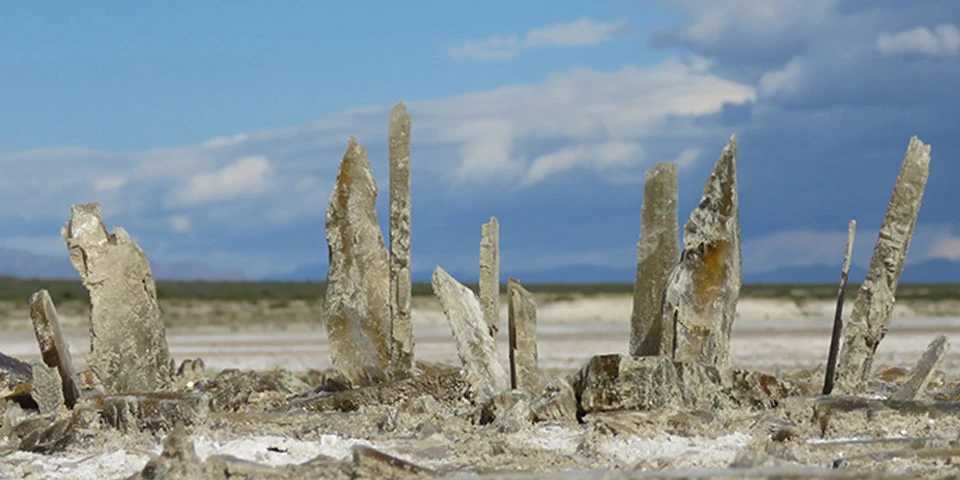
The gypsum photograph looked very different from the dunes. Crystals caught the light, with shapes the children could examine more easily than a tiny sand grain.
“Sparkly leftovers,” Augie said.
“A useful starting description,” Ana replied. “Let’s find out how they formed.”
As water evaporated, dissolved minerals became more concentrated. Under the right conditions, gypsum crystallized. Selenite was a crystalline form of gypsum found in this landscape.
Allie drew water in a shallow dish on one page and crystals on another. Between them she wrote evaporation and crystallization.
“The water goes into the air,” she said. “The mineral can remain and form crystals.”
Andy gave one crystal a small flag. “Stayed behind. Excellent view.”
Lake Lucero was a playa: a low area that could hold water temporarily and later dry. Seeing a dry lakebed did not mean that water had never been important there. Nor did a picture of a wet lake promise the same conditions on a future visit.
Some crystal formation happened beneath the muddy surface, where groundwater and mineral-rich conditions also mattered. The simple picture of a dish drying in sunlight introduced one idea, but the actual basin had more pathways and changes.
Augie added a question mark under the surface of his drawing.
“For the parts we can’t see.”
Over time, exposed crystals could break into smaller pieces through weathering and other processes. Water and wind could move fragments and help wear them down. Eventually, the pieces became grains suitable for building dunes.
Ana put three drawings in order: dissolved material, crystal, sand grain.
“Different stages of the mineral’s journey,” she said.
Andy looked back at the bright dunes. “So before the sand could travel, there was a long preparation job.”
Augie gave the crystal a very small suitcase. “Now it’s ready.”
5. The grains take tiny jumps
The dunes appeared still from a distance. Their shape, however, was evidence of movement.
“A hill made by traveling grains,” Allie said.
Wind could lift and push sand grains. Some bounced along close to the surface, striking other grains and helping them move. This hopping motion was called saltation.
Augie drew a row of tiny arches. “Kangaroo transport.”
“With much less luggage,” Andy said.
Other grains could roll or slide along the surface. Fine particles could be carried differently from larger ones. Wind movement was not one single action applied equally to every piece of material.
Ana drew a dune from the side. Sand could move up the gentler windward slope and collect near the top. On a steeper slope beyond, grains could slide downward. Repeated movement changed the dune’s shape and position.
“The whole dune doesn’t stand up and walk,” she said.
Andy crossed out the boots beneath his drawing.
“A recurring disappointment for my geology fashion department.”
Wind direction and strength mattered, but so did moisture, available sand and vegetation. Different dunes could change at different rates. One dramatic photograph or a single windy afternoon could not supply a universal speed limit for the whole dunefield.
Allie drew two pictures of one dune with the same fixed reference point beside it. “To study change, we’d need careful comparisons.”
The family did not plant a marker in a dune or leave an object behind. Their notebook model was enough for the lesson; researchers used suitable measurements and equipment.
Augie added the snowman explorer to the margin. A little sand had collected around its feet.
“It’s getting buried.”
“That,” Ana said, “is a very good question for the plants.”
The next part of their investigation would ask what it meant to live where the ground kept rearranging itself.
6. The yucca grows with the challenge
The plant photograph showed yuccas rising above white sand. Their leaves reached into the light while the dune concealed much of what lay below.
Augie looked at his half-buried explorer. “The plants have a better plan.”
At White Sands, soaptree yuccas could lengthen their stems as sand accumulated around them, helping keep their leaves above the dune. The visible plant was only part of a much longer structure.
“A plant with an upstairs strategy,” Andy said.
“Growth,” Ana answered. “Not a little elevator inside the stem.”
Allie drew a plant, added sand around its lower stem and showed leaves remaining exposed above. The drawing helped her understand the challenge, but it did not mean a yucca could grow indefinitely through every amount of burial.
When a dune moved away, a long exposed stem could lose support and fall. New growth could arise from the fallen plant. Survival here involved a changing relationship between plants and moving sand.
Other plants used different strategies. Some roots helped hold together a mound of sand as the surrounding dune shifted. Some grasses could spread or grow in ways that helped them persist.
Andy drew three plants with different toolkits.
“One neighborhood,” he said. “Several solutions.”
The plants also influenced the dunes. Vegetation could slow moving sand and help stabilize parts of the landscape. The residents were not simply decorations placed on top after the geology had finished.
“Like prairie dogs and grass at Wind Cave,” Allie said. “Living things change their surroundings too.”
The children observed without climbing a pedestal or pulling at roots to see how long they were. A structure that looked like an interesting little hill could be part of a plant’s home and support system.
Augie drew a sign beside the yucca: Please leave my downstairs alone.
Ana approved. The plant had already done enough work getting its leaves into the light.
7. A lizard dressed for the dunes
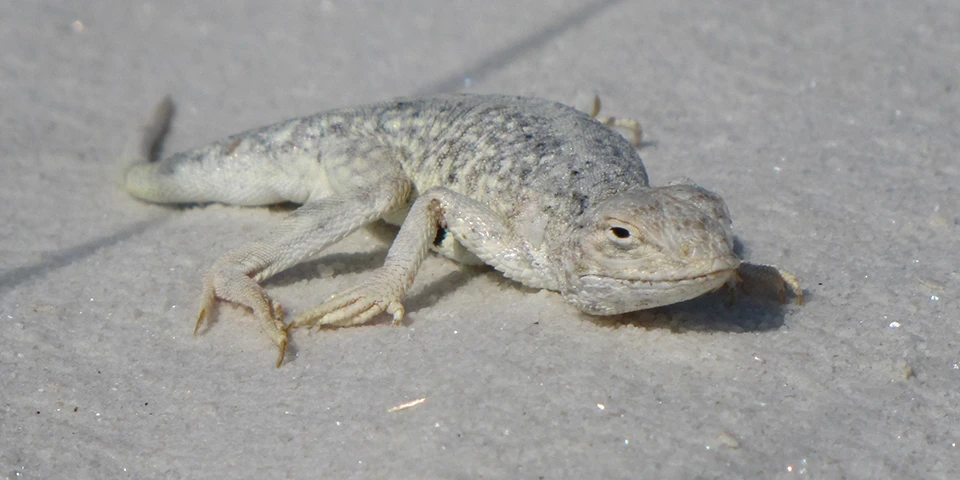
In another photograph, a pale lizard rested against white sand. Allie found its outline, lost it for a moment and found it again.
“Camouflage,” she said.
Andy studied the image. “Powdered-sugar edition.”
The bleached earless lizard was one of White Sands’ distinctive residents. Its pale coloration helped it blend with the dunes. The name referred to the absence of external ear openings; it could still hear.
Augie immediately gave his drawing two tiny listening marks.
“Important correction.”
Ana asked whether a lizard simply decided to become white when it arrived on a dune.
Allie shook her head. The explanation involved inherited differences and changes across many generations. Individuals whose coloration helped them survive and reproduce could contribute more descendants to later generations. Over time, a population could become better matched to its surroundings.
“So no paintbrush,” Andy said.
“And no lizard choosing a new outfit that morning,” Ana added.
Color was only part of the animal’s life. It also needed food, shelter and suitable temperatures. A pale animal still had to avoid dangers and find what it needed.
The children’s photograph was a chance to study a known species. A quick track or distant movement during their own outing would not let them confidently name every animal nearby.
Augie drew a little trail of footprints and wrote someone passed here.
“An observation we can defend,” Ana said.
They would never catch a lizard to compare its color with a drawing, or dig into a hiding place to improve their view. Looking closely included letting wildlife continue its ordinary business.
Andy put the lizard beside the yucca on their neighborhood page.
“The dunes have more residents than my snowman expected.”
Augie added a pencil to the explorer’s hand. It was beginning to look like a naturalist rather than a snowball champion.
8. A moving landscape still needs care
“If wind can erase a footprint,” Andy asked, “does that mean every mark disappears?”
Ana looked toward a plant patch. “We should ask what the mark affected.”
Loose sand could shift quickly under suitable conditions. Damage to a plant, its roots or a fragile habitat could have a much longer effect. A landscape that moved was not an empty playground waiting to be rearranged by visitors.
Allie added a care column beside their three investigation boxes. Material, movement and living neighbors each needed thoughtful observation.
The family stayed on their selected route, kept landmarks and route information in mind, and remained together. Similar-looking dunes could be confusing. A string of footprints behind them was not a dependable navigation system once wind began changing the surface.
Augie checked the snowman explorer’s compass.
“Our grown-up has the real directions,” he said.
They had brought water and protection from the sun. The pale ground reflected light strongly, and the desert’s conditions could change. White color did not promise cool weather or eliminate the need to plan a suitable distance.
At an exhibit, the children learned that scientists monitored dunes, vegetation and groundwater together. Repeated surveys could show how dunes changed; other measurements helped researchers investigate possible causes.
“One photograph is a moment,” Allie said. “A careful series helps tell a change story.”
Ana drew three columns again: what we observed, what we learned, what we still want to know.
They had seen the bright landscape and followed a short route. They had studied Lake Lucero, crystals, yucca strategies and the lizard through photographs and park explanations.
Andy liked that the notebook made room for both discoveries and uncertainty.
“Good explorers,” he said, “can finish a picnic without declaring the entire desert solved.”
Augie felt this was the strongest conclusion of the afternoon.
9. A water story written in dry sand
Allie reopened the first page, where three boxes waited beneath their title.
“What is the material?”
“Gypsum,” Ana answered. “A mineral that can dissolve and form crystals again.”
“How does it become dunes?”
Andy followed their arrows. “Water carries dissolved material into the basin. Crystals form, pieces break down, and wind moves the grains.”
“And why does so much of the story stay here?”
Augie pointed to the bowl drawing. “No river drain to the ocean.”
The answer included more than the bowl alone. Gypsum sources, changing lakes, groundwater, weathering, wind and living things all belonged in the explanation. Their simple sequence organized the main ideas without pretending every grain had followed an identical itinerary.
Allie looked at the dunes again. A dry view could preserve the results of a water story, just as mountains could preserve an ancient sea and hot springs could reveal a long underground journey.
“The water is sometimes hard to see,” she said. “Its work is easier to recognize once we know what to ask.”
Ana put a small line through the word snow on Augie’s original drawing.
He nodded. “The explorer can stay.”
It now had sunglasses, water, a notebook and sensible route information. Nobody needed to melt to complete the investigation.
Next in their park order was Virgin Islands National Park, where they would explore connections among reefs, seagrass, mangroves and island shores.
Andy smiled. “From sand with no nearby ocean to a whole new ocean neighborhood.”
“Another good question,” Allie said.
Augie checked his socks. “And possibly more sand.”
As the family left, light and shadow changed across the white ridges. The dunes looked quiet. Their story held dissolved minerals, growing crystals, tiny jumps and living neighbors—an extraordinary journey written one grain at a time.
Explorer’s notebook
Nine discoveries to keep
- White Sands National Park is in southern New Mexico, within the Tularosa Basin.
- Sand describes a grain-size range, not one universal ingredient. These dunes are made of gypsum grains.
- Water can dissolve gypsum from surrounding rocks and carry the material into the basin.
- The basin has no river outlet to the ocean. Evaporation, groundwater and temporary lakes remain important to its water story.
- Gypsum can crystallize as water evaporates. Selenite crystals and fragments help supply new sand from Lake Lucero and Alkali Flat.
- Weathering breaks material into smaller pieces. Wind moves grains through bouncing, rolling and other motions; bouncing is called saltation.
- Soaptree yuccas can lengthen their stems as sand accumulates, while other plants use different survival strategies and can help stabilize dunes.
- Pale coloration helps the bleached earless lizard blend with white sand. Such adaptations develop across generations rather than through an individual choosing a color.
- Shifting sand does not erase every effect of disturbance. Protect plants and wildlife, plan suitable routes and stay together.
Five family adventures
- Draw the mineral journey: Make cards for gypsum-bearing rock, dissolved material in water, crystals, sand grains and dunes. Connect them with labeled arrows. Add the closed basin around the sequence. Explain that the real history includes groundwater, changing conditions and many overlapping pathways.
- A basin in a tray: With a grown-up, shape a shallow bowl in modeling dough inside a waterproof tray. Add a little room-temperature water and observe where it collects. Draw a hypothetical outlet on paper and discuss how it would change surface drainage. The dough model omits groundwater, evaporation and the basin’s geological history.
- Leave a dissolved clue: With a grown-up, stir a small amount of table salt into warm tap water in a shallow dish. Leave it in a safe place to evaporate naturally and observe over several days. Do not taste it or use a stove. Explain that salt is a substitute illustrating dissolution and crystallization; it is not gypsum, and its crystals may look different.
- Show movement without flying sand: Use large paper dots on a drawn dune cross-section to model grains moving up a slope and sliding down the other side. Draw short arches for saltation. Keep real sand out of the activity so nobody needs to blow particles toward eyes or lungs. The paper diagram is a simple comparison, not a working dune.
- Camouflage with paper: Place pale and dark paper lizard shapes on white and dark sheets. Compare how easily you spot them without changing the shapes. Discuss how background affects visibility. Explain that real animals inherit traits and populations change across generations; a lizard does not choose new skin like a paper costume.
Four questions for the road
- Why does calling something sand tell you less than naming the mineral that makes up its grains?
- How does a basin without a river outlet help keep gypsum in the landscape?
- What different jobs do water and wind do in making the dunes?
- Why should a shifting landscape still be treated as a living habitat?
Eight words for your explorer kit
- Gypsum: A soft mineral made of calcium sulfate with water in its crystal structure.
- Basin: A low area that receives material or water from surrounding higher ground.
- Dissolution: The process by which a substance becomes dissolved in a liquid.
- Evaporation: The change of liquid water into water vapor.
- Crystallization: The formation of a solid with an organized crystal structure.
- Selenite: A crystalline variety of gypsum found among the sources of White Sands’ dune material.
- Saltation: The bouncing or hopping movement of sand grains near the ground.
- Camouflage: Features that make an organism harder to detect against its surroundings.