1. A very suspicious view
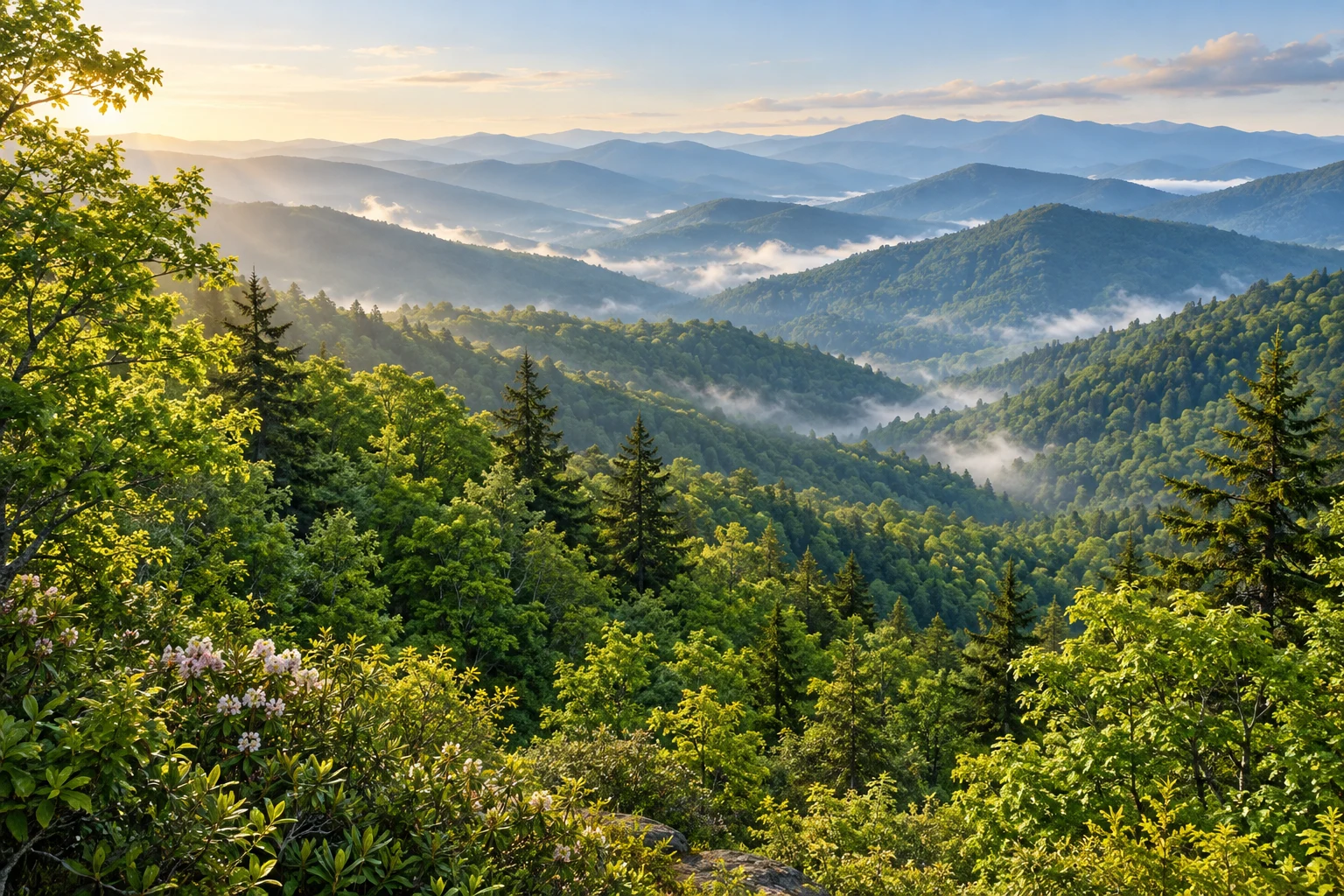
“Somebody stole the mountains,” Augie announced.
He stood beside his family at an overlook, pointing past the railing. One green ridge rose beyond the trees. Behind it, another ridge looked blue. Behind that, the mountains faded into something pale and mysterious.
Augie had expected mountains. Lots of mountains. Mountains that stayed where somebody put them.
“There were more a minute ago.”
Allie opened the notebook she had brought for their national park adventures. On the first page she had written FOUR EXPLORERS, followed by three careful question marks.
Andy had added a drawing of a sandwich.
“That’s our emergency equipment,” he explained.
Ana leaned against the railing without climbing it. “Maybe the mountains are hiding.”
“Behind what?” Andy asked. “An even bigger mountain?”
Their dad checked the map while their mom helped Augie straighten his small backpack. They had arrived in Great Smoky Mountains National Park, which stretches across parts of Tennessee and North Carolina. Today they would explore with their parents, ask questions, and see what they could discover.
Allie wrote their first question.
Where do the mountains go when they disappear?
“Smoke,” Andy suggested. “The name is a clue.”
Augie looked worried. “Who burned the mountains?”
“Let’s find out what that haze actually is,” Mom said. “A name isn’t the whole explanation.”
Allie drew four empty boxes beneath the question. One for each explorer’s best discovery.
“We need evidence,” she said.
“And a detective name,” said Andy.
Ana considered the view. “The Mountain Finders?”
Augie raised his hand. “The Snack Finders.”
“That’s our other department,” Andy told him.
2. A forest with a secret
At the visitor center, the children studied a display about the park’s forests. A ranger listened as Augie described the missing mountains.
“Were they large?” she asked.
Augie nodded seriously. “Very.”
The ranger smiled. “Then I think I know your suspects. Trees.”
Andy glanced toward the window. “They do look suspicious. All standing around pretending to be trees.”
The ranger explained that trees release water vapor and natural chemicals into the air. Some of those chemicals react in the atmosphere and help form tiny particles. The particles scatter sunlight, contributing to the distant ridges’ bluish appearance. Moisture, mist, and clouds also shape the changing view.
“So the forest helps make its own haze,” Allie said.
“Exactly. The famous blue haze isn’t simply smoke from a fire.”
Ana looked through the window again. “The trees aren’t hiding the mountains on purpose. They’re doing normal tree things.”
“That is what a tree lawyer would say,” Andy replied.
Allie wrote: The forest helps explain the blue haze.
Then she hesitated. “Does that mean any hazy air is good?”
The ranger shook her head. Natural blue haze and air pollution were different things. Pollution could harm plants and make views harder to see, too. Looking at a distant ridge did not tell the children everything about the air.
“We solved it!” Andy said.
Allie looked at the three empty discovery boxes.
“We solved why they look hidden. But what are we missing when we only look at the view?”
The ranger pointed toward the forest outside.
“That,” she said, “is an excellent next question.”
Augie peered at the trees. “Do we have to interview all of them?”
3. Before there was a park
Before leaving, Ana stopped at a history display.
“Our notebook starts today,” she said. “But this place’s story doesn’t.”
The family read about the Cherokee people, whose ancestral homeland includes these mountains. Cherokee communities knew and cared about this landscape long before it became a national park.
Allie noticed something important in the display: the story continued into the present. The Eastern Band of Cherokee Indians has a living community in western North Carolina. Cherokee language, art, knowledge, and traditions continue today.
“We should write ‘are,’” she said, pointing to her notebook. “Not only ‘were.’”
Dad nodded.
They also learned about the forced removal of many Cherokee people from their homes in the 1830s, a terrible injustice remembered as the Trail of Tears.
For a while nobody made a joke.
“Being an explorer means learning the sad parts, too,” Ana said.
Mom suggested that they plan a visit to the Museum of the Cherokee People in Cherokee, North Carolina, to learn more from Cherokee voices.
Allie added a note beneath the mystery: A place has people’s stories as well as nature’s stories.
Outside, Augie examined the notebook.
“Do I get a story?”
“You already have one,” Ana said. “It starts with accusing a forest of stealing mountains.”
Augie looked pleased. That was a strong beginning.
4. The mountain that used to be mud
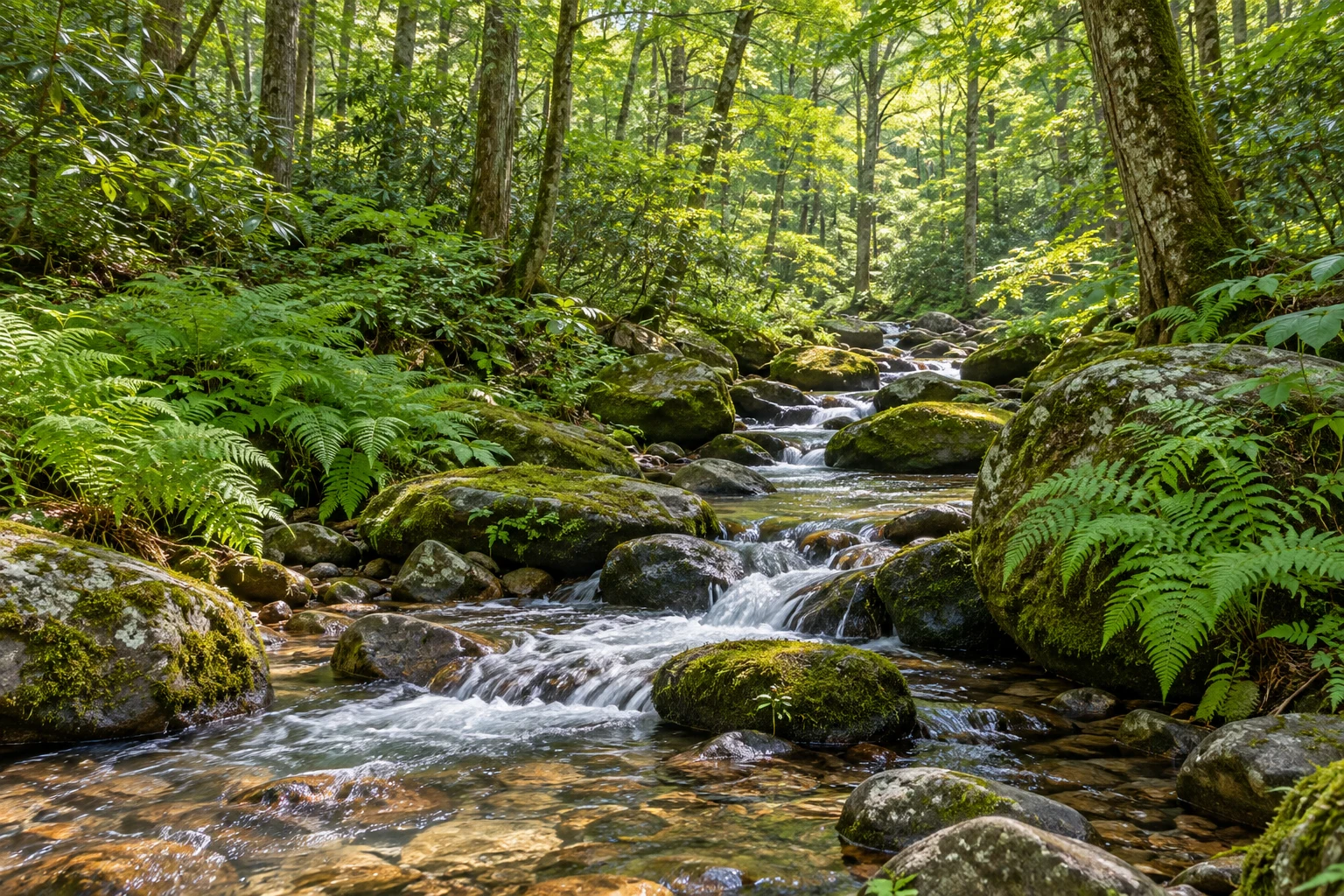
On a short forest walk chosen by their parents, the children stayed together on the marked trail. Light slipped between the leaves. Somewhere below, water tumbled over stones.
Andy stopped beside exposed rock at the trail’s edge.
“Evidence,” he whispered.
“You can use your normal voice,” Allie said. “The rock can’t escape.”
He pointed to lines in its surface. “How did that get here?”
Dad unfolded the geology leaflet they had picked up. Much of the park’s rock had begun as sediments such as sand and mud. Over enormous stretches of time, sediments became rock. Later, heat, pressure, and the movements of Earth’s great plates changed and lifted rocks during mountain building.
Ana pressed her hands together and slowly wrinkled the sleeve between them.
“Like pushing cloth into folds?”
“That helps us picture folding,” Dad said. “But actual rock and plate movement are much more complicated—and much slower than your hands.”
Andy studied the ridge overhead.
“So I’m looking at a mountain with a mud-related past.”
“That’s one way to put it,” Allie said.
“I also have a mud-related past,” Andy said. “Remember my shoes last Saturday?”
Augie lifted one boot for inspection.
“Mine has a mud-related now.”
Water, weather, and gravity had continued changing the mountains long after they formed. Erosion wore rock away and carried pieces downhill. The rounded ridges were part of a landscape still changing, even when the changes were too slow to watch.
Ana looked toward the sound of the stream.
“Maybe the mountains aren’t only being hidden,” she said. “Tiny pieces are moving.”
Allie filled the second box: Mountains change. Streams carry parts of their story downhill.
Andy looked at his muddy boot.
“I would like to return my piece.”
5. The smallest witness
Near a damp patch beside the trail, Ana suddenly stopped.
“Look carefully. By the leaf.”
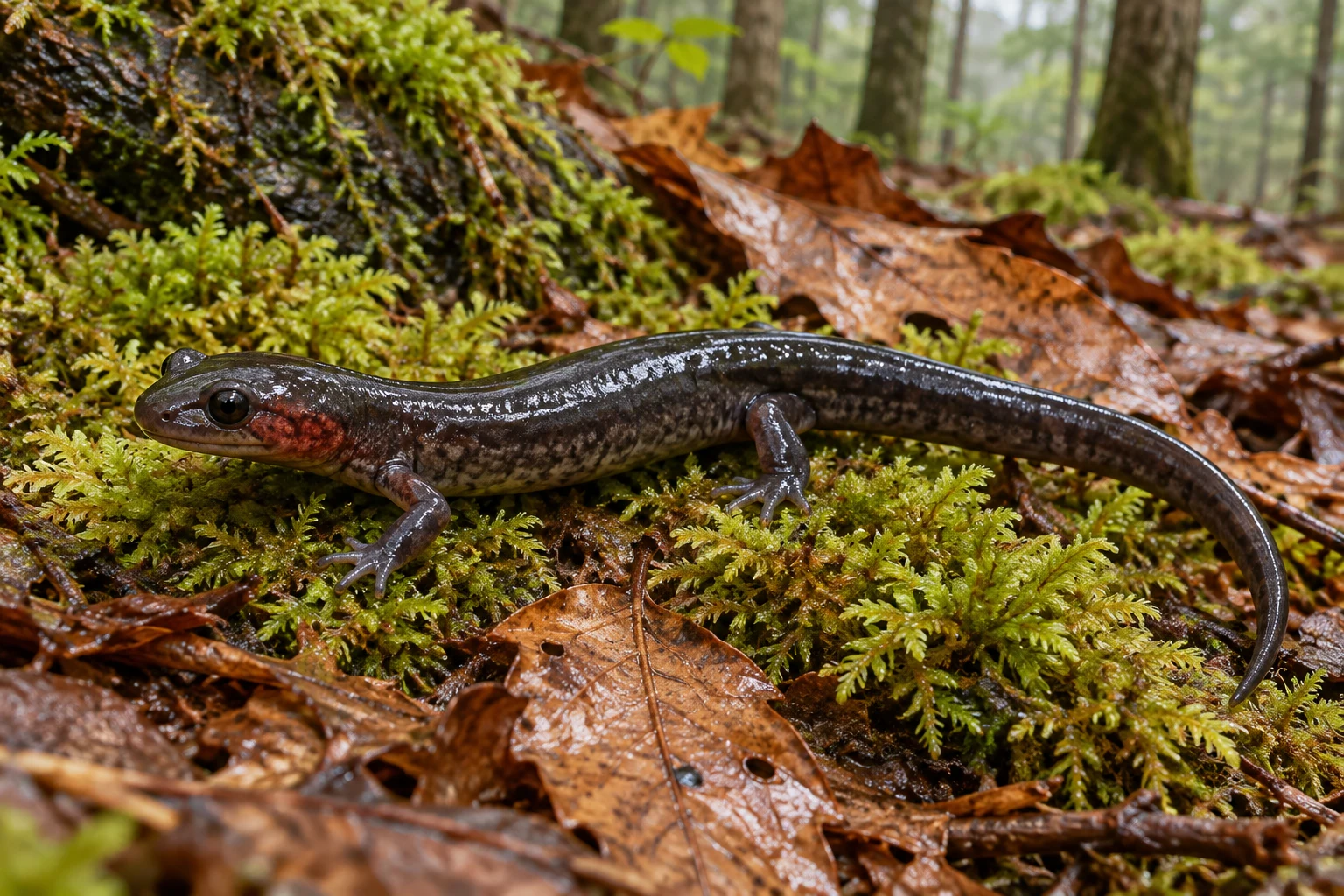
At first Allie saw only brown leaves and dark soil. Then one narrow shape moved.
Four tiny feet. A long tail. A body so small that Augie crouched beside Mom to get a better look without leaving the path.
“A baby dinosaur,” he whispered.
“Maybe a salamander,” Ana said.
Andy remembered a visitor center picture. “Lizards have scales. Salamanders have smooth, moist skin.”
“And salamanders are amphibians,” Allie added. “Like frogs, although they don’t look exactly like frogs.”
None of them knew which species this one was. Allie drew its shape instead of guessing a name.
“We can compare our drawing with the guide later,” she said.
Augie offered it a very quiet greeting.
The salamander continued being a salamander.
That seemed reasonable.
Their leaflet explained why the Smokies were famous for salamanders: the mountains offered many cool, damp places to live. Some salamanders in the park had no lungs at all. They exchanged gases through their moist skin and the lining of their mouths and throats.
Andy stared at his arm.
“My skin is mostly responsible for keeping my inside inside.”
“Yours has different equipment,” Ana said.
Augie started to stretch out a hand, then tucked it against his backpack.
“Looking hands,” he reminded himself.
Mom smiled. They would not touch the animal or pull apart its shelter. Substances on human hands could harm sensitive amphibian skin. The salamander’s home was not something to dismantle for a better look.
It slipped beneath a leaf.
Augie waved to the leaf instead.
Allie filled the third box: Small, hidden animals need the forest, too.
“We found a mountain secret that fitted under a leaf,” Ana said.
“Excellent hiding place,” Andy agreed. “Terrible place for a sandwich.”
6. A lunch investigation
At a designated picnic area, Andy opened his lunch container with the care of someone unveiling treasure.
“My department,” he said.
Dad reminded everyone that this was black bear country. Food and rubbish had to stay under their control and be stored or disposed of properly. Feeding wildlife—or leaving food scraps behind—could teach animals to seek food from people.
Augie held up a crumb. “Even this?”
“Even that,” Mom said, helping him put it with their rubbish.
Ana read the bear information they had brought. Black bears ate both plant and animal foods. Nuts, berries, and insects were among their natural meals.
Andy inspected his sandwich.
“Mine is not on the bear menu.”
“Let’s keep it that way,” Allie said.
They reviewed the park’s guidance: stay at least fifty yards from bears, and farther away whenever their presence disturbed an animal. Binoculars were for looking closer without walking closer.
“So we don’t chase one for a photograph,” Ana said.
“And we don’t invite one to lunch,” Andy added.
Augie frowned. “I only brought four crackers.”
They saw no bears during lunch. Allie decided that was worth writing down honestly.
No bear sighting. Still learned how to be a better guest.
After eating, they checked beneath the table and packed away their things. Augie found a wrapper by a bench, and Mom helped him collect it safely.
“Mountain cleaner,” he announced.
It was a good job title. Allie put it beneath his name.
7. The page that would not finish
Back at the overlook, the distant ridges were clearer. Augie counted them, lost his place, and began again.
“The mountains came back!”
“They stayed put,” Ana said. “Our view changed.”
Allie opened the notebook. Three boxes held discoveries. The fourth was empty.
Andy pointed at it. “We need something enormous.”
“Bigger than a mountain?” Ana asked.
He considered that. “An extremely ambitious sandwich?”
Allie shook her head, smiling. She wanted a final discovery that connected everything: the haze, the old rocks, the stream, the salamander, and the people who knew these mountains as home.
Mom reminded them about their evening plan. Earlier, their parents had arranged permitted access for a seasonal firefly viewing opportunity near Elkmont. They had checked the park’s instructions; this was not somewhere to arrive after dark without planning.
“We might see synchronous fireflies,” Ana said.
Augie tried the word.
“Sink-a-noodle?”
“Synchronous,” Allie repeated. “Doing something together in time.”
Andy and Ana clapped once at exactly the same moment.
Augie clapped a moment later.
“Mine was the surprise,” he explained.
8. The forest switches on
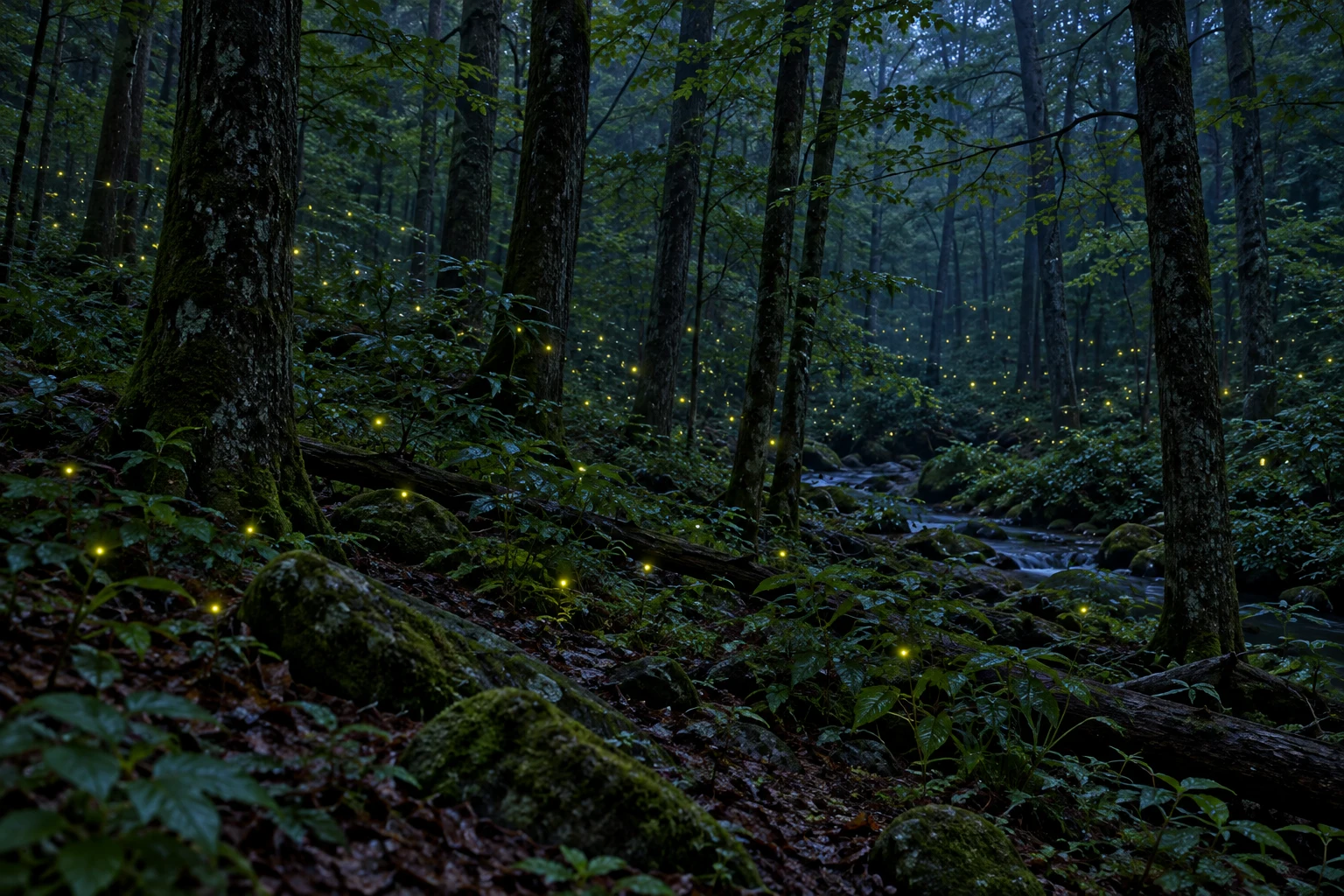
That evening, the family followed the viewing instructions and stayed on the designated route. The children kept close to their parents. The forest slowly lost its colors as darkness gathered.
There was no promise that nature would perform on a schedule. They waited quietly.
Then a light blinked between the trees.
Another answered farther away.
“Tiny stars,” Augie whispered.
More lights appeared. For a few moments they seemed scattered and separate. Then groups of flashes began to share a rhythm.
Light. Light. Light.
Darkness.
Then light again.
Andy’s mouth fell open. For once, no joke came out.
The children had learned that fireflies were beetles. Their light came from a chemical reaction in their bodies, a process called bioluminescence. They were not carrying miniature torches.
Ana leaned close to Allie. “The flashes help them find mates of their own species.”
Allie nodded. Each species had its own signals. These synchronous fireflies could coordinate their flashing, although scientists were still investigating exactly how and why the synchrony worked.
Knowing a little of the science made the scene more astonishing.
Somewhere in the darkness were beetles sending messages without a single spoken word.
Augie held both hands in his lap. He did not try to catch one.
“They need their lights for talking,” he whispered.
After another bright sequence, darkness settled again. The children waited instead of filling it with chatter.
Allie finally knew what belonged in the fourth box.
She did not turn on a bright light to write it. She would remember.
For now, the page could wait.
9. What the mountains were keeping
The next morning, Allie placed the notebook on the breakfast table.
“The case is closed,” she announced.
Andy looked up. “Were the trees arrested?”
“No.”
“Good. There weren’t enough seats in the car.”
Allie read the discoveries aloud. The forest helped create the blue haze. The mountains had been built and changed over immense stretches of time. Small animals depended on damp places that a hurried visitor might never notice.
Then she read the last box.
The mountains were never empty when we couldn’t see them. We just needed to look in different ways.
Ana smiled. “From far away, we saw ridges. Up close, we saw a salamander. In the dark, we saw messages.”
“And we learned whose homeland this is,” Allie said.
Andy added a small drawing beside each discovery: a tree, a rock, a salamander, and a beetle.
Augie asked for the pencil.
He drew a large wobbly circle with four short lines.
“A mystery animal?” Ana asked.
“A cracker,” he said. “It also disappeared.”
“Did the trees take it?” Andy asked.
Augie shook his head.
“I have evidence.”
He pointed at his mouth.
Allie laughed and turned the page. At the top of the next blank sheet, she wrote ZION.
Underneath, Andy added a question:
What can a little river do?
Augie considered it.
“Get my socks wet.”
They would discover that a river could do rather more than that.
Explorer’s notebook
What we discovered
- Where: Great Smoky Mountains National Park spans parts of Tennessee and North Carolina in the Appalachian Mountains.
- The blue haze: Natural chemicals released by trees help form tiny particles that scatter sunlight. Moisture and changing weather also affect the view. Natural haze and harmful air pollution are different.
- The rocks: Many began as sediments. Mountain building changed and lifted them; erosion continues to reshape the landscape.
- The small neighbors: Salamanders are amphibians. Some species breathe without lungs, using their moist skin and mouth and throat linings.
- The blinking neighbors: Fireflies are beetles. Bioluminescence means light made by a living organism through a chemical reaction.
- The human story: These mountains are part of the Cherokee ancestral homeland, and Cherokee communities and culture continue today.
- Being a good guest: Observe wildlife without disturbing it, leave habitats intact, and keep food and rubbish from animals.
Three questions for the road
- Why might a damp leaf be more important to a salamander than it looks to us?
- How can the same place reveal different discoveries in daylight and after dark?
- What would you draw in your own four discovery boxes?
Useful words
Evidence: Information that helps us test an explanation.
Erosion: The wearing away and movement of rock or soil by forces such as moving water.
Amphibian: An animal in the group that includes frogs, salamanders, and their relatives.
Bioluminescence: Light produced by a chemical reaction within a living organism.
Synchronous: Happening together in time.