1. The coat inspection
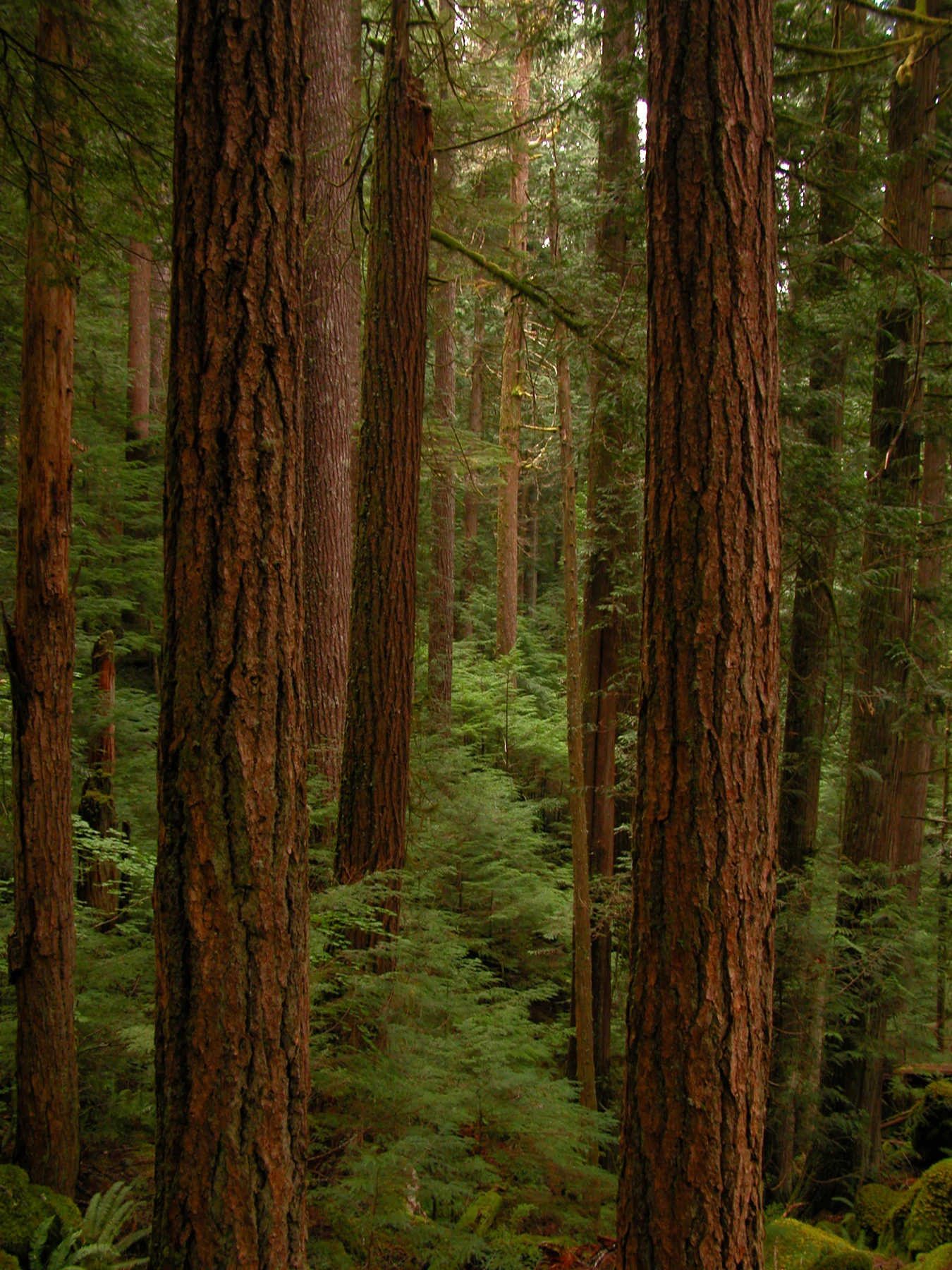
At Grand Teton, Andy had asked whether their next park was three parks wearing one coat. Augie had wanted to know whether the coat had pockets for the ocean.
Now Allie opened their Olympic National Park page and drew three enormous pockets.
“Mountain,” she labeled the first. “Rain forest. Coast.”
“Snack,” Augie corrected the third.
“The ocean goes there.”
“It can share.”
Olympic was on Washington’s Olympic Peninsula, in the northwestern United States. On their map, Pacific water lay to the west, mountains crowded the middle, and forested valleys reached between them.
Ana studied the pictures. One showed snowy heights. Another looked as though a green blanket had been draped over every branch. A third had ocean waves and tall rocks standing offshore.
“How can those all belong to one park?” she asked.
Andy examined his rain jacket. “Mine only has room for two gloves and a mysterious old raisin.”
Mom and Dad had planned a visit with separate outings and plenty of travel time. Roads did not run straight across the wild mountain interior to connect every picture. Choosing a place on the map was not the same as being able to walk there before lunch.
Allie wrote their case: WHO PACKED SUCH DIFFERENT WORLDS INTO OLYMPIC?
Augie pointed outside. A drop slid down the window.
“Someone forgot to close the water pocket.”
Their first clue would be water. But they were about to discover that water had several disguises, and that the same park could give it very different jobs.
2. A cloud delivers the shopping
Before their forest outing, their parents checked the forecast for that particular area, rather than trusting the weather somewhere else on the peninsula. Everyone packed suitable layers and rain protection.
Andy put on his hood.
“I am now a portable mushroom.”
“Please don’t grow out of the seat,” Ana said.
At a weather display, they learned how Pacific storms brought moisture toward the Olympic Mountains. When moist air was pushed upward, it cooled. Water vapor could condense into cloud droplets, and precipitation could fall as rain or snow.
Allie drew an arrow coming in from the ocean, then curving over a mountain.
“Air can go up even when there isn’t a road,” she said.
“Very unfair,” Andy replied. “Does it need a reservation?”
The western slopes and valleys received much more precipitation than some places northeast of the mountains. On the downwind side, air that had lost moisture could descend and warm, making conditions relatively drier. This was the rain-shadow effect.
Augie searched their drawing for a black patch.
“Where is the shadow?”
“It isn’t the mountain’s shadow from sunlight,” Ana explained. “The name describes the difference in precipitation.”
“So rain has a confusing name.”
The pattern did not mean the east side never got rain or the west side never saw sunshine. Weather changed from day to day, and location and elevation mattered.
Allie added a note beneath her arrows: A PATTERN, NOT TOMORROW’S FORECAST.
Andy drew a cloud unloading a shopping bag.
“Delivery for the forest. Twelve thousand imaginary buckets.”
“Imaginary,” Allie underlined firmly.
3. The forest that wears its garden
On a suitable rain-forest path, green seemed to have escaped from the ground and climbed into the trees. Moss hung from branches. Ferns spread below. Drops gathered, trembled, and fell.
Augie tilted his head back.
“The trees have hair.”
“Excellent hair,” Andy said. “Mine does that after sleeping in the car.”
This was a temperate rain forest. It was wet, but it was not a tropical jungle with the same climate and species as the Amazon. Olympic’s lowland rain forests had relatively mild conditions, abundant moisture, and their own communities of living things.
Ana compared a bigleaf maple in a park picture with a nearby conifer. Their shapes were different. Even a forest that looked like one great green wall contained many kinds of plants.
Allie found another useful word: epiphyte. An epiphyte grows on another plant for support. Mosses and ferns could occupy branches without being the tree’s leaves.
“So the garden is sitting on the garden,” Andy said.
“They aren’t all stealing food from the tree,” Ana added. “Growing on something and being a parasite aren’t the same thing.”
They stayed on the trail rather than pulling a mossy curtain down for a closer look. The dangling growth was somebody’s living surface, not a costume for visiting children.
Augie tucked his hands into his pockets.
“I can admire the hair.”
Allie listened. A drip landed on a leaf with a tiny tap; another struck the path with a softer sound. The forest was handling water at many levels, from the canopy above to fallen leaves below.
Their ocean delivery had not simply landed and disappeared. It was part of the whole green arrangement.
4. The tree nursery with no cribs
Beside the path lay a fallen trunk covered with small plants.
“Somebody forgot to tidy up,” Andy said.
Ana pointed to a row of little trees growing from it.
“Or somebody opened a nursery.”
A nurse log was a fallen, decaying tree that could provide a place for seedlings to grow. In a crowded forest, a raised log offered a different starting surface from the forest floor. As it decayed, it could hold moisture and supply nutrients.
Augie looked concerned.
“Does it have a bandage?”
“It’s helping young trees, not working at a hospital,” Allie said.
Fungi and other decomposers helped break down the wood. Insects and small animals used dead wood too. A tree could stop living and still be an important part of the forest’s life.
Andy leaned toward the log without touching it.
“Congratulations on your second career.”
The children studied a park photograph of larger trees with roots reaching around the place where a nurse log had once lain. After the old wood rotted away, a row of trees could remain, sometimes with spaces beneath their roots.
“A disappearing starting block,” Ana said.
“Tree stilts,” Augie decided.
Allie drew a seedling on a log, then a bigger tree with roots reaching down. She made three pictures, because one drawing could not show all the years involved.
Nobody climbed on the soft trunk. Their parents reminded them that delicate new growth and a rotten log were both good reasons to keep their feet on the path.
Andy crossed FOREST MESS off the notebook page.
Underneath, he wrote FOREST WORKSHOP.
It was the first workshop they had visited where the broken furniture was helping build the next furniture.
5. Upstairs, water changes its outfit
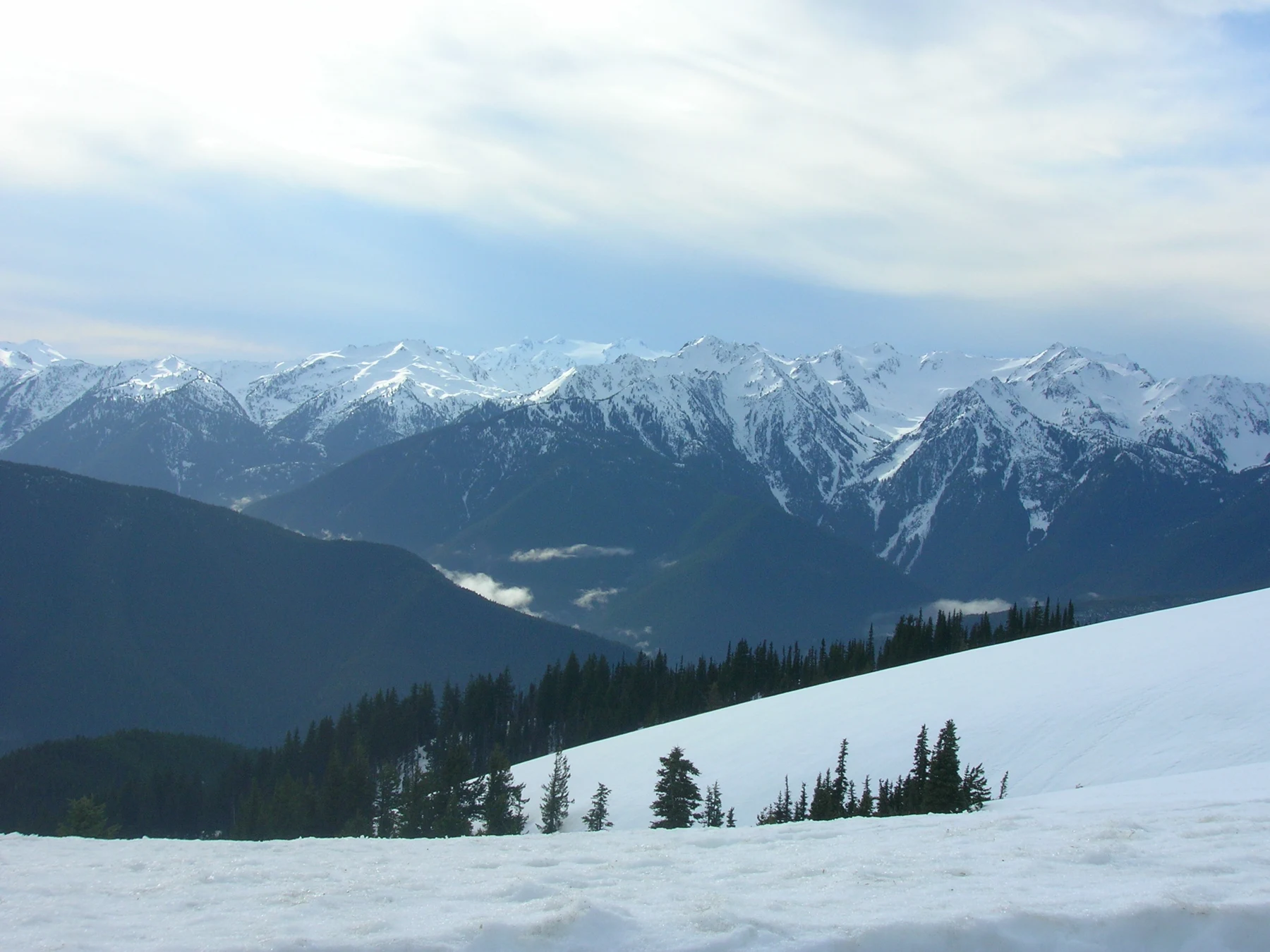
On a different day, the family investigated the mountain pocket through park exhibits and a suitable high-country viewpoint. Their parents checked road access, weather, and trail conditions before choosing where to go.
The children did not need to climb Mount Olympus or step onto a glacier to learn about it. Photographs could bring a dangerous, distant place into the notebook without moving the family into danger.
Andy put his hands on his hips.
“A sensible mountain elevator replacement.”
Allie found snow and ice in the pictures. Higher elevations were generally colder than the lowlands, and precipitation that fell as rain below could fall as snow above when conditions were right.
Snow could accumulate, compress, and become glacier ice. If a sufficiently large mass flowed under its own weight, it was a glacier—not merely any white patch on a slope.
“We met those tools at Grand Teton,” Ana said.
“And Yosemite,” Allie added. “Moving ice can carry rock and reshape valleys.”
Augie drew a glacier wearing a blue raincoat.
“The water changed clothes.”
“Good joke,” Ana said. “Different physical form: ice.”
Ice and seasonal snow could release water as they melted, helping feed streams below. But snowpack and glaciers were not identical. Seasonal snow usually came and went over a shorter cycle; a glacier could preserve ice for much longer while also gaining and losing mass.
Andy wrote WATER STORAGE above the mountain sketch.
Then he added NOT A DRINKING FOUNTAIN.
Their parents had packed drinking water. Clear-looking stream water still needed appropriate treatment before anyone could drink it.
The mountain pocket connected with the forest pocket after all. Some of what fell upstairs would travel downstairs.
6. A fish delivers a parcel
At a river interpretation stop, Ana traced a waterway toward the coast on their map. The children watched from a safe place with their parents, well away from the current.
“Delivery route,” Andy announced.
“For water,” Allie said.
“And fish,” Ana added.
Many Pacific salmon began life in fresh water, migrated to the ocean as they grew, and returned to fresh water to reproduce. Different species and runs had different timing, so a river visit was not a guaranteed salmon performance.
Augie pointed at a picture.
“Does the fish know the way?”
Salmon used several kinds of information during migration, including their sense of smell when locating home waters. The children did not try to reduce a remarkable journey to one magic trick.
“Better than my ability to find my shoes,” Andy admitted.
A healthy river needed more than water flowing downhill. Conditions such as suitable temperatures, access to habitat, and places for young fish mattered. Trees along a river could shade the water; their roots and fallen wood helped shape habitat.
Allie found a surprising connection: salmon could bring nutrients acquired in the ocean back into freshwater and surrounding land ecosystems. After spawning, the bodies of many Pacific salmon fed scavengers and decomposers. Animals could also move fish remains onto land.
“The sea sends a parcel inland,” Ana said.
“Smelly parcel,” Andy replied.
Augie wrinkled his nose at the illustration.
“Do not put that in the snack pocket.”
Their arrows now ran both directions. Rivers carried water toward the ocean, while migrating fish could help carry ocean-derived nutrients back. The coast and forest were neighbors in a much bigger exchange.
7. The beach with standing stones
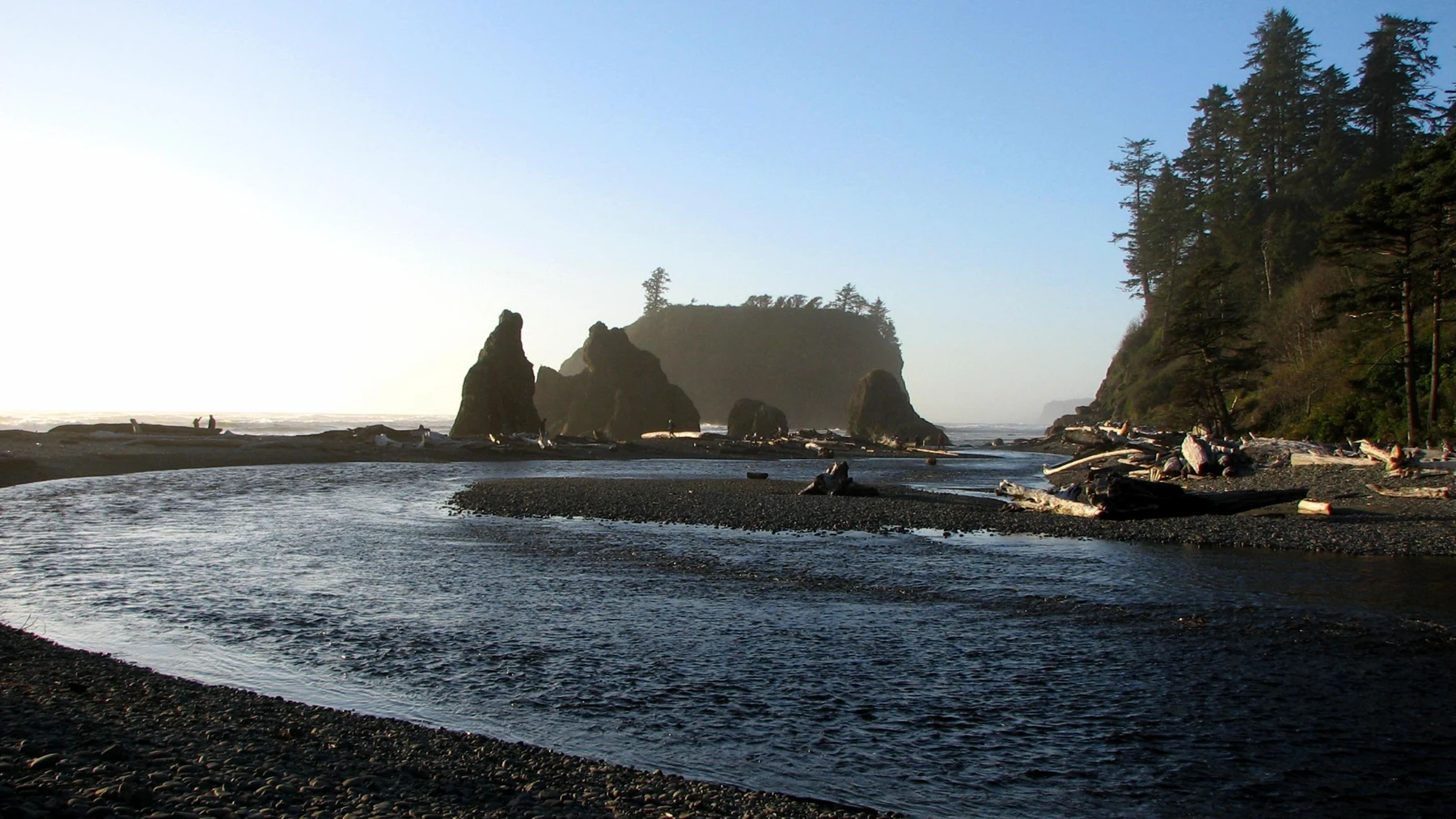
For their coastal outing, their parents checked local tides, surf forecasts, closures, and access. They chose a suitable viewing place and kept everyone together, well away from breaking waves and surf-tossed driftwood.
The Pacific sounded larger than anything in the notebook.
Augie listened carefully.
“Same ocean voice as Acadia. Different side.”
“Acadia was the Atlantic,” Ana said. “This is the Pacific.”
Andy looked toward a tall offshore rock. “That one forgot to come back to land.”
Sea stacks were rocky remnants standing near the coast. Waves attacked coastal rock, but differences in rock strength and structure affected what wore away fastest. Resistant pieces could remain while surrounding material eroded.
Allie sketched the stack and the water around it. The ocean did not build it by piling wet sand into a tower. It helped reveal and reshape what was already there.
Drift logs lay higher on the shore. Some had begun as trees beside rivers, then traveled downstream and out toward the sea. The family admired them from a safe distance. A log that seemed impossibly heavy on land could be moved by powerful surf.
“No climbing the ocean’s furniture,” Andy said.
They remembered their Acadia lesson: low tide did not turn waves off. They would not follow a headland route or explore an arch just because an attractive photograph showed someone could be there at another time.
Ana added a coast arrow to the map: FOREST WOOD CAN TRAVEL HERE TOO.
Augie nodded toward the sea stack.
“Maybe it is waiting for the furniture delivery.”
8. A neighborhood between tides
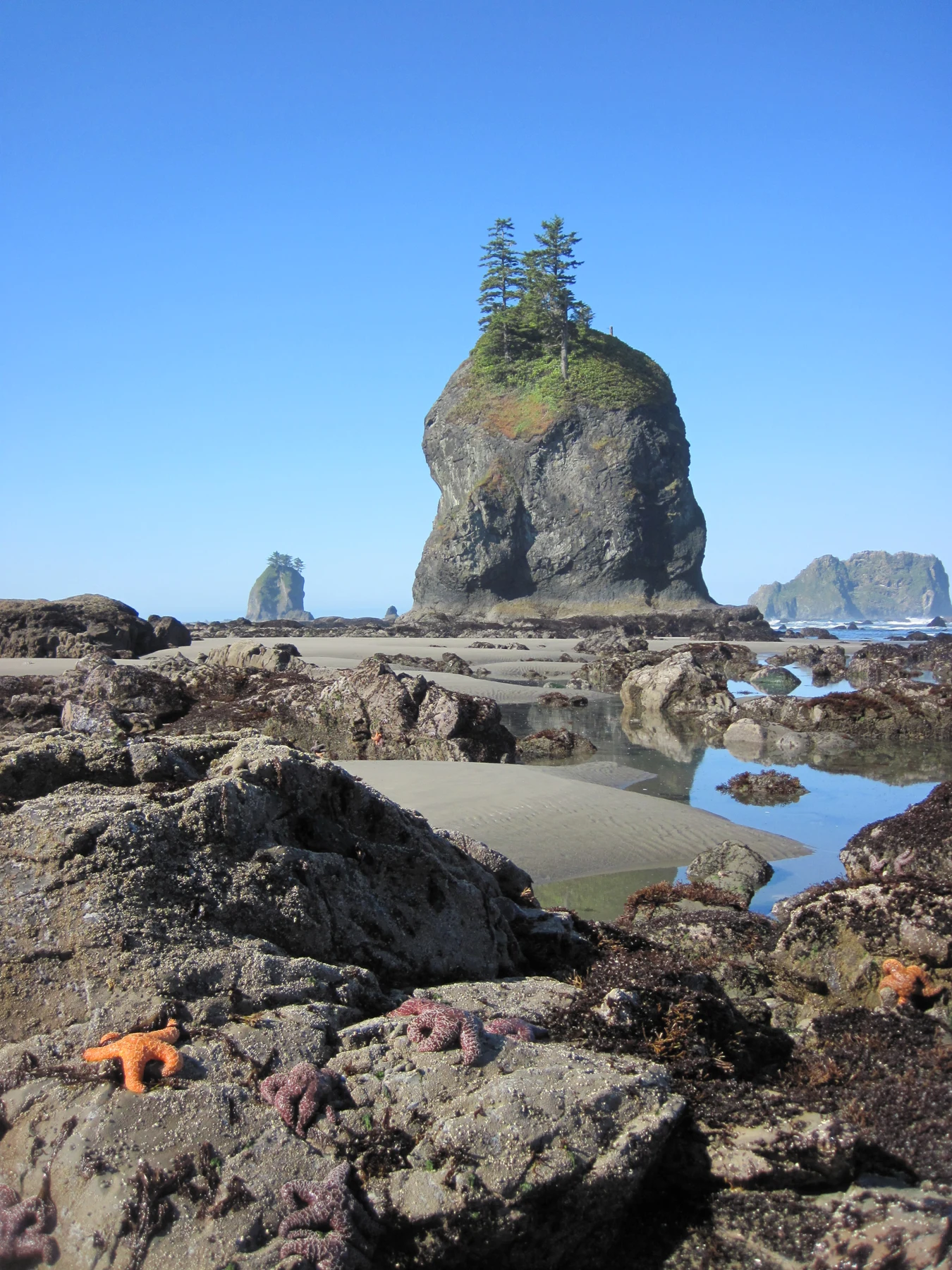
The family used park photographs to examine a tide pool closely. Conditions were not an invitation to scramble among slippery rocks, and the pictures offered a clear view without rushing their coastal stop.
An anemone spread tentacles in the water. A sea star clung to rock. Mussels crowded together.
Andy whispered, “Ocean Hotel, Pacific branch.”
“Same kind of connection,” Ana said. “Different residents and conditions.”
An anemone was an animal, despite its flowerlike appearance. Its tentacles helped catch food. Sea stars were animals too; their tube feet helped them move and hold on. A creature did not need a familiar face or legs to be busy living.
Augie counted arms in a picture, then tried to count all the mussels.
“The hotel is full.”
Organisms in the intertidal zone faced changing exposure to air, waves, drying, and temperature. A tide pool retained seawater, but it was connected to the larger shore system rather than being a sealed, unchanging aquarium.
Allie drew a dotted border around her pool. “This edge is temporary.”
The children would leave animals attached, shells in place, and rocks undisturbed on any suitable future tide-pool visit. Looking carefully did not require peeling a sea star from its home.
Andy drew a manager’s sign: GUESTS MAY REMAIN EXACTLY WHERE THEY ARE.
They had not found three unrelated parks stuffed into one coat. Mountains, forests, rivers, and coast exchanged water and materials. The differences were real, but so were the connections.
Augie considered the drawings.
“Very complicated pockets.”
9. Whose coat is it, anyway?
That evening, Allie spread the notebook pages across the table. Their parents helped them make room without letting a drinking cup become a surprise lake.
Ana noticed that the map’s park boundary did not contain every river, every weather system, or every animal’s journey.
“The connections keep going outside the line,” she said.
They had also learned about the Olympic Peninsula’s Tribal nations. The Hoh, Quileute, Makah, Quinault, Klallam communities, and Skokomish had enduring relationships with these lands and waters. These were living communities with their own histories and voices, not characters the children could invent for an old-fashioned story.
Allie wrote: LEARN FROM THE PEOPLE WHOSE HOME THIS IS.
A park visit could introduce questions about stewardship, fishing, forests, and the meaning of a place. It could not tell every community’s story in one afternoon.
Andy added a fourth pocket to their coat drawing.
“People?” Ana asked.
“Questions. We brought home too many.”
They reviewed the case. Pacific moisture, mountain height, rain shadows, changing water, growing and decaying trees, rivers, salmon, and waves all helped explain the park’s different worlds.
Augie supplied the final conclusion.
“One coat. Many pockets. No fish in my snack.”
Allie turned to the next page: Glacier National Park.
Andy saw mountains and lakes in a photograph.
“More ice?”
“More clues,” Ana said. “And we should ask what the name tells us—and what we still need to find out.”
Augie drew a tiny question mark wearing mittens.
Their weather-closet case was closed. The notebook, happily, was not.
Explorer’s notebook
Nine discoveries to take with you
- Olympic National Park is on Washington’s Olympic Peninsula.
- Pacific storms bring moisture toward the mountains.
- The rain-shadow effect helps explain wetter western valleys and relatively drier places downwind.
- A temperate rain forest differs from a tropical rain forest.
- Epiphytes grow on other plants for support; this does not automatically make them parasites.
- Nurse logs and decomposers help support new forest life.
- Mountain snow and glaciers store water differently and can feed streams as they melt.
- Migrating salmon connect ocean, rivers, and land ecosystems through their lives and nutrients.
- Coast, rivers, forests, mountains, and human communities remain connected across park boundaries.
Five ways to explore thoughtfully
Plan with an adult using current area forecasts, road and trail conditions, tide and surf guidance, accessibility information, and your family’s abilities. These are choices across a visit, not a one-day checklist.
- Compare a mountain, rain-forest, and coastal photograph. List clues about moisture and temperature.
- Observe mosses and ferns along an appropriate forest trail without pulling them from branches.
- Sketch a nurse log from the path, showing young plants and roots without climbing on it.
- Investigate salmon through an exhibit or suitable river viewpoint. Stay clear of swift water; sightings depend on season and conditions.
- View the coast from a safe location, or explore intertidal life through park photographs when shore conditions are unsuitable.
Three questions for the crew
- How is a rain shadow different from a shadow made by sunlight?
- How can a fallen tree still help a forest?
- Can you draw one connection from mountain to ocean, and another from ocean toward land?
Words worth keeping
- Precipitation: water falling from the atmosphere, including rain and snow.
- Rain shadow: a relatively drier area downwind of mountains that affect passing moist air.
- Epiphyte: an organism such as a moss or fern growing on another plant for support.
- Nurse log: a fallen, decaying tree that provides a growing place for seedlings.
- Decomposer: an organism that breaks down dead material and helps recycle nutrients.
- Sea stack: a coastal rock remnant standing apart from the shore.