1. The volcano identification committee
Augie had suggested a helmet for a volcano at the end of their Black Canyon chapter. On a later family journey to northern California, Andy drew one.
It had a chin strap large enough to wrap around a mountain.
Ana inspected the picture.
“How would you find its chin?”
“Geological survey,” Andy said confidently.
Allie opened the real guide before the helmet acquired matching boots. They were visiting Lassen Volcanic National Park, a landscape of volcanic peaks, forests, lakes, meadows, and places where underground heat reached the surface.
The family began with a manageable visit in the southwest area, using currently open places selected by their parents. The adults had checked access, snow, weather, air quality, and any closures. They had water, food, layers, and a plan that allowed plenty of time to stop.
Nobody was going to climb four mountains before lunch.
Ten-year-old Allie wrote the day's question: Why don't all volcanoes look alike?
Nine-year-old Ana drew four empty boxes. Seven-year-old Andy drew four volcanoes wearing different hats. Four-year-old Augie supplied a very small cloud over each one.
“Those could mean different things,” their parent said, pointing to the clouds. “We should find out before we label them.”
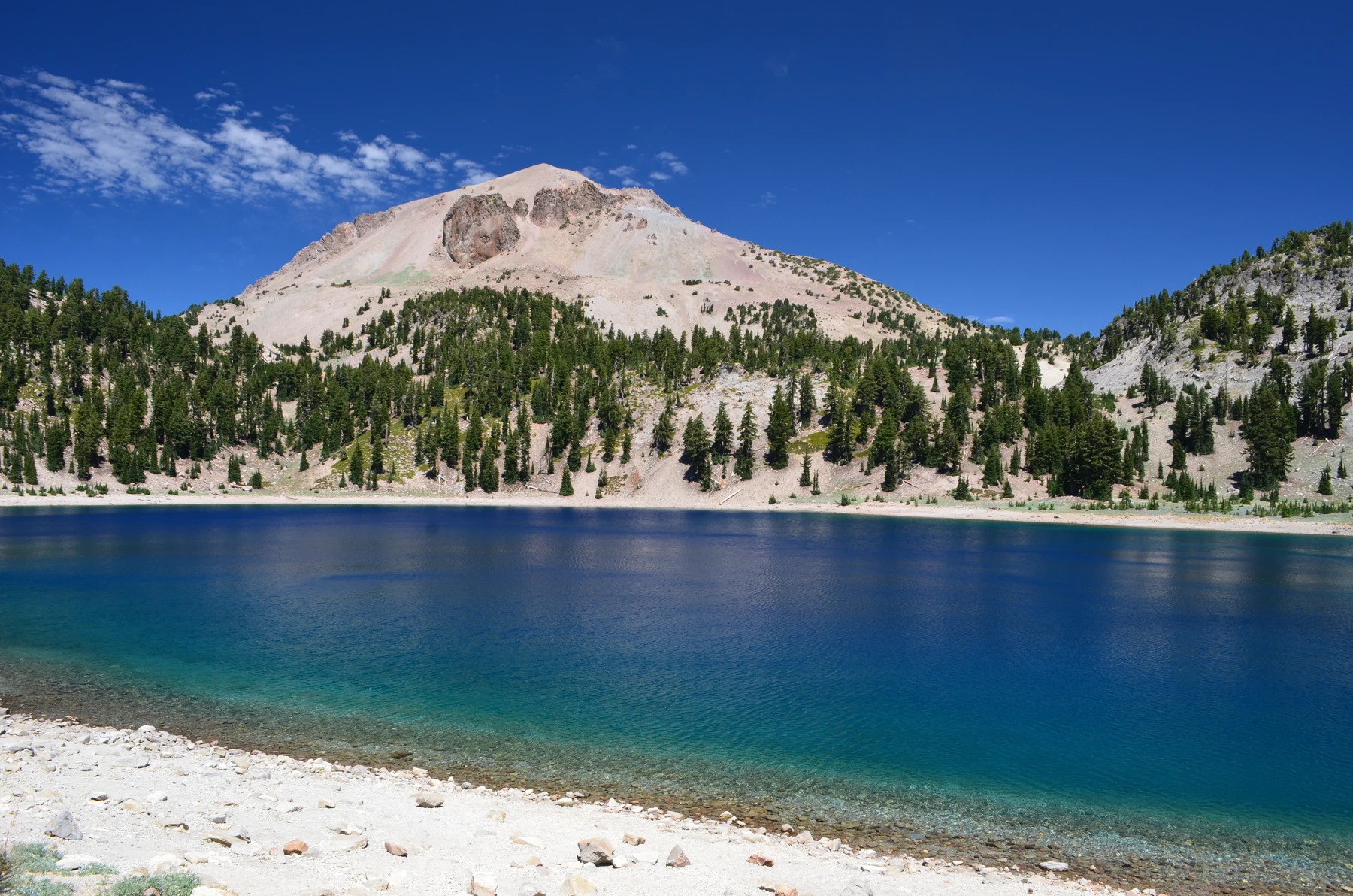
A photograph showed Lassen Peak rising behind the blue water of Lake Helen. The mountain did not resemble the neat triangle Andy had always drawn when someone said volcano.
Ana added a second question: What built the shape?
The park offered examples of four primary volcano types: lava dome, cinder cone, shield, and composite. That did not mean the whole park contained only four individual volcanoes, or that every volcano on Earth fitted perfectly into four tidy boxes.
Augie looked at their page.
“Four boxes. Lots of mountains.”
“Exactly,” Allie said. “A sorting tool, not the entire story.”
Andy put the helmet in a fifth box labeled equipment not requested by the mountain.
The volcano identification committee was ready to begin.
2. The mountain that wouldn't spread out
Lassen Peak gave them their first type: a lava dome, also called a plug dome.
Allie helped Augie separate two words. Molten rock below the surface was called magma. When it emerged onto the surface, it was called lava.
“Same material changing address?” Andy asked.
“A useful start,” Ana said. “But let's keep learning.”
Very thick, sticky lava could pile up near a volcanic opening instead of spreading far away. Scientists used the word viscosity for resistance to flow. Highly viscous lava helped build steep domes.
At their rest table, the children made two imaginary paths with arrows. One spread widely from a central point. The other stayed close to the middle and built upward. They were thinking about movement and shape, not producing real lava or heating anything.
Andy tried saying the new word.
“Vis-co-city. A town where everything moves very slowly.”
Ana wrote the correct spelling beside his imaginary street sign.
Augie pointed at the upward arrows. “Sticky mountain.”
“The lava that helped build it was very resistant to flowing,” Allie explained. “Today's mountain is solid rock.”
Their parent added an important complication. A dome was not a guarantee of gentle behavior. Dome growth could happen as part of a volcanic history that also included explosive events. Shape alone could not tell a visitor what would happen next.
Andy erased quiet volcano from his first box and replaced it with lava dome.
Ana approved. A description of how a feature formed was more useful than a promise it had never made.
The photograph let them study Lassen Peak without adding a summit climb to their day. Its snow patches, uneven slopes, and rocky outline contained more detail than their first triangle.
Augie removed the little cloud from his drawing and saved it for later.
“Needs checking,” he said.
Their first box now contained a name, a broad shape, a formation idea, and one very slow imaginary city.
3. A cone built from flying pieces
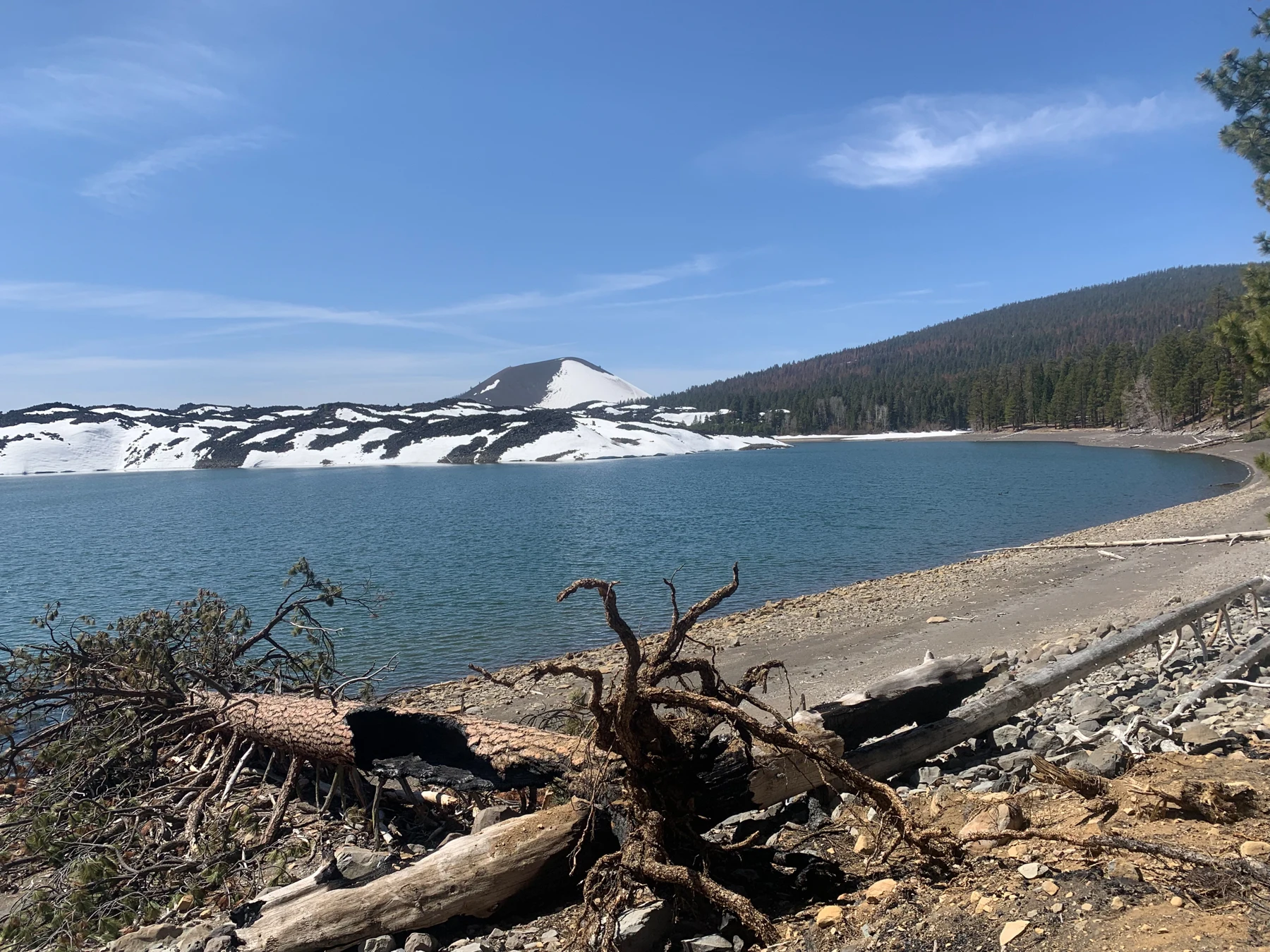
The next photograph took them to another part of the park without requiring another drive.
Across Butte Lake, dark lava rock lay beneath volcanic slopes. The image included Cinder Cone and Prospect Peak, two names that would soon belong in different boxes.
Andy studied Cinder Cone.
“That one looks more like my drawing.”
“A better resemblance,” Ana agreed. “Now explain it.”
Cinder cones grew as fragments thrown out of a vent accumulated around it. Pieces of lava cooled and solidified, building a steep-sided pile. The fragments could contain holes left by gas bubbles. Many cinder cones had a crater near the top, and lava flows could also be associated with them.
The word cinder did not mean the mountain was a heap of ordinary campfire ash. These were volcanic materials, formed through eruption processes.
Augie checked the picture for a fireplace.
“Not one.”
Allie drew a vent, then arrows showing fragments falling around it. Ana added a key so nobody thought the arrows were directions for visitors to follow.
Andy drew a sign reading falling-rock delivery service.
“No deliveries today,” their parent reminded him. “We're learning from a photograph and a guide.”
Their family was not climbing Cinder Cone, stepping onto loose slopes, or collecting volcanic pieces. The picture gave them an overview that could support a question without turning into an itinerary.
Allie asked whether the image alone could tell them the exact age of the cone.
Ana shook her head. Scientists used evidence to investigate eruption history; a mountain did not wear a reliable birthday badge.
Andy offered to draw one.
“That would make the problem worse,” Ana said.
Augie placed the second label in its box: cinder cone — built largely from erupted fragments.
The four clouds in their original drawing had looked identical. Already, the committee had found two very different ways to build a volcanic shape.
Andy left the birthday badge in the imagination box beside the enormous helmet.
4. The volcano in a wide-brimmed hat
Prospect Peak introduced their third type: a shield volcano.
Its broad profile offered a different clue from the steep little cone. Shield volcanoes formed largely from repeated flows of relatively fluid lava. Lava spreading across a wide area could gradually build a broad shape with gentle overall slopes.
Andy drew the outline as a hat with an exceptionally wide brim.
“Not an actual hat,” Ana said.
“I have developed a labeling system.”
He wrote shape comparison beneath it before she could add anything else.
Allie returned to the viscosity page. Lava that flowed more readily could travel farther from a vent than the very viscous lava that tended to pile up into a dome. Repeated activity mattered too; the whole shape was not necessarily the product of one flow.
Augie traced an outward arrow, then another on top of it.
“More goes over old?”
“In a broad sense, yes,” Allie said. “A volcano can build through repeated events.”
Their parent asked what the word gentle described.
“The overall slopes,” Ana replied.
“Does it promise a harmless place?”
“No.”
The children underlined that distinction. A broad volcano was still a volcanic landscape, with its own history and hazards. They would not judge access, eruption risk, or a route's suitability from a silhouette.
At the table, Andy stacked several paper outlines to suggest successive flows spreading out. Allie pointed out that flat paper did not behave like hot lava. They were showing an idea about repeated spreading, not recreating the physical process.
Ana gave the model two labels: what it helps us picture and what it leaves out.
Augie put an arrow in the first box and almost everything else in the second.
“Honest model,” their parent said.
Their third volcano type had no dramatic pointed hat, no enormous helmet, and no obligation to match a child's first drawing. The wide shape itself was a clue worth noticing.
5. The volcano with missing pages
The guide introduced Brokeoff Mountain, whose present outline was part of a much larger story.
“Fourth volcano?” Andy asked.
“Part of an older one,” Allie replied.
Brokeoff Mountain was a remnant of Brokeoff Volcano, also called Mount Tehama. This had been a composite volcano, a kind also known as a stratovolcano. Repeated eruptions built layers of lava and fragmental material such as ash and cinders.
The original volcano no longer stood as a complete, neat cone. Erosion, including glacial action, and hydrothermal alteration had helped change it. Mountains that were once connected parts of a larger volcanic structure now appeared as separate remnants.
Ana drew a simple outline around several peaks in their learning sketch, marking it as a reconstruction idea from the guide rather than something they could directly see.
Augie considered the missing part.
“Some pages gone.”
“Like a book whose remaining pages help you investigate the story,” Allie said.
Andy immediately drew a volcano-shaped book. It was a difficult item to fit on a shelf.
Their parent helped them compare this with Black Canyon. There, the children had separated the age of old rock from the later cutting of the canyon. Here, they needed to distinguish the building of a volcano from its later alteration and erosion.
The present outline contained more than a construction story.
Ana put build and change on opposite sides of the page. She joined them with a timeline instead of selecting only one explanation.
Allie asked whether a mountain that looked incomplete had failed at being a volcano.
“No,” Andy said. “It has a longer biography than my drawing.”
Augie put a book cover around their fourth box.
The committee now had four formation ideas. But the photographs had also shown that categories were only a beginning. Time could alter a shape, eruptions could vary, and one volcano's history could contain several kinds of activity.
Andy closed the paper volcano book very carefully. It still had a mountain-shaped bookmark sticking out.
6. The ground is not a kitchen

One cloud from their original drawing finally found a useful question.
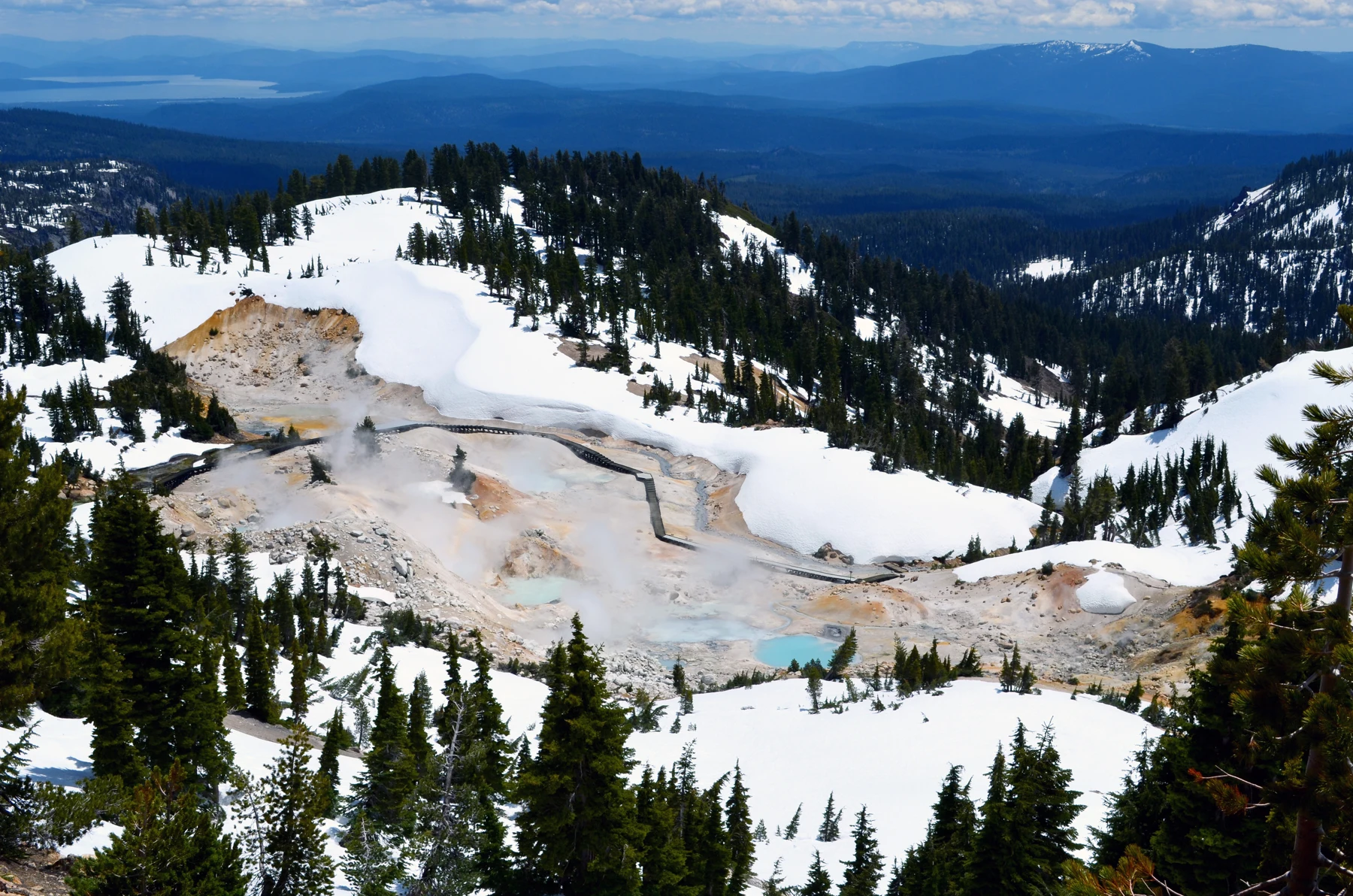
A photograph showed a colorful hydrothermal basin at Bumpass Hell, with steam rising and a boardwalk crossing the ground. The family studied the photograph; this was not an extra hike squeezed into their southwest outing.
Later, at a currently open viewing place selected by their parents at Sulphur Works, the children stayed on the established walkway and behind barriers. The adults kept Augie close. They could observe without touching water, leaning over a feature, or stepping onto the surrounding ground.
“What heats it?” Ana asked.
Rain and snow supplied water that could move underground. Hot rock and magma at depth provided heat. Heated water and steam could return toward the surface through openings and cracks, producing hot pools, mudpots, and steam-and-gas vents called fumaroles.
Hydrothermal joined an idea about water with an idea about heat. It did not mean molten lava was bubbling in every pool.
Andy drew a tiny kettle, then crossed it out.
“No kitchen staff.”
“And no cooking,” their parent said.
Ground near these features could look firm while hiding dangerous hot water or mud below a thin crust. The family would never test it with a foot, stick, or hand. Footprints elsewhere were not proof of safe ground.
Augie looked at their protected place to stand.
“Questions from here.”
“Exactly,” Allie said.
They listened quietly, staying together and following current instructions. Their imagined volcano clouds had become several separate ideas: weather clouds, visible vapor near a hot-water feature, and eruption clouds described in historical information.
Ana gave each idea its own label.
The clouds were not interchangeable, and one look at a plume would not tell the children what was happening underground.
Andy put the unused cloud back in the drawing box. Their most useful discovery was not a new piece of equipment. It was learning when a question should stay on the safe side of a barrier.
7. A mountain with a recorded history
The next part of their investigation happened in learning materials, far from any attempt to watch an eruption.
Lassen Peak erupted between 1914 and 1917. A particularly powerful explosive eruption occurred in May 1915. Photographs and written observations helped preserve information about those events.
Augie looked at the dates.
“Before us?”
“Before all of us,” their parent said.
Andy began to ask whether that included the sandwiches, then decided the joke had already traveled quite far enough from their Voyageurs chapter.
Allie drew two columns: what people recorded then and what scientists measure now.
Scientists studied the volcanic center using several kinds of evidence. Earthquake monitoring, measurements of ground changes, gases, and geological history could help them understand activity. A volcano was not monitored by simply asking whether a visitor thought the mountain looked sleepy.
Ana drew a sleeping face on Andy's first triangle, then put a clear line through the prediction beside it.
No giant snore = no scientific conclusion.
Their parent explained that monitoring could improve understanding and warnings without producing a perfect timetable for every future event. The children would follow current park and scientific guidance rather than try to forecast an eruption themselves.
Augie tapped the date column.
“So a mountain can have different chapters.”
“Yes,” Allie said. “Its dome shape, its later eruptions, and its hot-water system tell related parts of the story.”
They returned to the four boxes. The boxes described broad volcanic forms, but they did not erase individual histories. Lassen Peak could be a lava dome and also have an explosive eruption history. Those were compatible pieces of information.
Andy gave his volcano book a table of contents.
Ana smiled. “That is much more helpful than a helmet.”
The helmet remained available for fictional mountains only. Real volcanic learning required evidence, expertise, and attention to changing information.
The committee added a final heading beneath its measurements page: keep learning; don't pretend to predict.
8. More than a collection of volcanoes
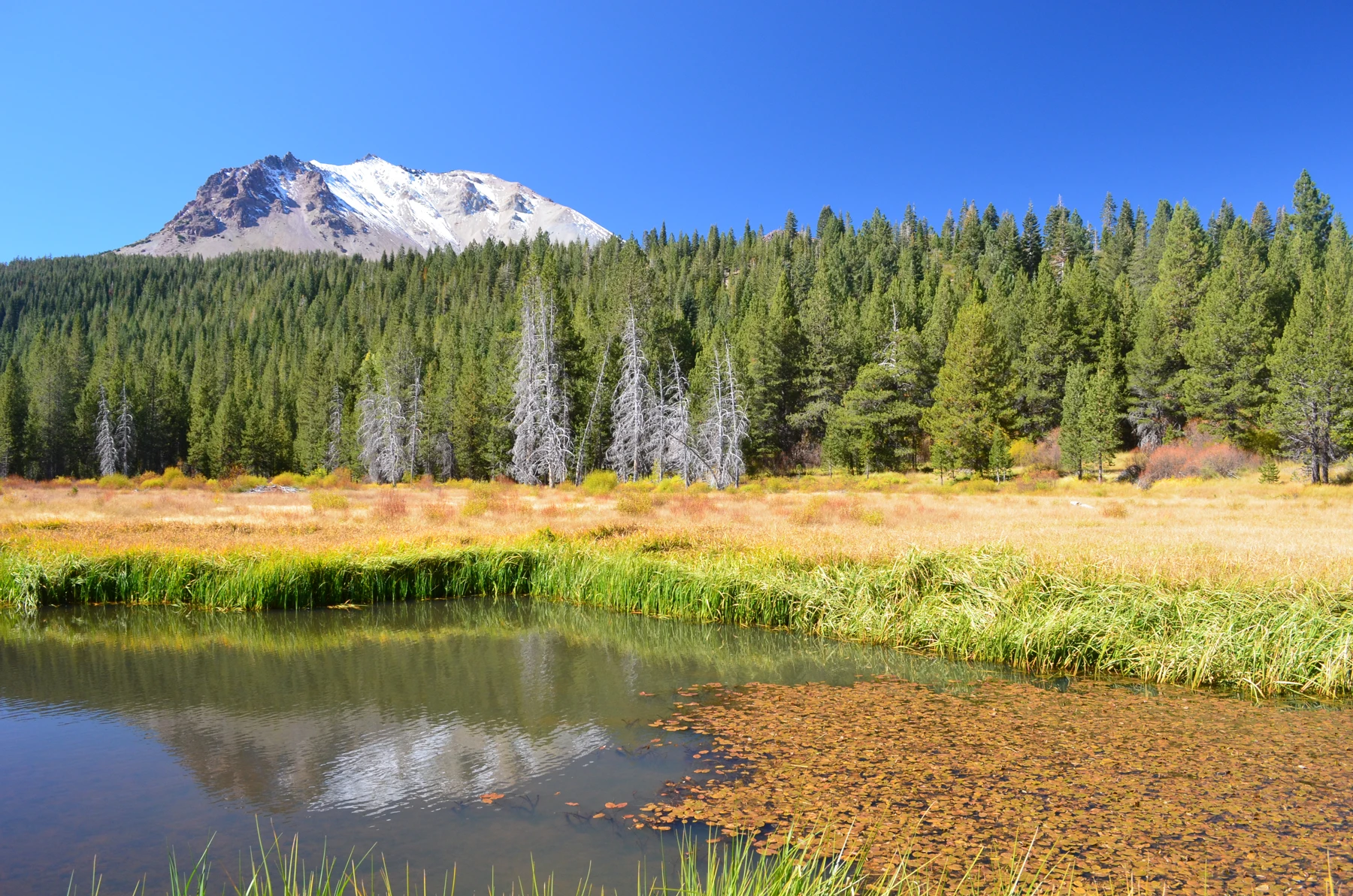
Outside their geology boxes was a much wider park.
Lakes reflected peaks. Meadows, forests, and creeks added living habitats to the volcanic landscape. The children could study those relationships without assuming that every interesting part of Lassen had to be hot, bare, or bubbling.
Andy drew a frog demanding its own chapter.
“Reasonable request,” Ana said. “We're running low on pages.”
Their parents explained that the region was also a homeland, not an empty landscape waiting for a park name. The park described long relationships involving Atsugewi, Yana, Yahi, and Maidu peoples. These were distinct peoples and histories, not four interchangeable cultural labels to match the four geology boxes.
Allie moved the human-history page out of the sorting exercise altogether.
“Different question,” she said. “Different way to learn.”
They learned that Kohm Yah-mah-nee meant Snow Mountain in Mountain Maidu. The visitor center's name offered a starting point for further learning. Tribal members had also contributed to interpretation, exhibits, and the sharing of publicly offered knowledge.
Ana wrote continuing relationships, with an arrow pointing beyond their visit.
Their parents helped them recognize that colonization and settlement had caused severe harm to Indigenous communities. Present-day cultures and connections persisted despite those losses. The family would learn from community voices and respect knowledge, objects, and places not offered for visitors to use or copy.
Augie put his pencil down for a moment.
“More listening.”
There was another reason not to treat a picture as a complete account. Wildfire had changed parts of the park. Earlier photographs could show forests unlike those seen during a later visit. Parents needed current information about closures, damaged areas, smoke, and suitable routes.
Andy added a date box to their imaginary photograph captions.
“A picture has a chapter too.”
Allie liked that. Their four boxes had helped them begin, but the landscape was not a display cabinet. It held ongoing geological change, living habitats, human histories, and choices about how visitors cared for the place.
9. Four boxes, more questions
At the last rest stop, Ana placed the four labeled pages side by side.
“Committee report,” she announced.
Andy sat up straight. Augie held an imaginary microphone. Allie tried not to laugh before the meeting had officially begun.
“Lava dome,” she said, pointing to Lassen Peak. “Very viscous lava can pile up near an opening.”
“Cinder cone,” Ana continued. “Erupted fragments build around a vent.”
“Shield,” Andy said. “Repeated, relatively fluid lava flows help build a broad form.”
Augie pointed to the last page.
“Book with some pages gone.”
“Composite volcano,” Allie supplied. “Layers from repeated eruptions, with Brokeoff Mountain showing part of an older structure that has changed.”
Their parent asked whether they had visited four summits.
“No.”
“Found every volcano in the park?”
“No.”
“Learned enough to start noticing useful differences?”
All four nodded.
They had used a modest family outing, photographs, maps, and interpretation to investigate a much larger landscape. A good day did not require racing from feature to feature, collecting rocks, or getting closer to hot water.
Ana added one last comparison. At Black Canyon, they had asked how moving water helped remove rock. Here, they had asked how erupted materials helped build landforms. Erosion, heat, and water complicated both stories in different ways.
Andy looked at the helmet drawing again.
“Still no chin.”
“An excellent reason to retire the design,” Ana said.
Augie gave it to the imaginary frog, which now required an unusually large wardrobe.
Their next chapter would take them to Glacier Bay National Park and Preserve, where ice, water, and returning plants would raise a different question about a changing landscape.
Allie left a clean page ready.
The volcano identification committee packed its own rubbish and belongings, stayed together, and closed the meeting. Four boxes had not finished the park. They had given the children four better ways to ask what they were looking at.
Explorer’s notebook
Nine discoveries to take home
- Lassen Volcanic National Park is in northern California. It contains many volcanic features, not just four individual volcanoes.
- The park illustrates four primary volcano types: lava dome, cinder cone, shield, and composite. Categories are useful starting points, not complete biographies.
- Magma is molten rock below the surface; lava is molten rock that reaches the surface. Viscosity describes resistance to flow.
- Lassen Peak is a lava dome. Very viscous lava can pile up rather than spread far from an opening.
- Cinder cones build largely from erupted fragments around a vent. Shield volcanoes grow broadly through repeated, relatively fluid lava flows; Prospect Peak is a park example.
- Brokeoff Mountain is a remnant of the older composite Brokeoff Volcano, also called Mount Tehama. Building and later erosion are different parts of its story.
- Hydrothermal features involve heated water, steam, and gases. They are not pools of lava, and their ground and water can be extremely hazardous.
- Lassen Peak erupted between 1914 and 1917. Scientists monitor the volcanic center using several forms of evidence; visitors should follow current guidance.
- Indigenous histories, continuing community knowledge, forests, meadows, lakes, and changing habitats all belong in the story of this park.
Five small adventures
- Make a volcano comparison page. Draw broad profiles for a dome, cinder cone, shield, and composite volcano. Add a park example and a formation clue. Label the drawings as simplified comparisons, not identification rules that work from every angle.
- Follow two imaginary lava paths. On paper, compare arrows spreading widely with arrows building near an opening. Explain viscosity in your own words. Keep it a drawing activity; no heating, chemical reactions, or real rock collection is needed.
- Separate building from changing. Draw an imagined complete composite volcano, then show how erosion might alter it. Use the Brokeoff example from a reliable source without claiming your reconstruction is an exact picture of the old volcano.
- Sort the cloud questions. Make three labeled sketches: a weather cloud, vapor near a hydrothermal feature, and a historical eruption cloud. Write what evidence you would need to tell the stories apart. Never approach a feature or plume to investigate.
- Write a modest expedition plan. With a grown-up, list what to check before a visit, one safe activity, and a photograph or exhibit that could teach you about a place you will not physically visit. Include time to rest and a way to change the plan.
Talk it over
- Why doesn't the title mean there are only four individual volcanoes in the park?
- How can the way lava moves help influence a volcanic shape?
- How can a lava dome also have a history involving explosive eruptions?
- Why is apparently solid ground near a hot-water feature not a place to test with your feet?
Words for your explorer pack
- Magma: molten rock beneath Earth's surface.
- Lava: molten rock that has emerged onto the surface.
- Viscosity: resistance to flow; very viscous material does not spread readily.
- Vent: an opening through which volcanic material or gases can reach the surface.
- Cinder: a volcanic fragment, often with gas-bubble holes, ejected during an eruption.
- Composite volcano: a volcano built through repeated eruptions of lava and fragmental materials; also called a stratovolcano.
- Hydrothermal: involving heated water.
- Fumarole: an opening that releases steam and volcanic gases.