1. Please remain seated, canyon
Andy had drawn a river holding a spoon at the end of their Voyageurs chapter. On a later journey to western Colorado, he added running shoes to the canyon walls.
Ana looked over his shoulder.
“If those start running, I'm getting back in the car.”
“The title says fast walls,” Andy explained.
Allie smiled. “Perhaps we should investigate what that could mean before you give the mountain a training schedule.”
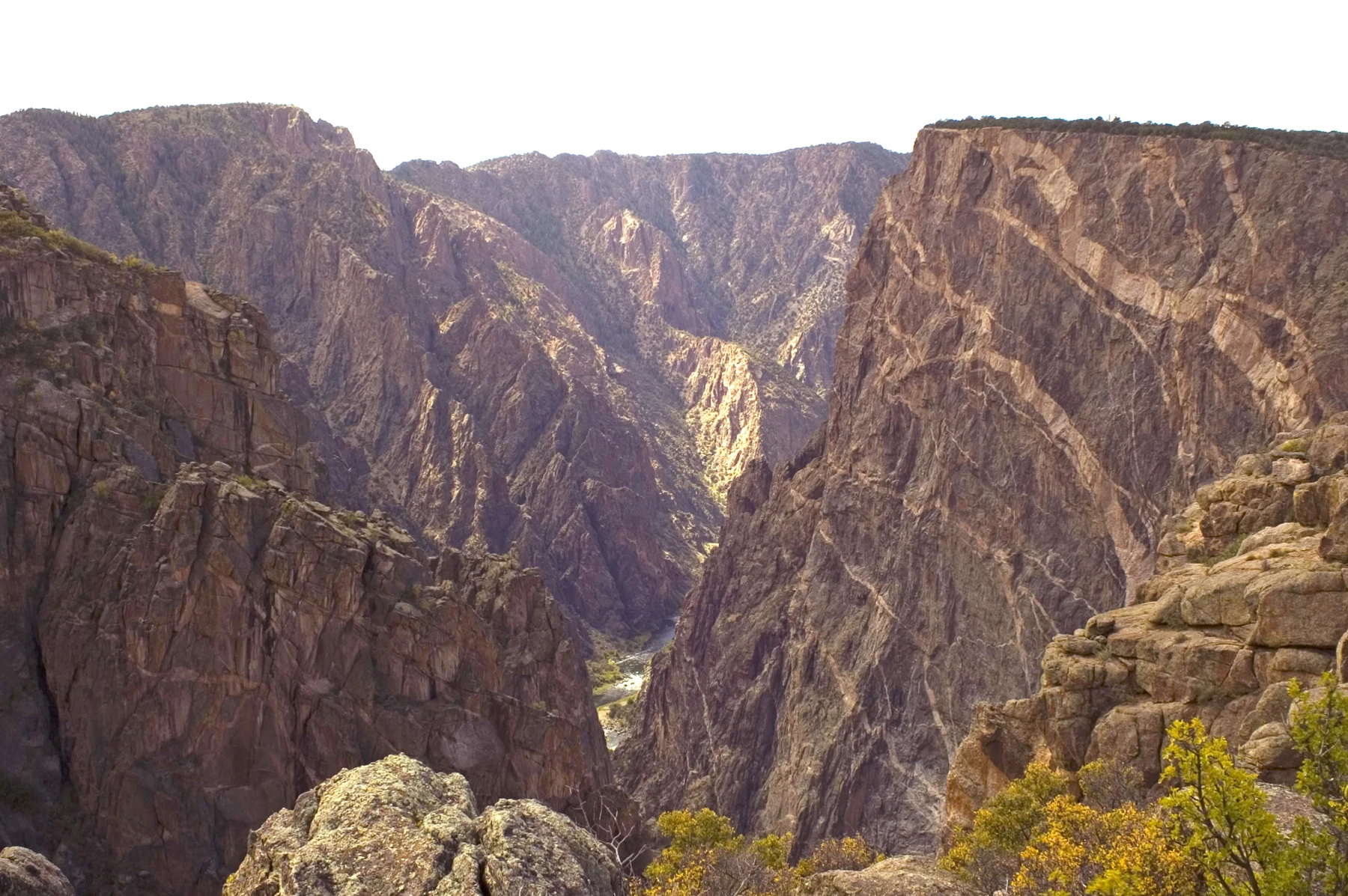
The four children were visiting Black Canyon of the Gunnison National Park, where steep rock walls enclosed a much narrower world below. A photograph of the Painted Wall showed pale streaks crossing dark rock, autumn color near the rim, and a depth that made Augie hold his notebook a little tighter.
“Big crack,” he whispered.
Their parents had planned a short South Rim visit using currently open places suitable for the family. They had checked conditions, weather, access, and any closures. They carried their own drinking water and layers, and nobody was planning a scramble down to the river.
At the viewpoint chosen by the adults, the children stayed well back from edges and behind any barriers. Their parents kept Augie close. A better view was never worth climbing onto a rock or leaning over a railing.
Ten-year-old Allie opened a fresh page. Nine-year-old Ana prepared the questions. Seven-year-old Andy supplied a canyon with sneakers. Four-year-old Augie supplied a firm request that the canyon remain seated.
Allie wrote: How could moving water make walls like these?
From their safe viewing place, the canyon seemed too solid to have been changed by something that flowed out of a tap at home.
Andy held his pencil above the little spoon.
“Either the river has been very busy,” he said, “or this is an extremely small tool.”
Ana gave the drawing its own corner. The real investigation would need rock, water, and a great deal of time.
2. Who turned down the lights?
The name raised a second mystery.
“Is every rock black?” Augie asked.
A closer look at photographs showed grays, browns, and pale pinkish streaks. Some surfaces caught the light. Others disappeared into deep shadow.
The canyon's steep, deep, narrow shape could keep parts of it shaded even when the sky above was bright. Dark-looking rock also contributed to its appearance. The name did not mean that someone had painted every wall black.
Andy drew a person trying to reach the bottom with an enormous paint roller.
“No,” Ana said, before he had finished the handle.
At their rest table, their parent helped them make a small model. Two upright pieces of cardboard stood close together. A flashlight shone from one side, with the light kept away from everyone's eyes.
Allie watched where the shadow fell. Ana moved the cards farther apart, then changed the light's angle. Augie reported each appearance of the bright strip as though a tiny sunrise needed an official announcement.
“Light arriving!”
“Thank you, dawn department,” Andy said.
Their little model could show a relationship between shape, light, and shadow. It could not reproduce the canyon's exact dimensions, the Sun's whole daily path, or every surface in the real landscape.
Ana added that limitation beneath the drawing. Andy added a cardboard parking space for his paint roller.
Their parent asked whether a shadow was a kind of rock.
“No,” Augie said. “It's where the light isn't getting.”
“Exactly,” Allie replied. “The rock and the lighting both affect what we see.”
Back at a permitted viewing area, they compared a sunlit face with a shaded one without moving toward the edge. The canyon had not changed its rock wardrobe while they ate lunch. Their view depended partly on the light.
Andy crossed giant paint roller off the case list. The running shoes remained under investigation.
3. The river has passengers
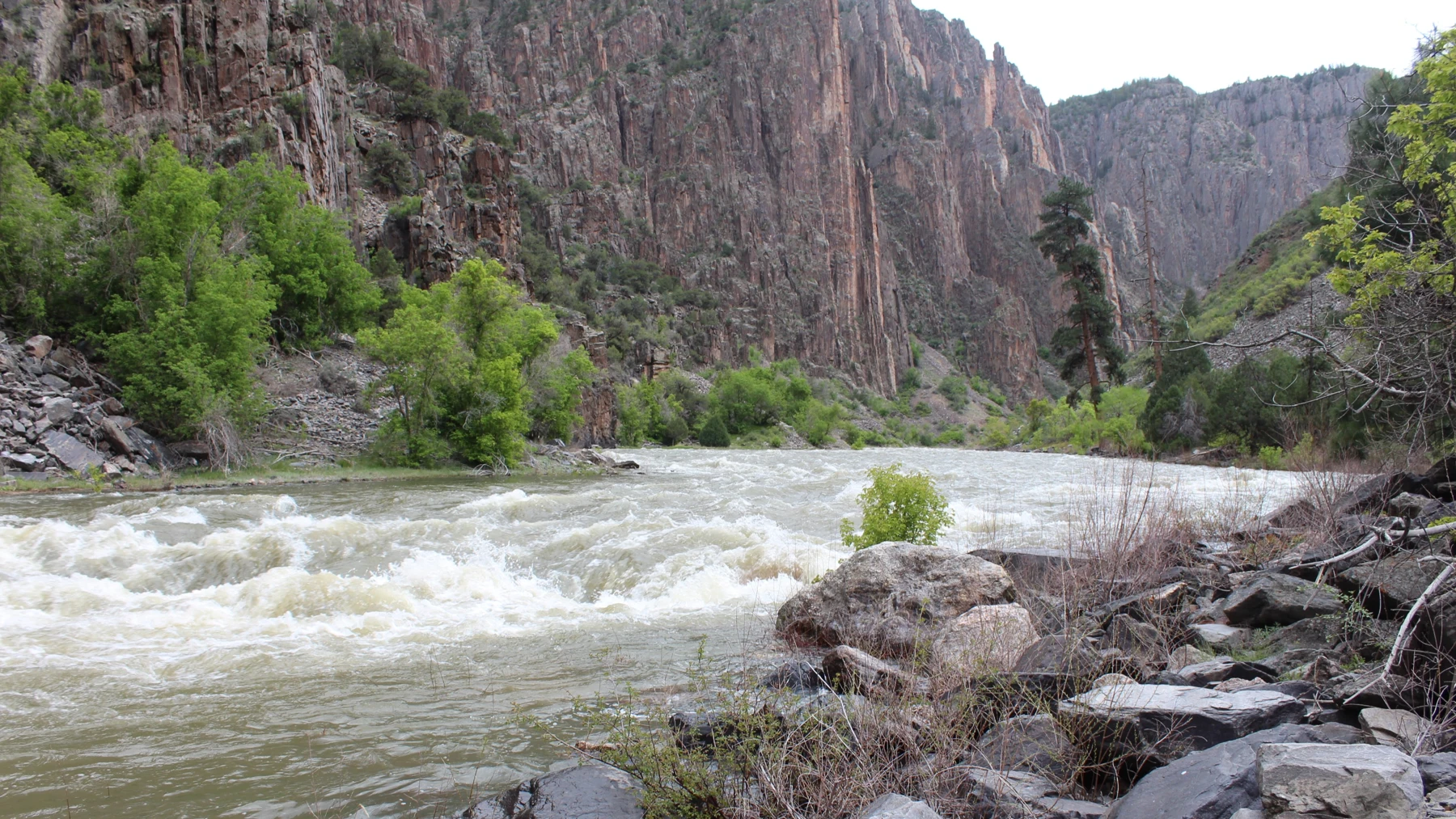
Far below, the Gunnison River looked small compared with its walls.
Augie pointed from where he stood beside his parent.
“That little thing did all that?”
Allie checked their learning materials. A distant river could look small without being gentle. A close photograph showed turbulent water among rocks, a very different impression from a thin line seen from the rim.
The Gunnison descended steeply through the canyon. Moving water carried sediment, sand, gravel, and sometimes larger rock material. Those materials could scrape and strike surfaces as the river transported them. Water and its rocky passengers helped wear down the channel.
Andy drew a river bus full of pebbles.
“One ticket to downstream.”
Ana supplied a more useful word: abrasion, wearing caused when materials rub or strike against something.
They compared two sketches. One showed water moving through a broad lake; the other showed water dropping along a steep channel. The Voyageurs lake highway and this canyon river were both water landscapes, but that did not make them interchangeable boating adventures.
Their parent was very clear: this family's investigation stayed on the rim. The fast, powerful river below was not a place for their paper-portage game, paddling practice, swimming, or stone collecting.
Augie put a large X through the spoon in Andy's river drawing.
“The passengers do some scraping.”
“Yes,” Allie said. “And we still need to explain the rock and the time.”
They made a three-part question: What is moving? What is it carrying? What is it moving across?
Andy liked that better than simply writing water wins. A river's effects depended on its flow, materials, channel, and surroundings.
Their parent asked whether a glass of water poured over the table would prove how this canyon formed.
Ana protected the notebook immediately.
“No experiment required.”
The river bus stayed on paper. Its passengers had already taken their thinking much farther than the imaginary spoon.
4. A wall with an older story inside
The Painted Wall's pale patterns looked almost like someone had spilled a bowl of noodles across dark stone.
Augie considered them carefully.
“Rock spaghetti.”
“Useful shape description,” Ana said. “Unhelpful lunch order.”
The pale streaks were rock too. They included pegmatite, an igneous rock with unusually large crystals. Long ago, molten rock called magma had entered cracks in older rock underground and cooled there.
The darker rocks included gneiss, pronounced like “nice,” and schist. Heat and pressure had transformed earlier rocks into these metamorphic rocks, around 1.8 billion years ago. Their story began far earlier than the cutting of the canyon people could see today.
Andy tried the new word.
“A very gneiss wall.”
Ana closed her eyes briefly. “We have reached the geology jokes.”
“All discoveries have consequences,” Allie said.
She drew a simple cross-section: older rock, a crack, magma entering, then cooled pale rock inside. Nobody had dribbled liquid paint down the exposed cliff. These features had formed deep underground before later events revealed them.
Their parent helped them distinguish two ideas. Metamorphic described rock changed by heat and pressure. Igneous described rock formed as molten material cooled and solidified. Both kinds appeared in their investigation.
Augie gave each word its own box so the letters did not fight for space.
Andy wanted to collect a small example.
“We can collect a description,” their parent said.
The family left rocks and minerals where they belonged. Photographs, sketches, and public exhibits were enough for their notebook. There would be no scratching a wall, chipping a sample, or hunting for loose pieces.
Allie labeled the oldest part of their timeline rock formation. Much farther along she placed canyon carving.
“So the walls have an age,” Ana said, “and the opening between them has a different history.”
Andy removed one shoe from his cliff drawing. The rock had not needed to sprint into place. Its story was becoming more interesting than that.
5. Fast water, patient canyon
At the next suitable stopping place, Allie spread their timeline across the table.
“Now we have to fit the parts together.”
The ancient rocks had formed deep below the surface. Later uplift brought them higher, while younger material covered parts of the region. Over a long sequence of events, the Gunnison cut down through overlying rock and eventually into the much harder rocks below.
The steep inner canyon had been developing over roughly the past two million years. That was a very long time for a family, although much shorter than the age of the old rock.
Augie drew two birthday cakes. The older one needed so many candles that he gave up and labeled it with a large question mark.
“Probably a fire problem,” Andy said.
Allie explained that the river's strong downward cutting, together with the resistant rock, helped produce a narrow canyon with steep walls. Weathering and gravity also changed the sides. Different processes worked together; the river was not a magic knife slicing a finished hole overnight.
Ana wrote fast flow does not mean instant canyon.
Their parent asked them to compare a minute, a year, and a million years. Andy began counting on his fingers, then looked at the others' hands.
“We have insufficient fingers.”
They used nested boxes instead. A small box represented a human afternoon. Much larger boxes represented longer spans. The drawing could help them imagine the difference, even though it was not to scale.
Augie added their snack break inside the smallest box.
“It barely fits,” he said.
The title's fast walls no longer meant stone wearing running shoes. It was a playful invitation to investigate steepness, powerful river flow, and change over time. The walls did not race along the rim.
Andy crossed out the second shoe.
He kept the socks in the margin, because throwing away a perfectly good drawing seemed wasteful.
“Case solved?” he asked.
“Partly,” Ana replied. “We still haven't asked why the two sides don't look exactly the same.”
Allie turned to a new page. The canyon had another clue.
6. Two sides, different neighborhoods
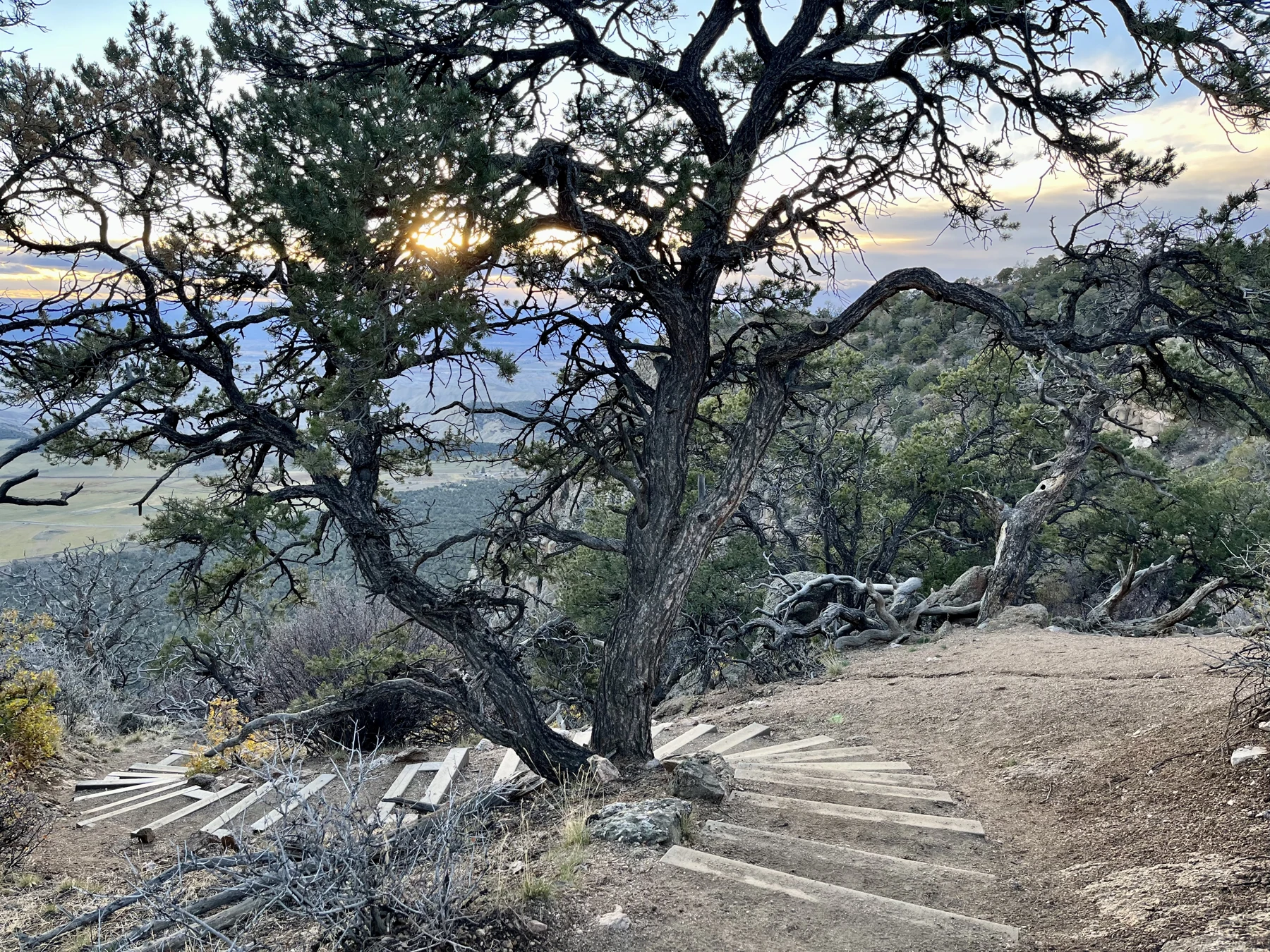
A photograph and the park's interpretation showed that the canyon walls did not provide identical growing conditions everywhere.
Some slopes spent longer in shade. Others received more direct sunshine. Moisture, temperature, cracks, soil, and the steepness of a surface could all help determine what grew there.
Andy drew two imaginary neighbors. One wore a sunhat. The other carried an umbrella.
“Not actual plant behavior,” Ana reminded him.
“I was about to label them.”
In shaded places, moisture could last longer. Repeated freezing and thawing could help weaken rock. As rock broke down and soil accumulated in suitable places, plants could gain footholds. North-facing slopes could support trees such as Douglas-fir and Colorado blue spruce.
Higher up, the family learned about pinyon pine and juniper woodland. Their photograph of a pinyon along Warner Point Trail illustrated one part of this habitat; it was not a claim that the family had walked that whole trail.
Augie looked at the twisting tree.
“Short forest?”
“A forest doesn't have to look like Redwood,” Allie said.
Ana made three broad habitat labels: rim, canyon slopes, and river corridor. She added conditions underneath rather than giving each animal an apartment number. Living things responded to food, shelter, water, and other needs, not to the boxes in her notebook.
Their parents also explained that fire could change the landscape. Some park photographs had been taken before the South Rim Fire. A picture was not a promise that every patch of vegetation would look the same during a later visit. Closures and restoration areas needed to be respected.
Andy drew a small camera beside his habitat map and wrote one view, one time.
That was a useful label.
Augie added a pencil beside it.
“More questions later.”
The children did not need to visit every life zone themselves. They could investigate from safe places, compare photographs, and learn how a change in light or moisture could create a different neighborhood within the same canyon.
Ana turned the page sideways. A vertical landscape needed a vertical way of thinking.
7. The cliff resident with a different route
A bird crossed the open space beyond the viewpoint.
Andy watched it from beside the family.
“That is a much easier way across.”
“For that animal,” Allie said. “Not a suggestion for us.”
They did not have enough detail to identify the passing bird confidently. Instead, the children used a guide to learn about some of the canyon's birds.
Peregrine falcons could nest on ledges in canyon walls and pursue other birds in flight. Swifts and swallows also used the air around the canyon. A place that blocked a walking visitor could contain routes and feeding opportunities for an animal adapted to flying.
Augie examined his own arms, flapped once, and shook his head.
“Staying here.”
“Excellent transport decision,” Ana said.
Their parent explained why nesting areas might have protective closures. An animal's apparent confidence on a cliff did not mean visitors should approach, make noise, or try to make it take off. Watching quietly from an appropriate distance was the better investigation.
Andy drew a clipboard with a large do not disturb sign. He added a bird wearing spectacles, checking it.
“The spectacles are pretend,” Ana said automatically.
“I know. They help him read the pretend sign.”
The joke stayed in the notebook. The real birds continued without anyone demanding a performance.
Allie asked what counted as a successful wildlife stop if no animal appeared.
Ana suggested learning a habitat clue. Andy suggested identifying the right place to look without disturbing it. Augie suggested eating their own snack instead of giving it to somebody with feathers.
Their parent approved all three, with the snack kept under control and packed away properly.
Allie added a possibility is not a promise beside the bird list. The same rule applied to the pale rock patterns, distant river sounds, and any evening stars. A visit did not have to supply every photograph from a guidebook to be worth remembering.
Andy looked up once more. The open air was a route he could appreciate without needing to follow it.
8. The map isn't the beginning
At their next break, the family returned to the human story.
The canyon's modern park name and boundary were only a small part of a much longer history. Indigenous peoples had relationships with the lands around it for thousands of years, long before this visiting family arrived with a notebook.
The park identified several traditionally associated peoples: the Ute Indian Tribe of the Uintah and Ouray Reservation, Ute Mountain Ute Tribe, Southern Ute Indian Tribe, White Mesa Ute Community, Jemez Pueblo, and the Absentee-Shawnee Tribe of Indians of Oklahoma.
Ana gave each name room on the page.
“These aren't six names for one identical story.”
Their parents helped them read publicly shared information from the Southern Ute Indian Tribe about Ute knowledge of landscapes, plants, animals, and travel. They also learned that colonization and loss of land had harmed Ute communities. Those experiences belonged in the history alongside the scenery.
Allie left space for more reading from the different communities themselves.
Augie traced the park boundary on their map with his finger.
“People before this line?”
“Yes,” Allie said. “And people and relationships continuing now.”
Andy had been about to write we discovered the canyon. He changed it to we began learning about the canyon.
Ana nodded. That was more accurate.
The family would leave cultural objects and places undisturbed, follow access rules, and learn from material offered for public sharing. A beautiful pattern or an old object was not permission to collect, copy, or invent somebody else's tradition.
Their parent asked what the notebook still lacked.
“Enough pages,” Andy said.
“Also enough listening,” Allie added.
This time Andy did not draw a joke beside the answer. He opened a new page and carefully wrote the heading voices to learn from.
The canyon had looked like a gap when they first arrived. Their understanding was filling with relationships: between rocks and water, light and habitat, and people and homelands.
None of those relationships stopped neatly at the printed edge of the map.
9. The socks can stay on paper
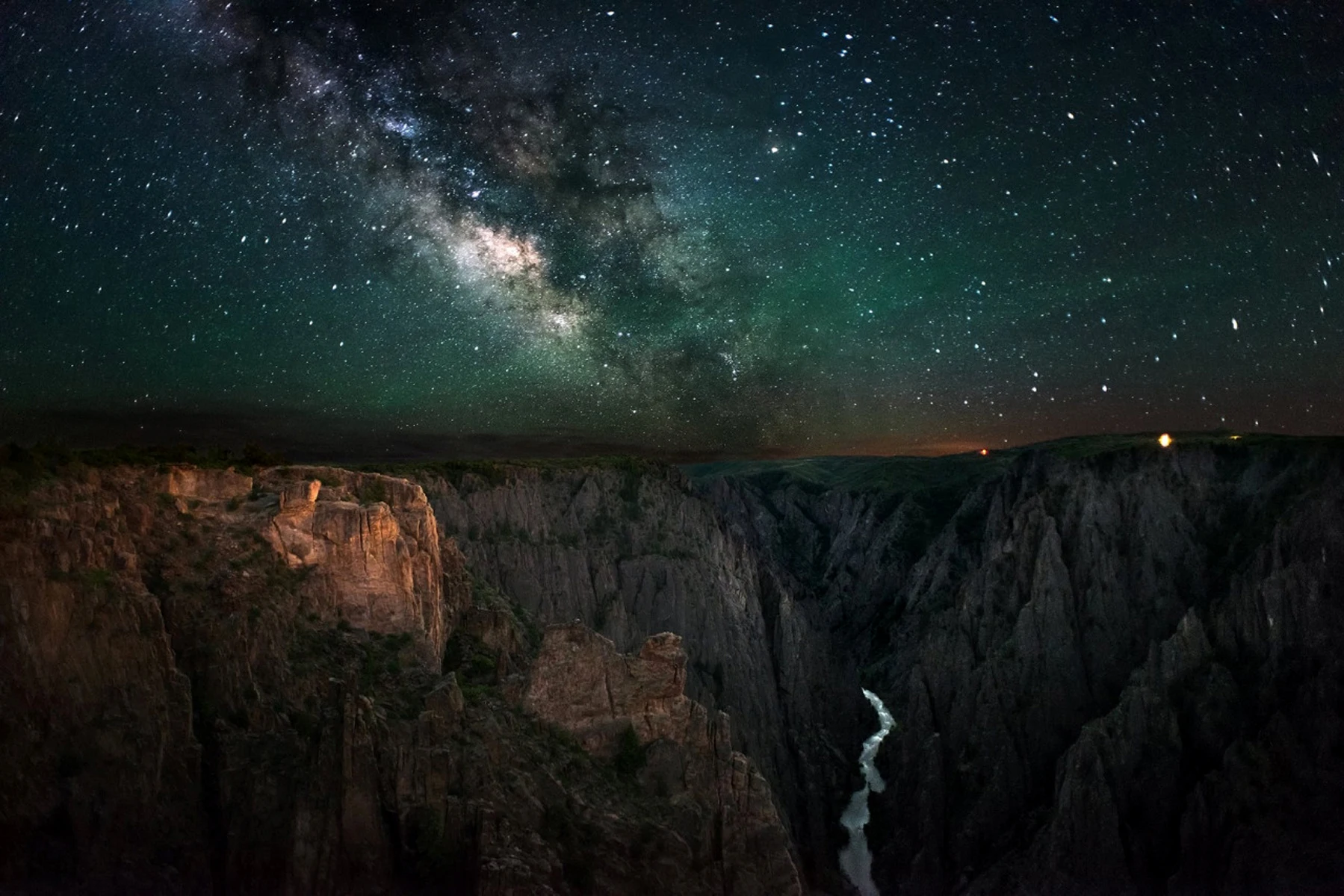
Before leaving, the children looked at a night photograph of Black Canyon.
Stars filled the sky above dark canyon shapes. After their Voyageurs chapter, Augie knew better than to demand an instant northern-lights show.
“Different night picture,” he said.
Black Canyon offered opportunities to appreciate dark skies. The family could learn about astronomy programs and suitable viewing arrangements from the park. Their photograph opened that topic without requiring them to add a night hike to the day.
Andy drew the canyon wearing pajamas.
Ana considered objecting, then allowed the drawing on the grounds that the pajamas were safely confined to paper.
Allie spread out the case notes.
Their first suspect had been a river with a spoon. Their next had been running walls. Neither survived much checking.
“The old rock came first,” Ana said. “Then a very long sequence brought it into the landscape we see.”
“The river carried scraping passengers,” Andy added. “It cut downward over a very long time.”
“Light made shadows,” Augie said. “Not black paint.”
“And different conditions made different habitats,” Allie finished.
Their parent asked whether the canyon was now finished.
The children looked at one another.
“No,” Ana said. “Weathering, erosion, water, and gravity still change it.”
That did not mean a visitor should stand near an edge waiting for a demonstration. The sensible way to finish their investigation was to pack up, keep the family together, and leave the real landscape undisturbed.
Andy put a final label on the discarded running shoes: an idea that helped us ask a better question.
Their next chapter would take them to Lassen Volcanic National Park, where volcanoes would give them a new set of shapes and a different kind of rock-making story.
Augie asked whether the volcano would need shoes.
“No,” Ana said.
“Helmet?”
“We'll start with the guide,” Allie replied.
The children closed the notebook. The canyon had not run anywhere. Their ideas had traveled a remarkable distance.
Explorer’s notebook
Nine discoveries to take home
- Black Canyon of the Gunnison National Park is in western Colorado. This fictional visit stays on suitable, open South Rim places.
- Deep shadows and dark-looking rock help explain the canyon's name; its walls are not uniformly black.
- Moving water and the sediment it transports help wear down a river channel. A distant river can look small while being powerful and hazardous.
- Gneiss and schist are metamorphic rocks. Heat and pressure changed earlier rock long before the present canyon was carved.
- Pale pegmatite streaks formed as magma entered older rock underground and cooled. They are rock, not paint.
- The age of the old rock is different from the age of canyon carving. Steep inner-canyon development has taken roughly two million years.
- Light, moisture, soil, slope, and elevation help create different habitats from rim to river.
- Canyon ledges and open air provide opportunities for birds adapted to those habitats. Observe without approaching nests or causing disturbance.
- Several Indigenous peoples have continuing cultural ties to the area. Their histories and knowledge extend beyond the modern park boundary.
Five small adventures
- Make a shadow canyon. With a grown-up, stand two pieces of cardboard close together on a table. Shine a flashlight from the side, away from eyes, and compare shadows as you change the spacing or angle. Explain what the model cannot show.
- Draw the river's passengers. Sketch water carrying sand, gravel, and rock fragments. Add arrows showing movement and label abrasion. Keep the investigation on paper; never throw anything into a canyon or disturb a riverbank to demonstrate it.
- Put two ages in order. Make a timeline with ancient rock formation, later magma intrusions, uplift and covering layers, and much later river carving. Add your own visit at the end. Label the drawing as not to scale.
- Design a habitat cross-section. Draw rim, canyon slope, and river corridor. Add questions about sunshine, shade, moisture, and soil. Use a reliable guide rather than assuming every plant or animal stays in one box.
- Collect a better explanation. Pick one funny first idea from this chapter. Write what evidence changed it, what your improved explanation is, and one question you still have. Leave all natural and cultural objects in place.
Talk it over
- Why can a river that looks tiny from a viewpoint still have great power?
- How can the rocks be far older than the canyon opening between them?
- What changes when you look at the same landscape in sunshine, shadow, or a night photograph?
- Why is “we began learning about this place” a better description than “we discovered it”?
Words for your explorer pack
- Rim: the upper edge of a canyon; visitors need to stay well back from hazardous edges.
- Sediment: loose material such as sand, silt, gravel, and rock fragments.
- Abrasion: wearing caused when materials rub or strike against a surface.
- Metamorphic: describing rock transformed by heat and pressure.
- Igneous: describing rock formed when molten material cools and solidifies.
- Pegmatite: very coarse-grained igneous rock with unusually large crystals.
- Weathering: the breakdown or alteration of rock where it is.
- Erosion: the removal and transport of rock or sediment by processes involving water, ice, wind, or gravity.